Is Water's Volume Expansion Upon Freezing an Intrinsic Property?

swissgirl1999 Refer
Messages
16
Reaction score
3
TL;DR
Simple experiments about the volume expansion of freezing water inside different materials — why plastic containers can change the intrinsic water's chemistry mediated volume expansion of ice formation?
The standard physical chemistry and thermodynamics literature states that water expands upon freezing due to the crystalline structure of ice (hexagonal ice I_h), which occupies approximately 9% more volume than liquid water at the same mass. This expansion is treated as an intrinsic property of the water molecule's phase transition, independent of the container material.


As stated in typical references:

The density of liquid water at 0°C is approximately 999.8 kg/m³.

The density of ice at 0°C is approximately 916.8 kg/m³.


This density difference corresponds to a volume increase of about 9.05% upon freezing. The crystallization pressure of ice is approximately 300 atm (about 30 MPa), which is why it can shatter glass and deform metal containers. These values are presented as universal constants for pure water, independent of the container material. The phase transition is described as a property of the water itself, not of the water-container system.


So far so good — nothing out of the ordinary yet.


My curiosity began after I had forgotten a full plastic bottle of water in the freezer and noticed that instead of the expected increase in volume, it had shrunk.


So I decided to run some simple experiments.


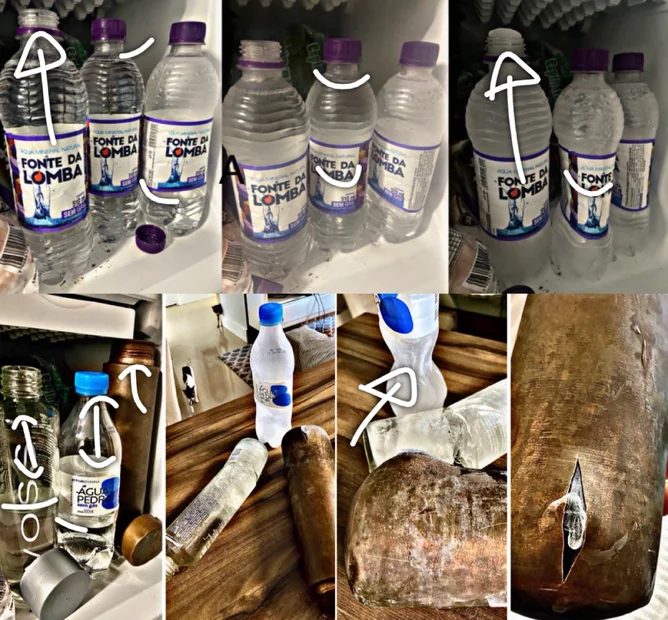
First, I tragically lost my copper bottle, which I had left half-full and open, the same way I did with the glass bottle, which I assumed would break anyway. Even with the cap open and only half-full, the glass broke and the copper was torn, while the plastic bottle — with its cap on — collapsed inward during freezing, giving the appearance that the water/ice system occupied less external volume than before.


One might think that the air inside the plastic bottle shrank, but where it really shrank was exactly where the ice was (as in the picture below):
9b35e72b-449b-4b97-84b4-786c8a8fd67a-1_all_37059.webp

One might also think that the ice forms on top first and then the rest of the ice formation can't push the already-formed ice upward. However, that's not the case inside the plastic bottle: in this case, the ice pushes the already-formed ice upward and still cannot deform the plastic bottle (as in the picture above).

One might also think that the plastic is more elastic, so it does not tear due to deformation. However, the plastic does not deform by expanding its volume — it shrinks.


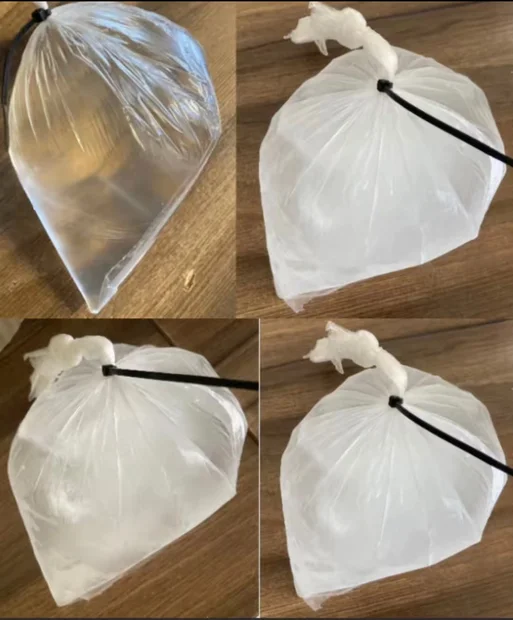
So I took the most fragile plastic bag I could find, filled it to capacity with water, and sealed it with a cable tie, with no air left inside (as in the picture below).
The volume of the water shrank and kept shrinking over the days.
9b35e72b-449b-4b97-84b4-786c8a8fd67a-1_all_37074.webp

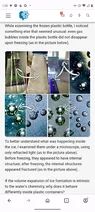
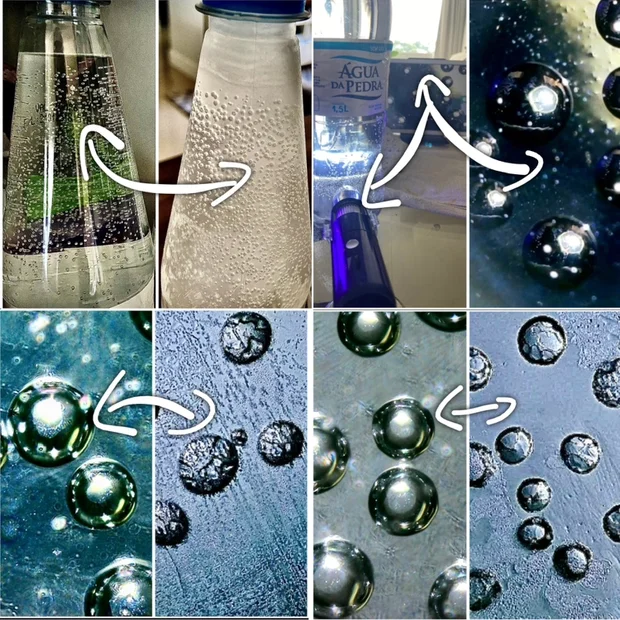
While examining the frozen plastic bottle, I noticed something else that seemed unusual: even gas bubbles inside the plastic bottle did not disappear upon freezing (as in the picture below).
9b35e72b-449b-4b97-84b4-786c8a8fd67a-1_all_37067.webp

To better understand what was happening inside the ice, I examined them under a microscope, using only refracted light (as in the picture above).
Before freezing, they appeared to have internal structure; after freezing, the internal structures appeared fractured (as in the picture above).

If the volume expansion of ice formation is intrinsic to the water's chemistry, why does it behave differently inside plastic containers?

A final reminder to whom might think these experiments lack rigorous control — the only really important variable here is the discrepancy in behave of water freezing inside plastic containers.

Anyone curious enough has only to put a plastic bag and/or bottle of water to freeze and see for yourself, which I strongly recommend in doing so before dismissing the question.

Thanks in advance.
 
Last edited:
  • Like
Likes   Reactions: WWGD, Ibix and PeroK
Physics news on Phys.org
swissgirl1999 Refer said:
So I took the most fragile plastic bag I could find, filled it to capacity with water, and sealed it with a cable tie, with no air left inside (as in the picture below).
The volume of the water shrank and kept shrinking over the days.
Did you weigh the bag every day to make sure that there was no mass loss through permeation of water vapor?
 
  • Like
Likes   Reactions: Ibix, Lord Jestocost and PeroK
I freeze glass jars with water filled to 2/3 all the time, with no breakage. They are covered, but not securely airtight. So, after freezing, the ice in the jar has gone up higher than the water was, but no breakage if I leave enough space for the expansion. Even if the cover was truly airtight, I wouldn’t necessarily expect breakage due to how compressible air is.
 
  • Like
Likes   Reactions: russ_watters
Did you actually measure the density of the ice in the plastic bottle to rule out an unusual deformation?
 
I usually freeze 1.5L plastic bottle, I fill it with water from the sink and put in the freezer and always found expansion. Have you used water with added CO2 ?
In that case could be possible that when the temperature drop the amount of gas inside water just leaked out?
 
I froze a plastic bottle full of water (as near to mo air as I could manage) and put it in a bowl of water. It floated:
IMG_20260621_210413.webp

And a crop of the shoulder of the bottle showing the waterline:
InShot_20260622_082449335.webp

Then I left it out overnight and put it in the water again once it had unfrozen. It sank:
IMG_20260622_081217.webp

Again, here's a crop of the shoulder, showing no waterline (and the bubble I failed to exclude):
InShot_20260622_082905119.webp

So it certainly looks to me like the water in the plastic bottle is more dense than the ice. The bottle also seemed distended when it contained ice, although I did not measure anything (edit: the paper label was loose once the bottle had unfrozen - not sure if that's because it, or its glue, had been stretched, or if it was just due to having been in a water bath).

As with the other responses above, I suspect some confounding factor in the OP's experiments.
 
Last edited:
  • Like
Likes   Reactions: Dale, FactChecker, PeroK and 1 other person
A quick (perhaps offtopic) question: How many other elements actually freeze from the top down? Any chemists here?

EDIT: Well, compounds I guess. Not elements.
 
  • Like
Likes   Reactions: sbrothy
I don't want to hijack the thread so this is my last comment, but I find it on par with the finetuning problem that we should be so lucky that water freezes like it does. We would have been up a frozen river without a paddle if not! :smile:
 
  • #10
I am wondering if someone better versed in non-equilibrium thermodynamics than me can attribute these, apparently initial-condition-dependent observations, to the Mpemba effect.
 
  • Like
Likes   Reactions: binis
  • #11
The volume expansion from water to ice is an intrinsic property of water specifically under the constraint of negligible confining stress. It the ice is subjected to confining stress, the volumetric expansion will be less. Imaging first freezing to ice under no stress and lower tine temperature below 0 C; then imposing a chosen compressive stress distirubtion on the ice. It will deform just like any other solid. If the compressive stress is very high, a new equilibrium between ice and water will be established at the lower temperature, and ice will melt. This is what happens under the blade of an ice skate.
 
  • Like
  • Informative
  • Agree
Likes   Reactions: Dale, binis and FactChecker
  • #12
swissgirl1999 Refer said:
TL;DR: Simple experiments about the volume expansion of freezing water inside different materials — why plastic containers can change the intrinsic water's chemistry mediated volume expansion of ice formation?
Interesting results, and I think the images of gas bubbles are diagnostic. Did you de-gas the water before putting in a container?

The container material does not alter the volumetric expansion of freezing water, but the container material could be semipermeable, allowing dissolved gasses to escape, reducing the volume.
 
  • #13
swissgirl1999 Refer said:
... the plastic bottle — with its cap on — collapsed inward during freezing, giving the appearance that the water/ice system occupied less external volume than before.

One might think that the air inside the plastic bottle shrank, but where it really shrank was exactly where the ice was
I'd be fairly sure that the lower temperature caused the air pressure to decrease in the bottle, and that caused the sides of the bottle to be pulled in at the weakest point, before the water had frozen (raising the water level a little), and the subsequent expansion of the frozen water was not enough to push it back out.

I rinse out plastic bottles before recycling them, and I know that if I put a little cold water in one on a warm day, put the cap on and shake, it will immediately reduce in volume and may crumple a bit. Freezing would be a more extreme version of the same effect.
 
  • Like
Likes   Reactions: Roberto Pavani, 256bits and Gleb1964
  • #14
Andy Resnick said:
Interesting results, and I think the images of gas bubbles are diagnostic. Did you de-gas the water before putting in a container?

The container material does not alter the volumetric expansion of freezing water, but the container material could be semipermeable, allowing dissolved gasses to escape, reducing the volume.
The container could impose compressive stress on the ice which alters the thermodynamic relationship between ice and water, and can result in volumetric strain.
 
  • Agree
Likes   Reactions: binis
  • #15
Chestermiller said:
The volume expansion from water to ice is an intrinsic property of water specifically under the constraint of negligible confining stress. It the ice is subjected to confining stress, the volumetric expansion will be less. Imaging first freezing to ice under no stress and lower tine temperature below 0 C; then imposing a chosen compressive stress distirubtion on the ice. It will deform just like any other solid. If the compressive stress is very high, a new equilibrium between ice and water will be established at the lower temperature, and ice will melt. This is what happens under the blade of an ice skate.
OK, I understand that the ice melts because of the high pressure under the ice skate blade. How does that compare with the pressure inside a closed copper pipe full of water that bursts in extremely cold weather? Why isn't a new equilibrium established in this case so the water in the pipe stays liquid as the pressure builds up? Is it because the new equilibrium pressure is higher than what the pipe can provide?

I had no feel for the numbers involved so I looked for them on the web. I found that

Standard (Type L) 3/4-inch copper tubing fails and bursts around 4,000 psi.
A typical skate blade has a thickness of 0.12 in and contact length with the ice of 1 - 2 in.
A typical skater weighs 150 pounds
Thus, the equilibrium pressure exerted by the skater is ##~p=\dfrac{150~\text{lbs}}{(0.12~\text{in})\times (1~\text{in})}=1,250~\text{psi}.##

It seems that the copper pipe is plenty strong to keep the water in the liquid phase. Is this a naive comparison? Why?
 
  • #16
Jonathan Scott said:
.. lower temperature caused the air pressure to decrease in the bottle, and that caused the sides of the bottle to be pulled in at the weakest point, before the water had frozen (raising the water level a little), and the subsequent expansion of the frozen water was not enough to push it back out.
Yes, first the air volume shrinks the plastic bottle as it cools down, and then the water freezes inside the already shrunken bottle.
 
  • #17
kuruman said:
OK, I understand that the ice melts because of the high pressure under the ice skate blade. How does that compare with the pressure inside a closed copper pipe full of water that bursts in extremely cold weather? Why isn't a new equilibrium established in this case so the water in the pipe stays liquid as the pressure builds up? Is it because the new equilibrium pressure is higher than what the pipe can provide?
Yes.
kuruman said:
I had no feel for the numbers involved so I looked for them on the web. I found that

Standard (Type L) 3/4-inch copper tubing fails and bursts around 4,000 psi.
A typical skate blade has a thickness of 0.12 in and contact length with the ice of 1 - 2 in.
A typical skater weighs 150 pounds
Thus, the equilibrium pressure exerted by the skater is ##~p=\dfrac{150~\text{lbs}}{(0.12~\text{in})\times (1~\text{in})}=1,250~\text{psi}.##

It seems that the copper pipe is plenty strong to keep the water in the liquid phase. Is this a naive comparison? Why?
Check out the phase diagram for water

Phase Diagram of Water​

Image showing the phase diagram of water, including the triple point, critical point, and boiling/freezing points

Also, the water experiences an increase in volume in the deformed copper tube which results in a lower pressure. This really has to be solved as a coupled problem involving the copper tube and the water.
 
Last edited:
  • Informative
Likes   Reactions: binis
  • #18
Some of those photos show a LOT of loss of volume. IMO, that much shrinkage is hard to explain. And it is very pronounced in some bottles, but not others. You should try well-controlled experiments rather than casual observations.

CORRECTION: Others have pointed out (thanks for the correction!) that it is not valid to interpret this deformation as a decrease in volume. It would be better to submerge it in a bath of water, before and after freezing, and compare the resulting level of the bath water.

1782143269467.webp
1782143245770.webp
 

Attachments

  • 1782143236020.webp
    1782143236020.webp
    7.4 KB · Views: 1
Last edited:
  • Like
Likes   Reactions: Dale, swissgirl1999 Refer and WWGD
  • #19
A simple controlled procedure to remove thermal contraction as a confounding factor:

1. Fill the bottle completely to the brim with tap water
2. Place it open in the fridge (4°C) for a few hours to equilibrate
3. Top off with cold water if needed, ensure zero headspace
4. Close the cap tightly
5. Place in the freezer

This eliminates the air contraction effect (no air inside). If the bottle still shrinks under these conditions, then something else is going on.
 
  • Like
Likes   Reactions: FactChecker
  • #20
FactChecker said:
Some of those photos show a LOT of loss of volume. IMO, that much shrinkage is hard to explain.
When a plastic bottle collapses in one direction, it gets larger in another, creating an elliptical cross section or even more crumpled state. I suspect the volume change is less than one might think from a first glance, and quite compatible with what happens when warm air is cooled.
 
  • Like
Likes   Reactions: FactChecker, Gleb1964, Ibix and 2 others
  • #21
If I were observing volume changes of a plastic bottle, I would,
  1. measure the mass before and after by placing the bottle on a kitchen scale, just in case there is mass loss that would have to explain;
  2. place the bottle in a pot of water, fully immerse it, and put a mark with indelible ink at the level to which the bath water rises;
  3. repeat the volume displacement measurement, after I do whatever I need to do, and place a second mark at the bath level;
  4. use a measuring cup to determine how much water I need to add or remove in order to bring the bath level back to the first mark;
  5. post my results here.
:wink:
 
  • Like
Likes   Reactions: Roberto Pavani, FactChecker and Ibix
  • #22
Jonathan Scott said:
caused the sides of the bottle to be pulled in at the weakest point
Quite sure the wall thickness of a plastic bottle is not uniform as it is blown plastic.
The 'oval' shape of the frozen water bottle will deform where it is thinnest thus expanding outwards from the ice pressure. The thicker part will pulled inwards.
Much like blowing up a balloon between two boards - the boards will from a thicker wall. The balloon not covered by the boards is the thinner part and expands out as the walls attempt to equalize internal air pressure.
 
Last edited:
  • Like
Likes   Reactions: russ_watters
  • #23
kuruman said:
t seems that the copper pipe is plenty strong to keep the water in the liquid phase
The water in the pipe freezes from the wall inwards, so there is a cavity of liquid surrounded by ice.
As long as the water does not freeze completley in a couple of spots sectioning off a portion with plugs, the copper pipe can expand along its whole length and radius. Once the plugs are formed, the interior volume in that section can produce tremendous pressure within as it becomes the last part to turn to ice and expanding, overwhelming the burst pressure of the copper in the adjacent area.

The metal container picture has it burst in an area that has been banged up and less capable of withstanding stress. It could be safe to assume that may have been the last part of the water to turn to ice.
 
  • #24
Jonathan Scott said:
When a plastic bottle collapses in one direction, it gets larger in another, creating an elliptical cross section or even more crumpled state. I suspect the volume change is less than one might think from a first glance, and quite compatible with what happens when warm air is cooled.
Good point. That makes the measurement of weight that others have recommended more important I can't judge the volume of the collapsed bottles.
 
  • Like
Likes   Reactions: 256bits
  • #25
1000003489.webp

Take a plastic bottle of mineral water, open the cap, let the pressures equalize, then close it.
Wait about 30 minutes, until the pockets of gas arrange itself in the shape of spherical bubbles — first question: why and how previously dissolved gas, after the internal pressure is released by the opening of the cap, slowly builds gas bubbles?
Take the bottle with it's gas bubbles to freeze — second question: why and how gas bubbles survive the ice formation?
Compare the images of the gas bubbles before and after freezing — third question: what's the inner structures of the gas bubbles? Fourth question: is it possible to break a gas?
 

Attachments

  • 1000003485.webp
    1000003485.webp
    44.2 KB · Views: 1
  • #26
Ibix said:
I froze a plastic bottle full of water (as near to mo air as I could manage) and put it in a bowl of water. It floated:
View attachment 372661
And a crop of the shoulder of the bottle showing the waterline:
View attachment 372662
Then I left it out overnight and put it in the water again once it had unfrozen. It sank:
View attachment 372663
Again, here's a crop of the shoulder, showing no waterline (and the bubble I failed to exclude):
View attachment 372664
So it certainly looks to me like the water in the plastic bottle is more dense than the ice. The bottle also seemed distended when it contained ice, although I did not measure anything (edit: the paper label was loose once the bottle had unfrozen - not sure if that's because it, or its glue, had been stretched, or if it was just due to having been in a water bath).

As with the other responses above, I suspect some confounding factor in the OP's experiments.
Ok, it floats, but that doesn't explain why it shrinks.
 
  • #27
Chestermiller said:
The volume expansion from water to ice is an intrinsic property of water specifically under the constraint of negligible confining stress. It the ice is subjected to confining stress, the volumetric expansion will be less. Imaging first freezing to ice under no stress and lower tine temperature below 0 C; then imposing a chosen compressive stress distirubtion on the ice. It will deform just like any other solid. If the compressive stress is very high, a new equilibrium between ice and water will be established at the lower temperature, and ice will melt. This is what happens under the blade of an ice skate.
If compressive stress suppresses expansion, then rigid containers (copper, glass) would suppress it more than flexible plastic. Yet copper tore and glass broke — confirming expansion pressure was there. The plastic, least resistant of all, shows no expansion. The stress argument predicts the opposite of what is observed.
 
  • #28
Andy Resnick said:
Interesting results, and I think the images of gas bubbles are diagnostic. Did you de-gas the water before putting in a container?

The container material does not alter the volumetric expansion of freezing water, but the container material could be semipermeable, allowing dissolved gasses to escape, reducing the volume.
Quite the contrary — this is still water (no added CO₂). The bubbles are not dissolved gas escaping; they are forming where there should be none, surviving ice formation, and showing fractured internal structure under microscopy. That is what needs explaining.
1000003489.webp
 
  • #29
swissgirl1999 Refer said:
Take a plastic bottle of mineral water, open the cap, let the pressures equalize, then close it.
Wait about 30 minutes, until the pockets of gas arrange itself in the shape of spherical bubbles — first question: why and how previously dissolved gas, after the internal pressure is released by the opening of the cap, slowly builds gas bubbles?
Take the bottle with it's gas bubbles to freeze — second question: why and how gas bubbles survive the ice formation?
Compare the images of the gas bubbles before and after freezing — third question: what's the inner structures of the gas bubbles? Fourth question: is it possible to break a gas?
The water can dissolve a quantity of gas based upon its temperature and the external pressure. If the pressure in the liquid is decreased, some gas will come out of solution as bubbles.

Water turning into Ice is purified by expulsion of dissolved gases. This happens at the boundary of ice crystal formation where tiny bubbles form. Rapid ice crystal growth surpasses the tiny bubbles entrapping them and the ice will look cloudy.

The structure seen is the ice crystal formation and structure outside the bubble. Whether one can call that internal bubble structure is debatable, but what is seen is the surface of the bubble/ice interface rather than anything else.

Is it possible to break a gas -- I am not sure what you mean,
 
  • #30
FactChecker said:
Some of those photos show a LOT of loss of volume. IMO, that much shrinkage is hard to explain. And it is very pronounced in some bottles, but not others. You should try well-controlled experiments rather than casual observations.

View attachment 372668View attachment 372667
Here lies a paradox: to the independent researcher it is demanded "infinite controls", nevertheless, when the outcome contradicts the textbooks, the results are dismissed as probable mistakes made by the independent researcher… unless peers start to review by replicating the experiment, the independent researcher cannot scape this loophole — he can't (shouldn't and never will) change the textbooks by himself.
The best that anyone can do by itself is to point to an unexpected outcome — to investigate it further ought to be a burden for the scientific community as a whole.
 

Similar threads

  • · Replies 1 ·
Replies
1
Views
2K
  • · Replies 8 ·
Replies
8
Views
2K
  • · Replies 7 ·
Replies
7
Views
3K
Replies
6
Views
1K
  • · Replies 10 ·
Replies
10
Views
5K
  • · Replies 2 ·
Replies
2
Views
2K
  • · Replies 8 ·
Replies
8
Views
5K
  • · Replies 4 ·
Replies
4
Views
3K
  • · Replies 3 ·
Replies
3
Views
12K
  • · Replies 17 ·
Replies
17
Views
3K