chubbyorphan
- 44
- 0
Hey forum, I know this is an easy one, but it's been a while for me :P
thanks for your help!
Given the following graph of h(x)
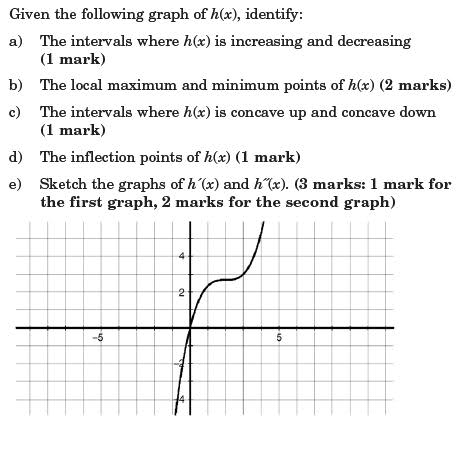
a) The intervals where h(x) is increasing and decreasing
b) The local maximum and minimum points of h(x)
c) The intervals where h(x) is concave up and concave down
d) The inflection points of h(x)
e) Sketch the graphs of h’(x) and h’’(x)
So far I have:
a)The function is not decreasing, and hence h’(x) is not < 0
The function is increasing, and hence h’(x) > 0 when x < 2 and x > 2
b) there are no maximum or minimum points
c)The function is concave up and hence h’’(x) > 0 when x > 2
The function is concave down and hence h’’(x) < 0 when x < 2
d)The inflection point occurs at x = 2
If someone could check this for me I would really appreciate it..
its especially part b) that I'm worried about
I know this question isn't very hard but it's been a long time since I've worked with graphs and my confidence is lacking. Thanks to anyone who can share some insight!
thanks for your help!
Homework Statement
Given the following graph of h(x)
a) The intervals where h(x) is increasing and decreasing
b) The local maximum and minimum points of h(x)
c) The intervals where h(x) is concave up and concave down
d) The inflection points of h(x)
e) Sketch the graphs of h’(x) and h’’(x)
The Attempt at a Solution
So far I have:
a)The function is not decreasing, and hence h’(x) is not < 0
The function is increasing, and hence h’(x) > 0 when x < 2 and x > 2
b) there are no maximum or minimum points
c)The function is concave up and hence h’’(x) > 0 when x > 2
The function is concave down and hence h’’(x) < 0 when x < 2
d)The inflection point occurs at x = 2
If someone could check this for me I would really appreciate it..
its especially part b) that I'm worried about
I know this question isn't very hard but it's been a long time since I've worked with graphs and my confidence is lacking. Thanks to anyone who can share some insight!