2.7.3 AP calculus Exam Riemann sum

Join the discussion
Registration is free. Ask a follow-up in this thread, or start your own.
3 replies · 1K views
karush
Gold Member
MHB
Messages
3,240
Reaction score
5
View attachment 9364

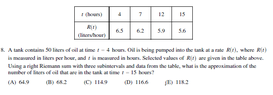
ok basically t is 3 hours appart except between 7 and 12 of which I didn't know if we should intemperate.
other wise it is just adding up the 4 $(t)\cdot(R(t))$s.
 

Attachments
  • 321.png
    321.png
    10.8 KB · Views: 156
Last edited:
Physics news on Phys.org
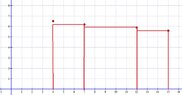
$\displaystyle 50 + \int_4^{15} R(t) \, dt \approx 50 + (3 \cdot 6.2 + 5 \cdot 5.9 + 3 \cdot 5.6) = 114.9 \text{ L}$
 

Attachments

  • Right_sum.jpg
    Right_sum.jpg
    33.1 KB · Views: 145
skeeter said:
$\displaystyle 50 + \int_4^{15} R(t) \, dt \approx 50 + (3 \cdot 6.2 + 5 \cdot 5.9 + 3 \cdot 5.6) = 114.9 \text{ L}$

ok, well I thot the intervals had to be equal but just take what is given here!

on your graph program is it possible just to show the ticks that apply?
 
karush said:
ok, well I thot the intervals had to be equal but just take what is given here!

on your graph program is it possible just to show the ticks that apply?

the intervals do not have to be equal ... what do you mean by "ticks that apply" ?

first base [4,7], height is R(7)

second base [7,12], height is R(12)

last base [12,15], height is R(15)