2 Questions About the Gyroscope Effect

  • Context: Undergrad 
  • Thread starter Thread starter Johnls
  • Start date Start date
  • Tags Tags
    Gyroscope
Click For Summary

Discussion Overview

The discussion revolves around the gyroscopic effect, specifically addressing questions about the relationship between torque and angular momentum, as well as the behavior of gyroscopes at varying angular momenta. Participants explore theoretical aspects, mathematical reasoning, and conceptual clarifications related to gyroscopic motion and precession.

Discussion Character

  • Exploratory
  • Technical explanation
  • Conceptual clarification
  • Mathematical reasoning

Main Points Raised

  • Some participants question whether torque and angular momentum must be calculated relative to the same point, suggesting that torque can be treated as a "couple" independent of the reference point chosen.
  • There is a discussion about the approximation that the angular momentum of a gyroscope is purely horizontal, with some arguing that this is valid for rapidly spinning gyroscopes but not for those with low angular momentum.
  • One participant explains that as the rotation rate of a gyroscope decreases, the precession rate increases, potentially leading to a situation where the gyroscope is not spinning around its intended axis.
  • Another participant seeks clarification on how torque can be viewed as a "couple" and its relation to the gyroscope example, prompting further elaboration on the forces acting on the gyroscope.

Areas of Agreement / Disagreement

Participants express differing views on the assumptions regarding torque and angular momentum, particularly in relation to reference points and the behavior of gyroscopes at low angular momenta. The discussion remains unresolved with multiple competing perspectives presented.

Contextual Notes

Limitations include assumptions about the reference points for torque calculations and the conditions under which the approximation of horizontal angular momentum holds true. The discussion also touches on the complexities of three-dimensional treatments of gyroscopic motion.

Johnls
Messages
11
Reaction score
0
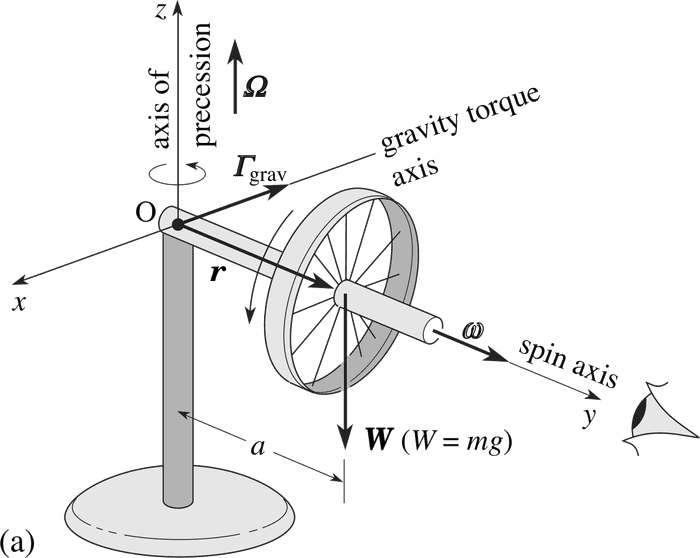
I'm talking here about this situation:
phys2_8f_15a.png

The explanation which is usually given as to why there is a precession, is that the torque is perpendicular to the angular momentum and the angular momentum changes in the direction of the torque.
A few things I don't understand about it:

1. The torque is relative to point O but the angular momentum is relative to the center of the wheel. When you derive that torque is the change in the angular momentum, don't you assume that they are both calculated relative to the same point?

2. Why doesn't it work for low angular momentums?
 
Physics news on Phys.org
Johnls said:
1. The torque is relative to point O but the angular momentum is relative to the center of the wheel. When you derive that torque is the change in the angular momentum, don't you assume that they are both calculated relative to the same point?
Two points...

A torque can be viewed as a "couple" -- a pair of equal and opposite forces separated by a distance that is not parallel to the forces. It does not matter where you choose to place the reference point when calculating the torque from a couple. You always get the same answer.

Point O lies on the axis of rotation anyway.
2. Why doesn't it work for low angular momentums?

The idea that the angular momentum of a gyroscope is purely horizontal, that it does not deflect downward at all under a vertical force and that the motion associated with the precession has no associated angular momentum is an approximation. For a rapidly spinning gyroscope, it is a good approximation. In first year physics courses one is usually exposed to angular momentum primarily as it applies in two dimensions. In that setting, one considers the gyroscope to be rotating in two dimensions and precessing in the third.

The full three dimensional treatment involves the notion of a "nutation" and analysis using tensors.

One simple way of seeing that the precession model cannot work for low angular momentum is to consider what happens as the rotation rate gets lower and lower. The precession rate gets higher and higher. If you get to a point where the precession rate is higher than the rotation rate, it's pretty clear that you're not considering a gyroscope that is spinning on its intended axis. Instead, it is rotating around a different instantaneous axis. And that axis may keep changing over time.

A gyroscope that is not spinning at all does not precess infinitely fast. It just flops down.
 
  • Like
Likes   Reactions: Johnls
jbriggs444 said:
Two points...

A torque can be viewed as a "couple" -- a pair of equal and opposite forces separated by a distance that is not parallel to the forces. It does not matter where you choose to place the reference point when calculating the torque from a couple. You always get the same answer.

Point O lies on the axis of rotation anyway.The idea that the angular momentum of a gyroscope is purely horizontal, that it does not deflect downward at all under a vertical force and that the motion associated with the precession has no associated angular momentum is an approximation. For a rapidly spinning gyroscope, it is a good approximation. In first year physics courses one is usually exposed to angular momentum primarily as it applies in two dimensions. In that setting, one considers the gyroscope to be rotating in two dimensions and precessing in the third.

The full three dimensional treatment involves the notion of a "nutation" and analysis using tensors.

One simple way of seeing that the precession model cannot work for low angular momentum is to consider what happens as the rotation rate gets lower and lower. The precession rate gets higher and higher. If you get to a point where the precession rate is higher than the rotation rate, it's pretty clear that you're not considering a gyroscope that is spinning on its intended axis. Instead, it is rotating around a different instantaneous axis. And that axis may keep changing over time.

A gyroscope that is not spinning at all does not precess infinitely fast. It just flops down.

First of all, thanks for the reply!
Could you please expand a little bit on how torque can be viewed as a "couple"? How can I do this conversion? How does it relate to the Gyro example?
 
Johnls said:
First of all, thanks for the reply!
Could you please expand a little bit on how torque can be viewed as a "couple"? How can I do this conversion? How does it relate to the Gyro example?
For the gyroscope, you have an upward force at point O from the support and a downward force from gravity at the center of gravity (a distance r from point O).

Pick any origin you like and compute the torque from the force at point O plus the torque from the force at the center of gravity. Then pick a different origin and compute it again. The two forces are a "couple" and the net torque they produce will be independent of the origin that you pick.
 
  • Like
Likes   Reactions: Johnls
jbriggs444 said:
For the gyroscope, you have an upward force at point O from the support and a downward force from gravity at the center of gravity (a distance r from point O).

Pick any origin you like and compute the torque from the force at point O plus the torque from the force at the center of gravity. Then pick a different origin and compute it again. The two forces are a "couple" and the net torque they produce will be independent of the origin that you pick.

Oh I see... Thanks!
 

Similar threads

Replies
4
Views
2K
  • · Replies 39 ·
2
Replies
39
Views
4K
  • · Replies 6 ·
Replies
6
Views
2K
  • · Replies 49 ·
2
Replies
49
Views
5K
  • · Replies 7 ·
Replies
7
Views
2K
  • · Replies 10 ·
Replies
10
Views
2K
  • · Replies 10 ·
Replies
10
Views
3K
  • · Replies 3 ·
Replies
3
Views
2K
  • · Replies 60 ·
3
Replies
60
Views
7K
  • · Replies 4 ·
Replies
4
Views
2K