Absolute begginer's question (direction of current flow)

Click For Summary

Discussion Overview

The discussion revolves around the concept of current flow in a voltage divider circuit, particularly focusing on how the resistors R1 and R2 influence the output voltage V(out). Participants explore the relationship between voltage, current, and resistance in the context of series circuits.

Discussion Character

  • Exploratory
  • Technical explanation
  • Conceptual clarification

Main Points Raised

  • One participant expresses confusion about how R2 affects V(out) since it appears after the V(out) branch, questioning whether current flows through R1, then R2, and back to V(out).
  • Another participant explains that current flows through both R1 and R2, leading to voltage drops across each resistor as per Ohm's Law and Kirchhoff's Voltage Law.
  • A different participant emphasizes that voltage is always measured across two points, clarifying that V(out) is a measurement point rather than a source of current.
  • One participant notes that V(out) does not output current until a load is connected, and the voltage division depends on the relative values of R1 and R2.
  • Another participant mentions that the voltage and current situation stabilizes after a finite time post-switch-on, indicating that R2 requires a steady current to establish a measurable voltage across it.
  • A later reply reiterates that there is only one current in the circuit, and both R1 and R2 affect the current and voltage drops across them.

Areas of Agreement / Disagreement

Participants generally agree on the principles of current flow and voltage measurement in a voltage divider, but there remains some uncertainty regarding the implications of these principles, particularly in relation to the role of R2 and the timing of voltage stabilization.

Contextual Notes

Some participants highlight the importance of understanding the steady-state conditions in the circuit and the relationship between current and voltage drops, but these aspects are not fully resolved in the discussion.

Ulnarian
Messages
27
Reaction score
0
So I've been trying to wrap my head around the concept of the direction of current flow. I thought a voltage divider would be a good place to start. One website I've visited told me that the following image is a voltage divider. Both R1 and R2 will work together to affect the voltage of V(out).
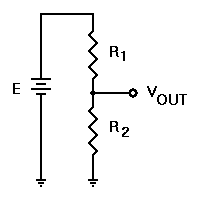
voltage_divider.gif


What I can't figure out is how R2 can possibly have an effect on V(out). Doesn't R2 appear in the circuit after the V(out) branch. Wouldn't the voltage going to V(out) just be whatever is remaining after it is reduced by R1? Or, does the current travel through R1, down to R2, and then back up to V(out)? Or something else?

Thanks!
 
Engineering news on Phys.org
From Ohm's Law, you know that a current through a resistor means you get a voltage drop over the resistor. The current in your series circuit has no where to flow but through R1 and R2. This means that R1 will drop a fraction (how much?) of the voltage, and R2 will drop the remaining fraction as per Kirchoff's Voltage Law. In fact, Vout is the measured voltage across R2 with respect to ground.

Regarding current flow, it always flows from a higher potential (voltage) to a lower potential, and thus it will not flow "back up to Vout from R2".
 
In fact, Vout is the measured voltage across R2 with respect to ground.

This is the key part of the answer.

Voltage is always measure across something or between two points. You cannot talk about a voltage at a point in isolation ( although we often rather lazily do when we call some other point ground).

You can refer to current at a point, or through something.
 
What you might be missing is that NOTHING actually goes out at Vout.
It is just a measurement point until you connect something to it.

The voltages in the resistor string will divide according to how each resistor compares with the total.

If both resistors were the same, the point Vout would have half the battery voltage relative to earth.
If R1 was twice as big as R2 then 1/3rd of the battery voltage would appear across R2, whether you measured it or not.

If you did this:
[PLAIN]http://dl.dropbox.com/u/4222062/series%20R.PNG

and all the resistors were equal, and the battery was 12 volts, then there would be 2 volts across each resistor.

You could measure them or not, but the voltages would still be the same.

So, relative to ground, the bottom Vout would be at 2 volts. The one above it would be at 4 volts and so on. The top one would give 10 volts out.
 
Last edited by a moderator:
One thing I could point out is that the voltage and current situation which we consider in this problem is what the system has settled down to at some time after switch-on. Only a few nanoseconds - but a finite time) Initially, there will be a step change and 'anything' could happen, depending on the actual circuit layout. The 'shares' of the supply volts are a result of how the system settles down. R2 needs to have some steady, established, current flowing through it before you can say the voltage you will get across it.
 
Awesome. Thanks for the responses (sorry I've been away from the computer for awhile) :)
 
vk6kro said:
What you might be missing is that NOTHING actually goes out at Vout.
It is just a measurement point until you connect something to it.

For sure, make sure you're comfortable with this concept.

Also, you should understand that through all of your circuit, there is only one current. This means that, from V=I*R, your current would be:

I = E / (R1+R2) ;

From that equation, it is immediately apparent that the values of both R1 and R2 affect the value of the current and, since again V = I*R, the voltage drop across each resistor depends on this very same current, I.
 

Similar threads

  • · Replies 4 ·
Replies
4
Views
2K
  • · Replies 6 ·
Replies
6
Views
4K
Replies
7
Views
3K
  • · Replies 21 ·
Replies
21
Views
3K
  • · Replies 14 ·
Replies
14
Views
2K
  • · Replies 10 ·
Replies
10
Views
3K
  • · Replies 1 ·
Replies
1
Views
2K
Replies
6
Views
5K
  • · Replies 3 ·
Replies
3
Views
2K
Replies
1
Views
2K