Discussion Overview
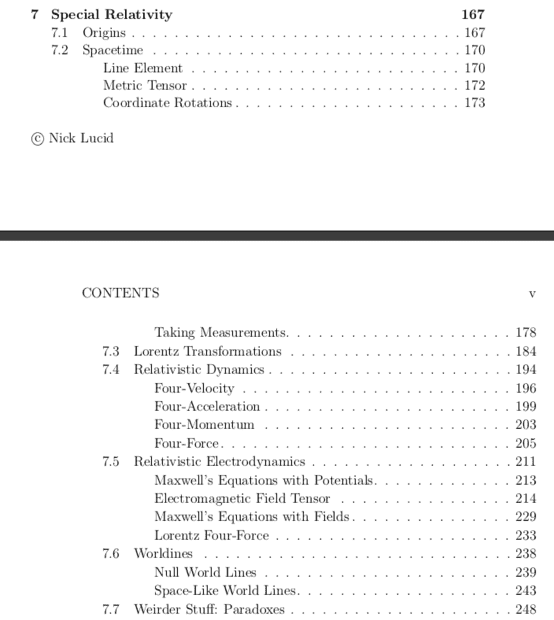
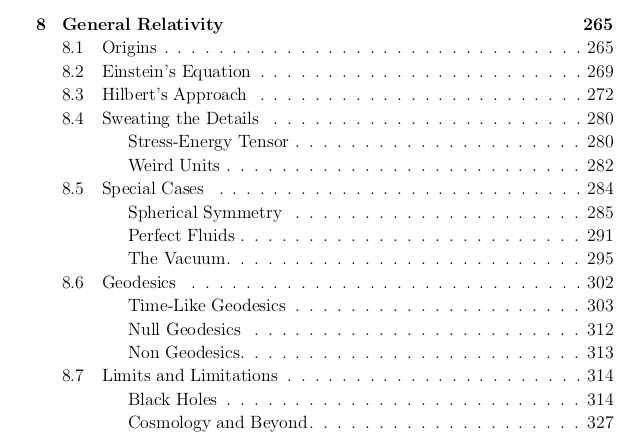
The discussion revolves around the suitability of the book "Advanced Theoretical Physics" by Nick Lucid for undergraduate students, particularly regarding its coverage of Special Relativity (SR) and General Relativity (GR). Participants explore the depth and accessibility of the material presented in the book, as well as alternative resources for learning these concepts.
Discussion Character
- Exploratory
- Debate/contested
- Conceptual clarification
- Homework-related
Main Points Raised
- Some participants express concern that Lucid's book may be too terse for those without prior exposure to SR and GR, suggesting it might be better suited for review rather than initial learning.
- Others emphasize the importance of mastering GR through problem-solving and understanding Differential Geometry, indicating that no single book can provide complete mastery.
- A participant notes that different books offer varying perspectives and that enjoyment in learning is also important, referencing Lucid's YouTube channel as a positive resource.
- Several participants suggest alternative books with lower mathematical expectations, such as "Gravity from the Ground Up" by Schutz and "Exploring Black Holes" by Taylor and Wheeler, as potentially more accessible options for beginners.
- One participant recommends Susskind's "Special Relativity and Classical Field Theory" for a more rigorous yet approachable introduction to relativity.
- Another participant shares a link to a first-year lecture series on dynamics and relativity as a supplementary resource.
- Sean Carroll's 24-page introduction to GR is mentioned as a concise resource that may complement other materials.
Areas of Agreement / Disagreement
Participants do not reach a consensus on the suitability of Lucid's book for beginners, with some believing it may not be adequate for those new to the topics, while others suggest it could be useful for review. Multiple competing views on the best resources for learning SR and GR are presented.
Contextual Notes
Participants highlight the varying levels of mathematical background required for different texts and the importance of foundational knowledge in calculus and introductory physics for understanding the material in Lucid's book.