Air flow through a hole in a submerged pressure tank

Click For Summary
SUMMARY

The discussion centers on calculating the volume air flow through a hole in a submerged pressure tank, maintained at a pressure between 1 and 4 bar. The user seeks to determine if the flow is choked using the formula P* = Patm + rho*g*h and whether the air speed can be assumed at 340 m/s. The discharge coefficient (Cd) is critical for accurate calculations, and the user references Sutton's Rocket Propulsion Elements for values. Ultimately, the user finds a solution using equations from Perry's Chemical Engineering Handbook, specifically equations 6-118 and 6-122.

PREREQUISITES
  • Understanding of compressible flow principles
  • Familiarity with discharge coefficients (Cd) for orifices
  • Knowledge of pressure and flow rate calculations
  • Ability to interpret engineering handbooks, specifically Perry's Chemical Engineering Handbook
NEXT STEPS
  • Study compressible flow dynamics using Perry's Chemical Engineering Handbook, focusing on sections 6-118 and 6-122
  • Research methods for determining discharge coefficients (Cd) for various orifice types
  • Explore the implications of hydrostatic pressure on flow rates in submerged systems
  • Learn about flow rate calculations in systems with multiple outlets and varying depths
USEFUL FOR

Engineers, fluid dynamics specialists, and anyone involved in designing or testing pressure tanks and flow systems in industrial applications.

Gustav Molin
Messages
8
Reaction score
1
Hello! I will try to formulate myself as clearly as possible, but english isn't my main language. I'm having trouble solving this problem that should be relatively easy to solve.

Let's say we have a submerged pressure tank, constantly fed with air through a compressor, so it's maintained at a certain pressure Ptank. The pressure tank has a hole in it at a known height from the surface, and with a known diameter, so that air will leak out. I want to calculate the volume air flow through the hole [m3/s].

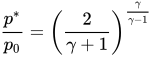
Can I use the formula
ab1d9a03c9138fa76ad908f3c13cd3bbcefa1d67
to conclude if the flow is choked by using
P* = Patm + rho*g*h
P0 = the pressure in the tube (between 1 and 4 bar or something)
gamma = 1,4 for air

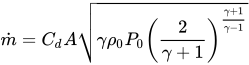
If the flow is proven to be choked, does this mean the air speed is 340 m/s through the hole? Can I then just multiply the speed with the area [m2] of the hole to get the volume air flow [m3/s]?I have tried using this formula but I can't seem to figure out Cd.
a62720a946ef3d47968f53c86c0909d67f8aba47
Thanks in advance!
 
Physics news on Phys.org
Is this a homework problem?
 
No it's not a homework problem. I'm building a test setup for a company, that consists of a tank with multiple holes and want to ensure that the mass flow through every hole is equal.
 
I believe in this case the discharge coefficient has to be determined via testing. There are published values for this coefficient based on the orifice type and the reference I typically use is table 8-2 in the latest edition of Sutton's Rocket Propulsion Elements. It highlights several liquid orifice types, diameters and the respective discharge coefficient for that kind of orifice.

Here personally, and I may be wrong so if someone thinks I am please let me know - I would love to hear you out, I would start with the volumetric flow rate Q = Cd * A * sqrt(2*ΔP/ρ). If you are feeding the tube with a compressor, the flow rate is that of the compressor output to the tube in total. If each orifice is the same, you can estimate the individual flow rate as the total flow of the compressor / the number of (equal size) outlets.
 
  • Like
Likes Gustav Molin
Thank you very much! I realized that all holes will have the same Cd so if I just guess what the Cd is, I can compare the different holes and calculate the estimated flow rate from there. You say that I can estimate the flow rate by dividing the total flow rate with the number of outlets. Is that true? I am thinking if the holes are placed at different depth, ΔP will differ from hole to hole and therefore the flowrate will differ. Is this correct?

Gustav
 
Well yes there will be a hydrostatic pressure increase but its not unreasonable to start with assuming a consistent flow rate across all. Is the change in height so significant that the pressure difference will be considerable?
 
  • Like
Likes Gustav Molin
The change in depth will only be maximum 2 meters so maybe the pressure difference isn't significant. I'll try the test setup in a few days, then we'll see if the flow rate really differs at the different depths.

Thank you for being helpful! I really appreciate it

Gustav
 
I noticed the equation you provided is only applicable for incompressible fluids. This leads me to believe I have to find another way of solving this. Any ideas?
 
Do you have reason to believe your fluid will exceed Mach 0.3?
 
  • Like
Likes Gustav Molin
  • #10
I found a way of calculating the air flow rate. Thanks for the help.
 
  • #11
Gustav Molin said:
No it's not a homework problem. I'm building a test setup for a company, that consists of a tank with multiple holes and want to ensure that the mass flow through every hole is equal.

Are the holes below the liquid surface and you want the same mass flow of liquid through each hole? What is the hole above the liquid surface for? Please try to state exactly what you want to do, without expecting us to guess.
 
  • #12
ahiddenvariable said:
Are the holes below the liquid surface and you want the same mass flow of liquid through each hole? What is the hole above the liquid surface for? Please try to state exactly what you want to do, without expecting us to guess.

Clearly, the holes are below the liquid surface and I want the same air mass flow. Air is not a liquid. There is no hole above the liquid surface. Where did you get that from? Please read instead of guessing. Lastly, I already solved the problem, which I stated.
 
  • #13
Hi Gustav,
Would be grateful to know your solution please, I am looking at a similar problem.
Regards
Nick
 
  • #14
Hi Nick!

Check out section 6-22, at the title "Compressible flow".
I used equations 6-118 and 6-122
https://chembugs.files.wordpress.com/2015/12/perrys-chemical-engineering-handbook1.pdf
 
  • Like
Likes nicknicknick

Similar threads

  • · Replies 9 ·
Replies
9
Views
4K
  • · Replies 2 ·
Replies
2
Views
2K
  • · Replies 67 ·
3
Replies
67
Views
5K
  • · Replies 10 ·
Replies
10
Views
4K
  • · Replies 17 ·
Replies
17
Views
5K
Replies
8
Views
2K
  • · Replies 7 ·
Replies
7
Views
5K
  • · Replies 15 ·
Replies
15
Views
4K
  • · Replies 2 ·
Replies
2
Views
11K
  • · Replies 12 ·
Replies
12
Views
4K