Air Turbine Design -- advice regarding a Hall sensor type air flow meter

Click For Summary
SUMMARY

The discussion centers on the design considerations for a Hall sensor type air flow meter, specifically regarding the implications of a bypass fluid path around the turbine. Key specifications include an inlet air velocity of 0-11.5 m/s, an inlet ID of 1.5 mm, a turbine diameter of 5 mm, and an air gap of 0.1 mm. It is established that a significant pressure drop across the turbine is necessary for proper operation; otherwise, the turbine may either impede intake air velocity or rotate excessively, leading to turbulence that disrupts accurate airflow measurement. The relationship between RPM and pressure differential is defined as RPM proportional to 1 / (1 - p2/p1).

PREREQUISITES
  • Understanding of Hall sensor technology and its application in flow measurement
  • Knowledge of fluid dynamics, particularly pressure differentials and flow rates
  • Familiarity with turbine design principles in airflow systems
  • Basic mathematical skills to interpret RPM and pressure relationships
NEXT STEPS
  • Research Hall sensor calibration techniques for accurate airflow measurement
  • Study the effects of pressure differentials on turbine performance in airflow meters
  • Explore advanced turbine designs that minimize turbulence in airflow systems
  • Investigate computational fluid dynamics (CFD) simulations for airflow analysis
USEFUL FOR

Engineers, product designers, and researchers involved in airflow measurement and turbine design, particularly those focused on optimizing Hall sensor type air flow meters.

jT990
Messages
1
Reaction score
0
Hello all,

I am after some advice regarding a hall sensor type air flow meter.

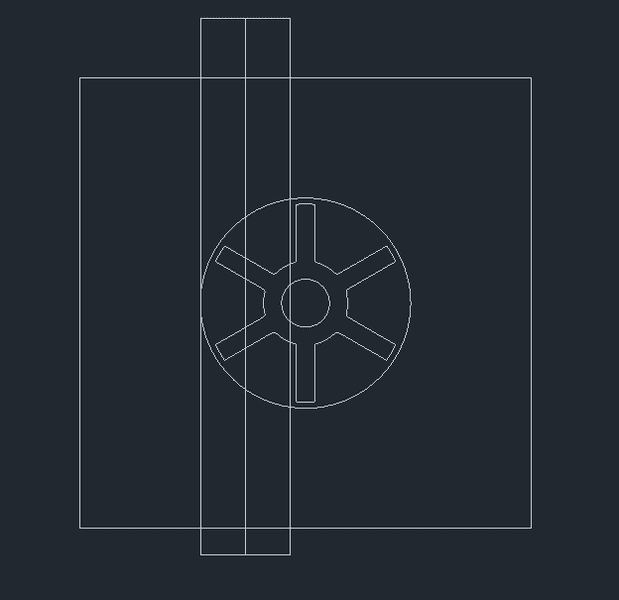
I know from experience that most hall sensor flow meters allow a bypass of fluid around the turbine/fan. However I would like to know what would happen if this was the case of the design below.

Specifications;
Inlet air velocity 0-11.5ms-1
Inlet ID 1.5mm
Turbine diameter: 5mm
Air gap between turbine and housing: 0.1mm

I assume two things will happen,
1.) the turbine itself will impede intake air velocity and eventually reach zero.
and/or 2.) the turbine will rotate too fast and the turbulence created inside the housing will in turn impede intake air.

I will attach calculations shortly.Thanks in advance.
8LWfsle.png
 

Attachments

  • 8LWfsle.png
    8LWfsle.png
    5.7 KB · Views: 441
Last edited:
Engineering news on Phys.org
First a belated welcome to PF, and apologies for the delay.
jT990 said:
I am after some advice regarding a hall sensor type air flow meter.
jT990 said:
I assume two things will happen,
1.) the turbine itself will impede intake air velocity and eventually reach zero.
and/or 2.) the turbine will rotate too fast and the turbulence created inside the housing will in turn impede intake air.
You are correct.
In order for the turbine to spin, there must be a significant pressure drop across the turbine, and because the system is regenerative, with flow back upstream, the rotation velocity will be high with little net flow. This will not make a good airflow meter.

Since the volume passing through the paddle wheel is the same as the volume being returned on the other side of the wheel, there will be no net mass flow, apart from leakage, unless the absolute output pressure, p2, is less than the absolute input pressure, p1.

With a slight pressure difference, the wheel will need to turn many times to transfer one wheel volume of air, hence the higher speed.
The RPM will be proportional to; 1 / ( 1 - p2/p1 ).
 

Similar threads

Replies
5
Views
3K
  • · Replies 45 ·
2
Replies
45
Views
6K
  • · Replies 1 ·
Replies
1
Views
2K
  • · Replies 8 ·
Replies
8
Views
2K
  • · Replies 23 ·
Replies
23
Views
6K
Replies
10
Views
3K
Replies
13
Views
4K
  • · Replies 19 ·
Replies
19
Views
36K
Replies
4
Views
6K
  • · Replies 4 ·
Replies
4
Views
16K