Align Multiple Points: A LaTeX Problem

Click For Summary

Discussion Overview

The discussion revolves around formatting equations in LaTeX, specifically focusing on aligning multiple points within equations. Participants explore various methods to achieve the desired alignment for complex equations, addressing both theoretical and practical aspects of LaTeX typesetting.

Discussion Character

  • Technical explanation
  • Debate/contested
  • Mathematical reasoning

Main Points Raised

  • One participant describes a problem with aligning multiple points in an equation using the align and split environments.
  • Another participant suggests using the alignat environment from the amsmath package as a potential solution.
  • A participant reports issues with using "&" to align columns, leading to unexpected behavior in the LaTeX output.
  • One participant proposes using the phantom command to achieve the desired alignment, which another participant confirms works well.
  • Another suggestion involves using the IEEEeqnarray environment, recommending the IEEEtrantools package for enhanced formatting capabilities.

Areas of Agreement / Disagreement

Participants express differing opinions on the best method for achieving the desired alignment, with multiple approaches being proposed and no consensus reached on a single solution.

Contextual Notes

Some participants note limitations with specific commands and environments, such as the behavior of "&" in the alignat environment and the need for additional packages like IEEEtrantools for certain formatting options.

ATY
Messages
30
Reaction score
1
So, I got the following problem: I want to write my equation the way you can see it in the picture:
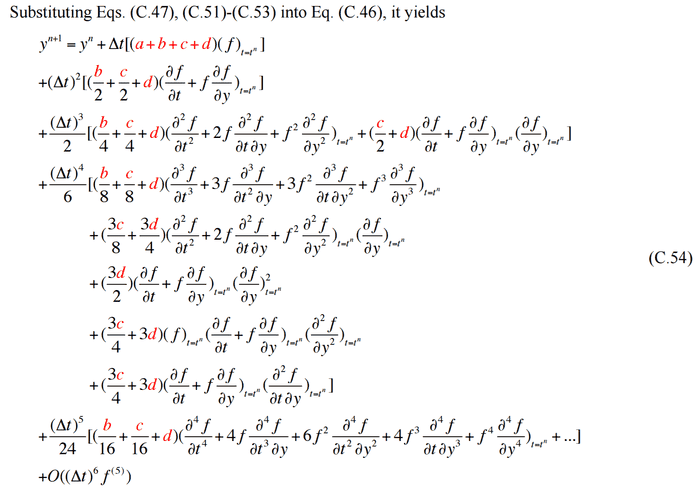
ZaOE1.png


I am actually running this:

\ begin{align}
\begin{split}
...
\ end{split}
\ end{align}

My problem is, that I can not set multiple align points. I need one point to attach the first 4 lines to the left side (because due to split they would otherwise go to the ride side), but the lines 5-8 look like they got aligned to the "+" from the first line.
How do I do this ? I hope that somebody can answer my question.
 
Physics news on Phys.org
ok, I tried it, but I got the following problem:
1. if I add a "&" at the beginning of every column to align the first 4 columns to the left side and additionally add an "&" before the "+" in the first column the program divides(?), because it thinks that I want to create a table.
38316_1.png


2. if I do not use the "&" before at the beginning of the first 4 columns, I manage to align the lines 5-8 properly, but the first columns are suddenly alligned to the right side of my paper.

38316_2.png
 
Sorry, that was a bad idea.

Thinking about it some more, try using fantom:
Code:
\begin{align*}
& + \frac{(\Delta t^4)}{6} [ (\frac{b}{8} + \frac{c}{8} + d)  \\
& \hphantom{{} + \frac{(\Delta t^4)}{6} [} (\frac{3c}{8} + \frac{3d}{4})
\end{align*}

$$
\begin{align*}

& + \frac{(\Delta t^4)}{6} [ (\frac{b}{8} + \frac{c}{8} + d) \\

& \hphantom{{} + \frac{(\Delta t^4)}{6} [} (\frac{3c}{8} + \frac{3d}{4})

\end{align*}
$$
 
  • Like
Likes   Reactions: ATY
this works fantastically :D
Thank you so much :)
 
You can also use the IEEEeqnarray environment for this sort of thing (install the IEEEtrantools package and load with \usepackage[retainorgcmds]{IEEEtrantools}). There's a nice explanation at http://moser-isi.ethz.ch/docs/typeset_equations.pdf.

Code:
\begin{IEEEeqnarray*}{rCll}
  y^{n + 1} &=& \IEEEeqnarraymulticol{2}{l}{
    y^{n} + \Delta t \bigl[ (a + b + c + d) (f)_{t = t^{n}} \bigr]} \\
  && \IEEEeqnarraymulticol{2}{l}{+\> \dotsb} \\
  && +\> \frac{(\Delta t)^{4}}{6} \Biggl[ &
    \biggl( \frac{b}{8} + \frac{c}{8} + d \biggr)
    \biggl( \frac{\partial^{3} f}{\partial t^{3}}
      + 3 f \frac{\partial^{3} f}{\partial t^{2} \partial y}
      + 3 f^{2} \frac{\partial^{3} f}{\partial t \partial y^{2}}
      + f^{3} \frac{\partial^{3} f}{\partial y^{3}} \biggr)_{t = t^{n}} \\
    &&& +\> \biggl( \frac{3c}{8} + \frac{3d}{4} \biggr)
    \biggl( \frac{\partial^{2} f}{\partial t^{2}}
      + 2 f \frac{\partial^{2} f}{\partial t \partial y}
      + f^{2} \frac{\partial^{2} f}{\partial y^{2}} \biggr)_{t = t^{n}}
    \biggl( \frac{\partial f}{\partial y} \biggr)_{t = t^{n}} \\
    &&& +\> \dotsb \\
    &&& +\> \biggl( \frac{3c}{4} + 3d \biggr)
    \biggl( \frac{\partial f}{\partial t}
      + f \frac{\partial f}{\partial y} \biggr)_{t = t^{n}}
    \biggl( \frac{\partial^{2} f}{\partial t \partial y} \biggr)_{t = t^{n}}
  \Biggr] \\
  && \IEEEeqnarraymulticol{2}{l}{+\> \dotsb} \\
  && \IEEEeqnarraymulticol{2}{l}{
    +\> \mathcal{O} \bigl( (\Delta t)^{6} f^{(5)} \bigr) \,.} \IEEEyesnumber
\end{IEEEeqnarray*}

Produces this:

pr1-1.png
 
Last edited:
  • Like
Likes   Reactions: DrClaude

Similar threads

  • · Replies 2 ·
Replies
2
Views
6K
  • · Replies 6 ·
Replies
6
Views
2K
  • · Replies 1 ·
Replies
1
Views
2K
  • · Replies 1 ·
Replies
1
Views
3K
  • · Replies 3 ·
Replies
3
Views
4K
  • · Replies 9 ·
Replies
9
Views
6K
  • · Replies 1 ·
Replies
1
Views
2K
  • · Replies 6 ·
Replies
6
Views
3K
  • · Replies 1 ·
Replies
1
Views
2K
  • · Replies 2 ·
Replies
2
Views
3K