Amplitude spectrum of signal, power of signal etc

Click For Summary

Discussion Overview

The discussion revolves around the analysis of a periodic signal in a circuit, focusing on calculating the amplitude spectrum, power contributions, and the effects of harmonics. Participants explore various tasks related to Fourier series representation, power calculations, and the implications of circuit parameters.

Discussion Character

  • Homework-related
  • Mathematical reasoning
  • Technical explanation
  • Debate/contested

Main Points Raised

  • One participant presents a Fourier series representation of the signal and applies the time shift property to derive the expression for $$u(t+1ms)$$.
  • Another participant substitutes values into the Fourier series and provides a modified expression for the shifted signal.
  • A participant suggests calculating the power due to the DC component and expresses it as a ratio of total power to find its percentage contribution.
  • Discussion on calculating the power of the third harmonic involves considering the transfer function of the circuit and using complex analysis to find output voltage and current.
  • One participant calculates the complex apparent power on the output capacitor and discusses the distinction between real and reactive power.
  • There is a clarification sought regarding whether the power calculation pertains to the power supplied to the capacitor or the output signal due to the third harmonic.
  • Another participant confirms the interpretation that the power calculation relates to the output voltage signal on the capacitor with the third harmonic input.
  • Multiple participants express uncertainty about the calculations and provide their approaches to finding average power using Parseval's theorem, with some discussing potential typos in their equations.

Areas of Agreement / Disagreement

Participants generally agree on the methods to calculate power and the use of Fourier series, but there are differing interpretations regarding the specific power calculations and the nature of the output signal. The discussion remains unresolved on certain details of the calculations and interpretations.

Contextual Notes

Some calculations involve assumptions about the periodicity and definitions of power in the context of Fourier series. There are unresolved mathematical steps and potential typos that may affect the clarity of the solutions presented.

etf
Messages
179
Reaction score
2
Hi!
Here is my task:

1. Homework Statement


Periodic signal is input signal for circuit (photo).
a) Calculate and sketch amplitude spectrum of $$u(t+1ms)$$,
b) Calculate participation (in percent) of DC component of power of total mean power of signal $$u(t)$$,
c) Sketch power spectrum of signal $$u1(t)=u(t)-1V$$
d) Calculate power of third harmonic on output
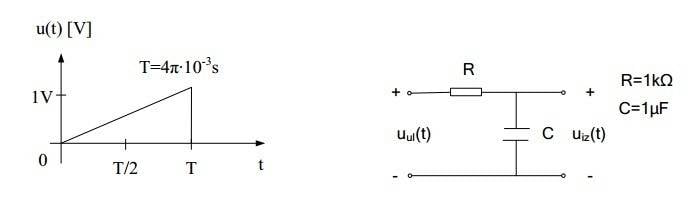
postavka2.jpg


Homework Equations


The Attempt at a Solution


[/B]
I represented $$u(t)$$ in terms of complex Fourier series as $$u(t)=\frac{E}{2}+\sum_{n=-\infty ,n\neq 0}^{n=\infty }F_ne^{jnw0t},$$ where $$F_n=\frac{E}{2n\pi }j,$$ $$T=4\pi *10^{-3}s,$$ $$w0=\frac{2\pi }{4\pi *10^{-3}},$$ $$E=1V.$$ Then I used time shift property of Fourier series to represent $$u(t+1ms)$$. I got $$u(t+1ms)=\frac{E}{2}+\sum_{n=-\infty,n\neq 0}^{n=\infty}F_ne^{-jnw0*0.001}e^{jnw0t}$$ ($$F_n$$ is same as for $$u(t)$$. Then I sketch it so task a) is completed. For task b) I calculated total mean power of signal as (if it's correct) $$P=\lim_{t->\infty}\frac{1}{T}\int_{\tau}^{\tau+T}(f(t))^{2}dt=\lim_{t->\infty}\frac{1}{T}\int_{\tau}^{\tau+T}(\frac{Et}{T})^{2}dt=...=\frac{E^{2}}{3}=\frac{1}{3}$$. What would be participation in percent of DC component? How to do other tasks?
 
Last edited:
Physics news on Phys.org
After substitution of E, T and w0 I get:
u(t)=\frac{1}{2}+\sum_{n=-\infty,n\neq 0}^{n=\infty}\frac{1}{2n\pi}e^{j\frac{\pi}{2}}e^{jn*500t}, u(t+1ms)=\frac{1}{2}+\sum_{n=-\infty,n\neq 0}^{n=\infty}\frac{1}{2n\pi}e^{j(\frac{pi}{2}-\frac{n}{2})}e^{jn*500t}
 
You have calculated the Fourier series and also know the dc component present , calculate the power due to dc component . Contribution of dc power in total power will be their ratio, to express in percentage multiply it with 100.
 
In order to calculate power of third harmonic on output, consider 3rd harmonic of your Fourier series as input signal and calculate output voltage considering transfer function of circuit ( reactance calculated with w=3w0). Now you have output function you can calculate power.
 
My third harmonic of input signals is -\frac{1}{3\pi }\sin{(1500t)}. It's representation in complex form is \frac{1}{3\pi }e^{j*0}, but I divided it with sqrt(2) to get rms...
I put it in input and solved circuit using complex analysis. I got current \underline{I}=\frac{1}{R-\frac{j}{wC}}\frac{1}{3\pi \sqrt{2}}=...=5.1941*10^{-5}+3.4628*10^{-5}j,\underline{Viz}=-\frac{j}{wC}\underline{I}=...=0.0231-0.0346j.. Now I can calculate complex apparent power on output (on capacitor) as \underline{S}=\underline{Viz}\underline{I^{*}} (I* is complex conjugate of I). Real part would be active and imaginary part reactive power?
 
Last edited:
I have not understood your question correctly. Do you want the power supplied to capacitor or the power of the output signal due to third harmonic.
 
The way you are trying to solve is calculating power supplied to capacitor . The power calculated will be volt ampere reactive power and thus 90 degree out of phase from real power across resistor.

Solve "VI*" and see that real part will cancel out only imaginary part would remain.
 
And if you want to calculate the power in the output voltage signal you have to work as I explained before.
 
lazyaditya said:
I have not understood your question correctly. Do you want the power supplied to capacitor or the power of the output signal due to third harmonic.
Output on scheme, uiz(t), is voltage on capacitor, so by "Calculate power of third harmonic on output" they mean power on capacitor (output) with third harmonic in input?
 
  • #10
Yup that what I thought at 1st glance, since they haven't asked the power supplied to capacitor.
 
  • #11
Ok, I did it. Here is how I try to find power:
Average power of periodic signal can be calculated using relation Ptotal=\sum_{n=-\infty}^{n=\infty}|Fn|^{2}. Using Parseval's theorem, it is equal to \frac{1}{T}\int_{\tau}^{\tau +T}(f(t))^{2}dt. For my signal, Ptotal=\frac{1}{T}\int_{\tau}^{\tau +T}(f(t))^{2}dt=\frac{1}{T}\int_{0}^{T}(\frac{Et}{T})^{2}dt=\frac{E}{T^{3}}\frac{T^{3}}{3}=\frac{E}{3} (E=1)=\frac{1}{3}. For DC component I have:\frac{1}{T}Pdc=\int_{0}^{T}(\frac{1}{2})^{2}dt=\frac{1}{4}. Is it ok?
 
  • Like
Likes   Reactions: lazyaditya
  • #12
I made typo, It should be Pdc=(1/T)*integral... But it doesn't affect solution :)
 
  • #13
etf said:
Ok, I did it. Here is how I try to find power:
Average power of periodic signal can be calculated using relation Ptotal=\sum_{n=-\infty}^{n=\infty}|Fn|^{2}. Using Parseval's theorem, it is equal to \frac{1}{T}\int_{\tau}^{\tau +T}(f(t))^{2}dt. For my signal, Ptotal=\frac{1}{T}\int_{\tau}^{\tau +T}(f(t))^{2}dt=\frac{1}{T}\int_{0}^{T}(\frac{Et}{T})^{2}dt=\frac{E}{T^{3}}\frac{T^{3}}{3}=\frac{E}{3} (E=1)=\frac{1}{3}. For DC component I have:\frac{1}{T}Pdc=\int_{0}^{T}(\frac{1}{2})^{2}dt=\frac{1}{4}. Is it ok?
I got the same values.
 

Similar threads

  • · Replies 14 ·
Replies
14
Views
4K
  • · Replies 1 ·
Replies
1
Views
1K
  • · Replies 6 ·
Replies
6
Views
2K
  • · Replies 4 ·
Replies
4
Views
9K
  • · Replies 8 ·
Replies
8
Views
3K
  • · Replies 7 ·
Replies
7
Views
2K
  • · Replies 2 ·
Replies
2
Views
2K
  • · Replies 8 ·
Replies
8
Views
11K
  • · Replies 8 ·
Replies
8
Views
2K
  • · Replies 4 ·
Replies
4
Views
3K