Linear system - calculate output signal

Click For Summary

Discussion Overview

The discussion revolves around a homework problem involving the calculation of the output signal of a linear time-invariant system given an input signal and its amplitude spectrum. Participants explore the use of Fourier transforms and convolution in the context of linear systems.

Discussion Character

  • Homework-related
  • Mathematical reasoning
  • Technical explanation
  • Debate/contested

Main Points Raised

  • One participant presents their solution for the input signal and its amplitude spectrum, seeking suggestions for calculating the output signal.
  • Another participant suggests using the Fourier transform to approach the problem.
  • Some participants question the necessity of using the Fourier transform, indicating uncertainty about its application.
  • It is proposed that frequency components below a certain cutoff frequency are multiplied by 1, while those between the cutoff frequencies are multiplied by 1/2, relating to the system's transfer function.
  • A participant provides a step-by-step tutorial from their book, outlining the process of defining the excitation in the frequency domain, multiplying the transfer function with the spectrum, and applying the inverse Fourier transform.
  • Another participant suggests that the input may be a pulse train rather than a single pulse, which could affect the approach to the problem.
  • It is mentioned that the Fourier inversion may not be necessary, and instead, the focus could be on multiplying the frequency components by the system's amplitude spectrum.

Areas of Agreement / Disagreement

Participants express differing views on the necessity and application of the Fourier transform, with some supporting its use while others remain uncertain. The discussion reflects multiple competing approaches to solving the problem without reaching a consensus.

Contextual Notes

Participants note that the transfer function is piecewise defined, which may complicate the application of the Fourier transform. There is also a lack of clarity regarding the nature of the input signal, whether it is a pulse or a pulse train, which could influence the calculations.

etf
Messages
179
Reaction score
2
Hi!

Homework Statement


postavka.jpg

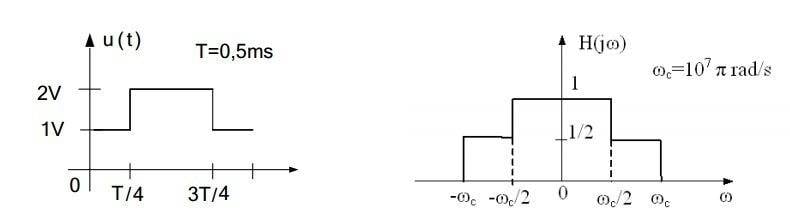
a) Calculate and sketch amplitude spectrum of u(t),
b) u(t) is input signal for linear time invariant system whose transfer function H(jw) is shown. Calculate output signal uo(t)

Homework Equations

The Attempt at a Solution


I completed task a), I got $$u(t)=\frac{3}{2}+\sum_{n=-\infty,n\neq 0}^{n=\infty}\frac{1}{2n\pi }(\sin{\frac{3n\pi}{2}}-\sin{\frac{n\pi}{2}})e^{jn\frac{2\pi}{0.5*10^{-3}}t},$$ where amplitude spectrum is $$F_n=|F_n|=\frac{1}{2n\pi }(\sin{\frac{3n\pi}{2}}-\sin{\frac{n\pi}{2}}).$$ Any suggestion about task b) ?
 
Last edited:
Physics news on Phys.org
Why should I use Fourier transform?
 
etf said:
Why should I use Fourier transform?
Only way I can think of.
 
Frequency components with w<wc/2 gets multiplied with 1 and and the frequency components between wc/2 and wc gets multiplied 1/2. Since, output is convolution of input and impulse response of the system, in frequency domain it becomes the multiplication of frequency spectrum of both the signals.
 
  • Like
Likes   Reactions: etf
Thanks for reply, but I'm still confused :( Here is "step by step" tutorial from my book:
1. Define excitation in frequency domain: Xn or X(jw)
I did it already, $$u(t)=\frac{3}{2}+\sum_{n=-\infty,n\neq 0}^{n=\infty}\frac{1}{2n\pi }(\sin{\frac{3n\pi}{2}}-\sin{\frac{n\pi}{2}})e^{jn\frac{2\pi}{0.5*10^{-3}}t},$$ where amplitude spectrum is $$F_n=|F_n|=\frac{1}{2n\pi }(\sin{\frac{3n\pi}{2}}-\sin{\frac{n\pi}{2}}).$$ (Xn from book is Fn here).
2. Multiply transfer function of system and spectrum of excitation (H(jw)Xn or H(jw)X(jw) to get response in frequency domain: Yn or Y(jw)
But my transfer function is piecewise defined, it's 1 in interval w<wc/2 and 1/2 between wc/2 and wc.
3. Apply inverse Fourier transform to find analytical expression for output signal
 
Looks like your input is a pulse train. I thought it was just a pulse.
In which case you can do as post # 5 suggests.
So you take each of your frequency components (harmonics"), starting with the zero'th (dc), multiply by the corrseponding |H(jw)| of your system amplitude spectrum, and form the corresponding new sum.
A Fourier inversion is not done.
 
  • Like
Likes   Reactions: etf

Similar threads

  • · Replies 2 ·
Replies
2
Views
2K
Replies
2
Views
5K
  • · Replies 12 ·
Replies
12
Views
3K
  • · Replies 14 ·
Replies
14
Views
4K
  • · Replies 1 ·
Replies
1
Views
2K
  • · Replies 1 ·
Replies
1
Views
2K
  • · Replies 4 ·
Replies
4
Views
9K
Replies
6
Views
2K
Replies
1
Views
2K
  • · Replies 6 ·
Replies
6
Views
5K