Engineering Analyzing this operational amplifier circuit with DC

Click For Summary
SUMMARY

The discussion centers on a flawed operational amplifier circuit presented in a textbook titled "Electronic Circuit Analysis" by David E. Johnson. Participants confirm that the circuit is non-physical and would generate errors in SPICE simulations. The primary issue identified is the lack of DC bias connections for the op-amp inputs, which prevents the circuit from functioning correctly. The conclusion emphasizes that the circuit's design is fundamentally incorrect, and understanding this flaw is crucial for analyzing op-amp circuits.

PREREQUISITES
  • Understanding of operational amplifier fundamentals
  • Familiarity with DC biasing techniques
  • Knowledge of SPICE simulation software
  • Basic concepts of electronic circuit analysis
NEXT STEPS
  • Study operational amplifier DC biasing methods
  • Learn how to use SPICE for circuit simulation
  • Review common errors in circuit design and analysis
  • Explore advanced topics in electronic circuit analysis
USEFUL FOR

Electrical engineering students, circuit designers, and anyone involved in operational amplifier analysis and electronic circuit design.

ZoeDale
Messages
11
Reaction score
1
Homework Statement
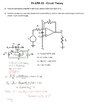
a) Treat the operational amplifier in the circuit below as ideal and solve for Vo.
b) Treat the op amp as a non-ideal device that is powered by VCC and VEE; describe several ways in which your answer in part a) will change.
Relevant Equations
KVL; KCL;
Hi all, I attached my attempt at a solution in the attached picture. I am using the textbook titiled as ”electronic circuit analysis“ by David E. Johnson, and op amp is in chap 3;
while I did not find any example that attach the Vee and Vcc with amplifier . It seems that v+ = v- doesn’t hold in this scenario; can anybody give me some hints?

thanks!
 

Attachments
  • IMG_3132.jpeg
    IMG_3132.jpeg
    27.5 KB · Views: 115
Last edited:
Physics news on Phys.org
IMG_3132.jpeg
 
Um, that circuit has a fundamental problem, and is non-physical. SPICE, for example, would throw an error if you tried to analyze it. Are you sure this came from a textbook?
 
this is a problem from our qualify exam samples for practice. No solutions provided. :cry:
 
ZoeDale said:
this is a problem from our qualify exam samples TAT for practice. No solutions provided.
Well, that circuit is complete nonsense as drawn, so there is no solution to the problem. Maybe that is the test of the problem -- you are supposed to reply that the circuit is nonsense in order to get credit.

Can you say what is totally wrong about that circuit?

1701990267207.png
 
berkeman said:
Um, that circuit has a fundamental problem, and is non-physical. SPICE, for example, would throw an error if you tried to analyze it. Are you sure this came from a textbook?
Seems that v+ can not be equal to v- in the ideal condition; or the non-ideal condition. But I can not figure out what will happen in the circuit; Can you give more hints on that? Thank you!
 
ZoeDale said:
Can you give more hints on that?
Opamp inputs must have some DC bias connection to somewhere to supply their input bias currents and to set the DC operating point. Do you see the issue now? :smile:
 
berkeman said:
Opamp inputs must have some DC bias connection to somewhere to supply their input bias currents and to set the DC operating point. Do you see the issue now? :smile:
oh, you mean they should be on each side of the lying triangle's waist, separately?
 
ZoeDale said:
oh, you mean they should be on each side of the lying triangle's waist, separately?
Sorry, I don't understand your response.
 

Similar threads

  • · Replies 8 ·
Replies
8
Views
2K
  • · Replies 1 ·
Replies
1
Views
2K
Replies
15
Views
2K
  • · Replies 4 ·
Replies
4
Views
3K
  • · Replies 18 ·
Replies
18
Views
4K
  • · Replies 4 ·
Replies
4
Views
5K
  • · Replies 2 ·
Replies
2
Views
3K
  • · Replies 13 ·
Replies
13
Views
2K
  • · Replies 12 ·
Replies
12
Views
4K
  • · Replies 0 ·
Replies
0
Views
2K