Angular Momentum of Rotating Cylinder

Join the discussion
Ask a follow-up here, or get your own question answered by working scientists, mathematicians and engineers — people, not an autocomplete.
Real named experts · corrections over time · the nuance an AI answer skips
11 replies · 13K views
cantgetaname
Messages
41
Reaction score
0
The problem at hand is finding the angular momentum of a cylinder (rotating about its center of mass, with the axis of rotation along its length) about an axis on the edge of the cylinder (this axis is also parallel to the axis of rotation).
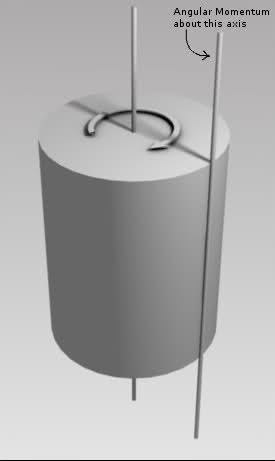
ojfgxf.jpg

Some general explanation will help too.
 
Physics news on Phys.org


Are you sure about that?
I mean, the cylinder isn't rotating about that axis.
I used conservation of angular momentum in a particular question using that method and the answers came out to be wrong.

If, for example, you consider a particle with mass M moving along the radius then the angular momentum along the new axis using the method you suggested is:

( MR^2 + MR^2 ) w

However if you simply use Mv x r, it changes with time.

EDIT: OK, maybe not the best example, but I think my point's valid.


You have two frames of reference with parallel axes, one with origin at the CM of the rotating cylinder, the origin of the other one somewhere on the x-axis at distance D (which is equal to R now, but do it for the general case.) Write the position vector and velocity of a mass element of the cylinder in the new system and use the definition of the angular momentum to get the contribution of the mass element. Integrate for the whole cylinder.

ehild


Hmmm... I'll do it.
No shortcuts? I wanted to know this so that certain problems would be faster to solve.


Yes, sorry guys, I misread the question. (Didn't think this would be in the Introductory Physics Forum!)
 
Last edited:
cantgetaname said:
Some general explanation will help too.

hi cantgetaname! :smile:

the total angular momentum about an axis is the angular momentum about that axis of the whole mass concentrated at the c.o.m., plus the angular momentum about a parallel axis through the c.o.m.

(ie total angular momentum = orbital angular momentum + spin)

(same as ∑ (d + ri) x (ω x miri) = d x (ω x ∑ miri) + ∑ ri x (ω x miri) = d x (ω x mtotalrc.o.m.) + ∑ ri x (ω x miri))

if, as in this case, the body is rotating about its c.o.m., then vc.o.m. = 0,

so L = mdvc.o.m. + Ic.o.m.ω, = 0 + Ic.o.m.ω = Ic.o.m.ω :wink:


but if the body is rotating about the new axis, then vc.o.m. = dω,

so L = mdvc.o.m. + Ic.o.m.ω, = (md2 + Ic.o.m.)ω, = Inew axisω :wink:
 
Last edited:
oops!

ehild said:
If I understood well the CM of the cylinder does not rotate about the new axis. Does it?

ehild

oops! i didn't read the question properly and i didn't even read what i'd written properly :redface:

i've edited my previous post to correct it

thanks, ehild! :smile:


tiny-tim said:
if, as in this case, the body is rotating about its c.o.m., then vc.o.m. = 0,

so L = mdvc.o.m. + Ic.o.m.ω, = 0 + Ic.o.m.ω = Ic.o.m.ω :wink:


but if the body is rotating about the new axis, then vc.o.m. = dω,

so L = mdvc.o.m. + Ic.o.m.ω, = (md2 + Ic.o.m.)ω, = Inew axisω :wink:
Thanks for your reply.
So if I'm not wrong, along the new axis the angular momentum will be the same as the one in the middle? (in this case)
 
that's right …

if the (instantaneous) axis of rotation passes through the centre of mass, then the angular momentum tensor is the same about any point, and the angular momentum is the same about any two parallel axes :smile:

(a bit like a couple being the same about any point)