Biot–Savart law: the origin of chirality?

  • Context: Graduate 
  • Thread starter Thread starter carrz
  • Start date Start date
  • Tags Tags
    Chirality Law Origin
Click For Summary

Discussion Overview

The discussion revolves around the Biot-Savart law and the reasons behind the use of the right-hand rule in electromagnetism. Participants explore whether the choice of convention (right-hand vs. left-hand) has any physical implications or if it is purely arbitrary. The conversation touches on concepts such as electron spin, magnetic dipole moments, and chirality in electromagnetic interactions.

Discussion Character

  • Debate/contested
  • Conceptual clarification
  • Exploratory

Main Points Raised

  • Some participants suggest that the right-hand rule may relate to the electron's magnetic dipole moment or spin, questioning how these properties influence the directionality of magnetic fields.
  • Others clarify that the right-hand rule aligns with the vector product in the Biot-Savart law, indicating that the direction of the magnetic field could have been defined oppositely, leading to a left-hand rule instead.
  • Several participants argue that the choice of the right-hand rule is largely a matter of convention, similar to the designation of the electron as negative, and that electromagnetism could function with different conventions without altering physical outcomes.
  • Some assert that nature does not inherently choose a direction for electromagnetism, emphasizing that any chirality observed is a result of human-defined conventions rather than a fundamental aspect of nature.
  • In contrast, a few participants claim that nature consistently aligns with a specific direction relative to the velocity vector, suggesting that this consistency is not merely a matter of convention.
  • One participant challenges the idea that changing conventions would not affect measurable results, proposing that experiments could demonstrate the implications of using different handedness in calculations.

Areas of Agreement / Disagreement

The discussion reflects significant disagreement among participants regarding the implications of the right-hand rule and whether it is a convention or has deeper physical significance. There is no consensus on the role of chirality in electromagnetism or the nature of directional choices in the Biot-Savart law.

Contextual Notes

Participants express various assumptions about the relationship between electron properties and magnetic field direction, as well as the implications of changing conventions on experimental outcomes. The discussion does not resolve these assumptions or the mathematical implications of the claims made.

carrz
Messages
126
Reaction score
0
As we know Biot-Savart law follows right-hand rule, like this:
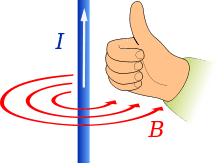
220px-Manoderecha.svg.png


...so the question is why right-hand rule, why not left?

I suppose it must have something to do with electron's magnetic dipole moment or "spin", as that's the only source of asymmetry I am aware of in this scenario. It follows then the orientation of the spin axis could be what defines this magnetic rotational direction, which would imply then the spin axis orientation is defined by the velocity vector. But still, the question remains, how or why could velocity vector have any specific directional impact on either intrinsic electron spin axis orientation or Biot-Savart magnetic field rotation?
 
Physics news on Phys.org
The right-hand rule works because it gives the same direction as the vector product in the Biot-Savart law:
$$
\mathbf j(\mathbf x') \times |\mathbf x - \mathbf x'|
$$
where ##\mathbf j## is current density at point ##\mathbf x'##, ##\mathbf x## is point where the magnetic field is sought.

The vector product chooses one direction for ##\mathbf B## from two possibilities. Direction of magnetic field could have been defined to be opposite. Then we would use left hand to get this opposite direction.
 
Last edited:
People use the right hand rule mostly because most people are right handed. It's easier to figure out the convention using the dominant hand. One can arbitrarily reverse all the fields and go by the left hand rule. The only physical effect is the motion of particles and forces on these particles inside these fields, so however direction you choose to define the fields is arbitrary as long as you get the motion correct in the end.
 
carrz said:
...so the question is why right-hand rule, why not left?
This is merely a matter of convention. Like why the electron is negative, why not positive? EM could work just fine if we picked different conventions (i.e. electrons positive, left hand rule, different units, etc.) Someone historically picked the right hand and established the convention and people have just used it ever since, there is no physical reason nor effect.
 
DaleSpam said:
This is merely a matter of convention. Like why the electron is negative, why not positive? EM could work just fine if we picked different conventions (i.e. electrons positive, left hand rule, different units, etc.) Someone historically picked the right hand and established the convention and people have just used it ever since, there is no physical reason nor effect.

Convention is arbitrary, but the reason for nature to always stick with the same direction is not.
 
Nature doesn't pick a direction for EM (I.e. there is no chirality observed in EM). Only our conventions do pick one, and we could pick the opposite convention without changing nature or experimental results in any way.
 
DaleSpam said:
Nature doesn't pick a direction for EM (I.e. there is no chirality observed in EM). Only our conventions do pick one, and we could pick the opposite convention without changing nature or experimental results in any way.

Nature does pick always the same direction relative to velocity vector. This has nothing to do with convention or whether you are going to call it right, west, or clockwise. It's always the same.
 
No, it doesn't.

Take any experiment you can think of, and any measurement you can devise. If we picked the opposite convention (left handed coordinates and cross products instead of right handed coordinates and cross products) then you would get all of the B fields reversing direction but none of the physically measurable results being altered in the least.

If you cannot think of an example, then work out the force between two current-carrying wires using both a left handed and a right handed convention. Don't forget to use the same handedness both for determining the direction of the field and the Lorentz force.

In other words, nature does not pick the handedness of the B field (and therefore the direction of the B field), our conventions do. Nature does pick the direction of the force, and that does not exhibit any chirality.
 
Last edited:
Nature does always pick the same direction relative to velocity vector.
 
  • #10
Work the exercise I suggested and see.
 

Similar threads

Replies
8
Views
1K
  • · Replies 1 ·
Replies
1
Views
4K
  • · Replies 1 ·
Replies
1
Views
2K
  • · Replies 1 ·
Replies
1
Views
2K
  • · Replies 1 ·
Replies
1
Views
6K
  • · Replies 18 ·
Replies
18
Views
2K
  • · Replies 5 ·
Replies
5
Views
7K
  • · Replies 21 ·
Replies
21
Views
2K
  • · Replies 5 ·
Replies
5
Views
2K
  • · Replies 4 ·
Replies
4
Views
3K