riseofphoenix
- 294
- 2
Ok so I already know how to solve it by looking at an example my teacher did in class...
This is what I did...
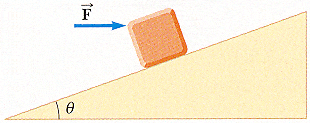
4. A 2.00 kg block is held in equilibrium on an incline of angle θ = 70° by a horizontal force vector F applied in the direction shown in the figure below. If the coefficient of static friction between block and incline is μs = 0.300, determine the following.
(a) the minimum value of F
Step 1) Draw Free Body Diagram
Step 2) Determine forces in x and y direction
Fx
fs
F cos 70
-mg sin 70
Fy
n
-F sin 70
-mg cos 70
Step 3) Sum of x-forces and sum of y-forces/Equilibrium equations
ƩFx = fs + F cos 70 + (-mg sin 70) = 0
ƩFy = n + (-F sin 70) + (-mg cos 70) = 0
ƩFy = n + (-F sin 70) + (-mg cos 70) = 0
ƩFy = n - F sin 70 - mg cos 70 = 0
ƩFy = n = F sin 70 + mg cos 70
ƩFy = n = 0.940F + (2.00)(9.8)cos 70
ƩFy = n = 0.940F + 6.704
Step 4) Solve for static friction fs
fs = μsn
fs = (0.300)n
fs = (0.300)(0.940F + 6.704)
fs = 0.282F + 2.0112
Step 5) Find the HORIZONTAL force vector by plugging in fs in ƩFx
ƩFx = fs + F cos 70 + (-mg sin 70) = 0
ƩFx = (0.282F + 2.0112) + 0.342F - 18.418 = 0
ƩFx = 0.282F + 0.342F + 2.0112 - 18.418 = 0
ƩFx = 0.624F - 16.4068 = 0
ƩFx = 0.624F = 16.4068
ƩFx = F = 26.29 N(b) the normal force exerted by the incline on the block
n = 0.940F + 6.704
n = 0.940(26.29) + 6.704
n = 31.4 N
MY QUESTION IS...
In STEP 2, why is the force "-mg sin 70" included in the X-DIRECTION and why is the force -mg cos 70 included in the Y-DIRECTION?
I thought the ONLY forces acting in the x-direction were static friction, fs and Fcos 70, while the only forces acting in the y direction were normal force, n, and -Fsin 70?
Help!
This is what I did...
4. A 2.00 kg block is held in equilibrium on an incline of angle θ = 70° by a horizontal force vector F applied in the direction shown in the figure below. If the coefficient of static friction between block and incline is μs = 0.300, determine the following.
(a) the minimum value of F
Step 1) Draw Free Body Diagram
Step 2) Determine forces in x and y direction
Fx
fs
F cos 70
-mg sin 70
Fy
n
-F sin 70
-mg cos 70
Step 3) Sum of x-forces and sum of y-forces/Equilibrium equations
ƩFx = fs + F cos 70 + (-mg sin 70) = 0
ƩFy = n + (-F sin 70) + (-mg cos 70) = 0
ƩFy = n + (-F sin 70) + (-mg cos 70) = 0
ƩFy = n - F sin 70 - mg cos 70 = 0
ƩFy = n = F sin 70 + mg cos 70
ƩFy = n = 0.940F + (2.00)(9.8)cos 70
ƩFy = n = 0.940F + 6.704
Step 4) Solve for static friction fs
fs = μsn
fs = (0.300)n
fs = (0.300)(0.940F + 6.704)
fs = 0.282F + 2.0112
Step 5) Find the HORIZONTAL force vector by plugging in fs in ƩFx
ƩFx = fs + F cos 70 + (-mg sin 70) = 0
ƩFx = (0.282F + 2.0112) + 0.342F - 18.418 = 0
ƩFx = 0.282F + 0.342F + 2.0112 - 18.418 = 0
ƩFx = 0.624F - 16.4068 = 0
ƩFx = 0.624F = 16.4068
ƩFx = F = 26.29 N(b) the normal force exerted by the incline on the block
n = 0.940F + 6.704
n = 0.940(26.29) + 6.704
n = 31.4 N
MY QUESTION IS...
In STEP 2, why is the force "-mg sin 70" included in the X-DIRECTION and why is the force -mg cos 70 included in the Y-DIRECTION?
I thought the ONLY forces acting in the x-direction were static friction, fs and Fcos 70, while the only forces acting in the y direction were normal force, n, and -Fsin 70?
Help!