Calculate Minor Losses due to Flow Geometry Alone

Click For Summary
SUMMARY

This discussion focuses on calculating minor losses due to flow geometry, isolating them from major frictional losses. The user seeks a first principles formula that relates these losses solely to area and velocity changes, while questioning the influence of fluid viscosity on minor losses. The conversation highlights that minor losses, represented by the local loss coefficient (KL), are not directly correlated with viscosity but rather depend on the pipe's dimensions. The user concludes that in inviscid flow, no losses occur, as the pressure gradient responsible for flow acceleration is reversible.

PREREQUISITES
  • Understanding of minor and major head loss concepts in fluid dynamics
  • Familiarity with the Darcy-Weisbach equation for frictional losses
  • Knowledge of local loss coefficients (KL) and their application
  • Basic principles of inviscid flow and Bernoulli's equation
NEXT STEPS
  • Research methods for calculating minor losses in fluid systems
  • Explore the relationship between viscosity and flow behavior in various fluids
  • Study the application of Bernoulli's equation in inviscid flow scenarios
  • Investigate empirical correlations for local loss coefficients in different geometries
USEFUL FOR

Fluid dynamics engineers, mechanical engineers, and anyone involved in hydraulic system design and analysis will benefit from this discussion.

Timtam
Messages
40
Reaction score
0
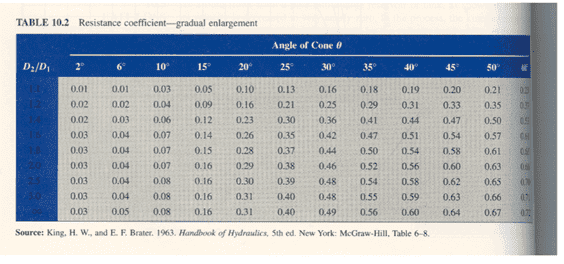
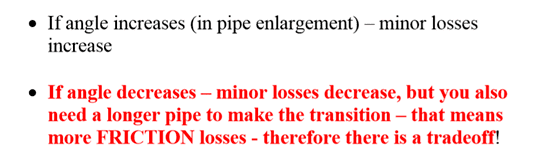
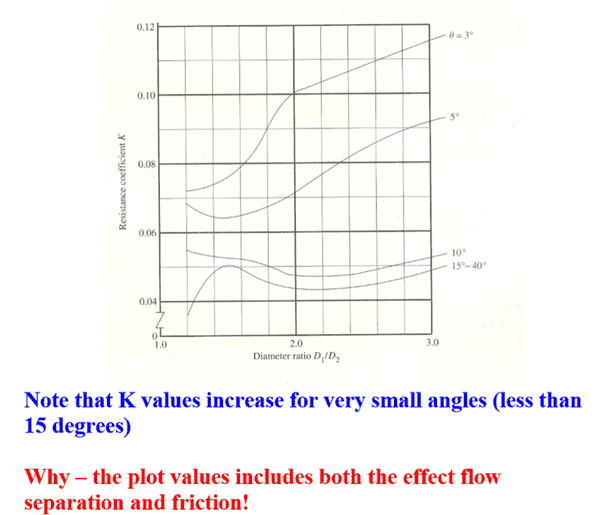
Hi does anyone know a way to calculate the Minor losses related just to flow Geometry isolated from Major frictional losses, all the k tables I can find combine the frictional losses with the geometry losses eg see below blurb from
upload_2016-5-16_10-29-10.png
upload_2016-5-16_10-29-30.png
upload_2016-5-16_10-29-40.png

but I was hoping to obtain a first principles formula that could equate these losses solely to area and velocity change

The reason being is I am assuming that major losses component of the K values must be based on particular viscosity fluid but I would like to calculate this for different viscosity fluids ?

Also for the Darcy Weisbach if I want to calculate just the frictional losses would I use the average diameter of a convergent or divergent section of pipe ?

If such a formula exists it ok to just plain add these two effects ?

Am I making life to difficult for myself is there an easier way ?
 
Science news on Phys.org
There's really nothing about these sorts of head loss calculations that comes from first principles. It is basically all empirical.

But here is a more fundamental issue: if there was no viscosity at all, what do you think would cause such losses to occur in these sorts of situations?
 
This is what confuses me. I always thought that minor losses are (like major head loss ) also proportional to the viscosity of the fluid but I am seeing statements like the below that suggest that it isn't.

where KL means (local) loss coefficient. Although KL is dimensionless, it is not correlated in the literature with the Reynolds number and roughness ratio but rather simply with the raw size of the pipe.

In an inviscid flow I was assuming that these Minor head losses come from the force required to change the Momentum of the flow or the orthogonal area the obstruction presents to the flow.

That said it makes sense to me that a lower viscosity fluid would find it easier to change direction and thus would incur smaller later flow separation

Is this correct ? could I also reduce my Minor head loss ( as well as my Major head loss) by using a lower viscosity fluid ?
 
The broader point I was trying to make is that an inviscid flow would incur no losses. Separation doesn't really make sense as a concept without viscosity. So, there is no source of dissipation to cause losses in an inviscid flow. Sure a force is required to accelerate the flow through a contraction, but that comes from a pressure gradient, and that pressure gradient is completely reversible in an inviscid flow. It's basically Bernoulli's equation.
 

Similar threads

  • · Replies 25 ·
Replies
25
Views
2K
Replies
8
Views
2K
  • · Replies 3 ·
Replies
3
Views
2K
  • · Replies 2 ·
Replies
2
Views
2K
  • · Replies 4 ·
Replies
4
Views
16K
  • · Replies 7 ·
Replies
7
Views
3K
  • · Replies 5 ·
Replies
5
Views
5K
  • · Replies 31 ·
2
Replies
31
Views
5K
  • · Replies 2 ·
Replies
2
Views
2K
  • · Replies 8 ·
Replies
8
Views
2K