Calculating Area of a Wedge Cut from a Cylinder

Click For Summary

Homework Help Overview

The discussion revolves around calculating the area of a wedge cut from a cylinder, specifically focusing on a scenario where the wedge does not extend from the center but rather spans across the cylinder. Participants are exploring the implications of the wedge's geometry and the associated calculations.

Discussion Character

  • Exploratory, Conceptual clarification, Mathematical reasoning, Assumption checking

Approaches and Questions Raised

  • Participants are attempting to clarify the nature of the cut and its geometry, questioning how the angle of the cut might vary. Some suggest using symmetry and volume integrals to approach the problem, while others consider the implications of integrating triangular areas.

Discussion Status

The discussion is active, with participants providing hints and exploring different interpretations of the problem. Some have offered potential approaches, such as using integrals and symmetry, while others are seeking further clarification on specific mathematical concepts related to the problem.

Contextual Notes

There are indications of missing information regarding the specifics of the wedge's geometry and the mathematical principles involved, particularly concerning the use of polar coordinates and plane equations. Participants express varying levels of familiarity with these concepts.

nobahar
Messages
482
Reaction score
2
Hello!
I've seen volume calculations involving cutting a wedge from a cylinder where the wedge cuts down to the centre of the circle (i.e. the length of the straight edge will be the diameter of the cylinder).
I was looking for hints on working out the area of a wedge cut from a cylinder where the wedge goes straight across from one side of the cylinder to the other; if that makes sense.
If not, here's my poor attempt at a drawing to illustrate:
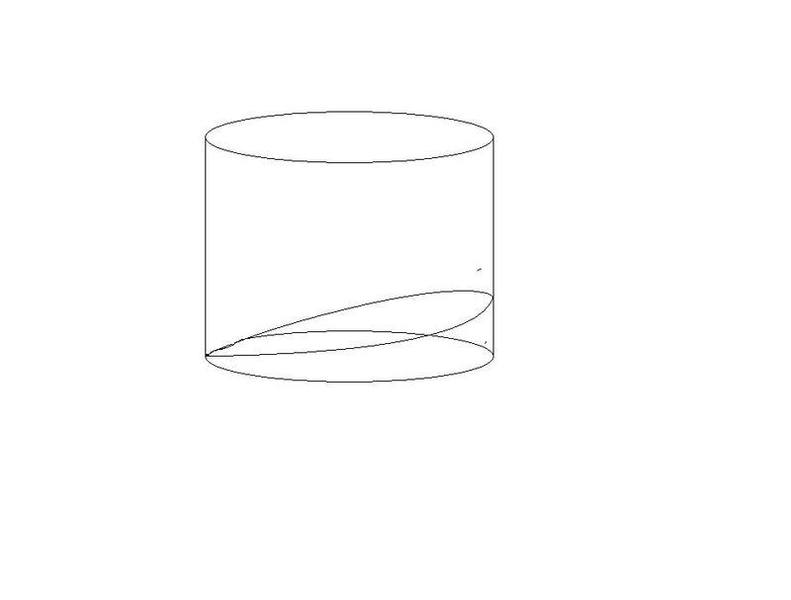
cylinder.jpg

Anyone know any websites or any hints? As I say, the only ones I found pertain to wedges where, I believe, the angle of the cut remains constant (where the cut is from the centre), I believe the angle changes in my example.
Thanks in advance.
 
Physics news on Phys.org
i'm not too sure what you mean exactly - is the cut a plane... what angle are you talking about & how/why does it vary?

If it is cut by a plane, it should be easy to come up with the volume from symmetry & the volume of a cylinder. Otherwise you'll probably need to look at setting up a volume integral.
 
Last edited:
I don't see why the angle between the slanted surface and the bottom would change. Suppose your cylinder was just tall enough to fit the wedge. Wouldn't the volume be just half of that cylinder?

Disclaimer: I haven't worked it out; that's just my best guess.

Edit: I have now and it is. :cool:
 
Last edited:
LCKurtz said:
I don't see why the angle between the slanted surface and the bottom would change.

I was thinking of integrating by adding up the area of lots of triangles; as you would in example 4 on this page:

http://tutorial.math.lamar.edu/Classes/CalcI/MoreVolume.aspx

In my example, I now think only one would be a triangle, the very centre one, the others wouldn't be.

LCKurtz said:
Suppose your cylinder was just tall enough to fit the wedge. Wouldn't the volume be just half of that cylinder?

Argggghhhh! That's so simple I completely overlooked it! I was thinking it would be long and 'difficult'. Although it (now you've pointed it out) seems obvious, is there another way I can prove this is so? That it is half the cyclinder up to the peak of the wedge?
Many thanks to both of you for the responses.
 
nobahar said:
Argggghhhh! That's so simple I completely overlooked it! I was thinking it would be long and 'difficult'. Although it (now you've pointed it out) seems obvious, is there another way I can prove this is so? That it is half the cyclinder up to the peak of the wedge?
Many thanks to both of you for the responses.

You can do it as an integral too. If the cylinder is x2+y2 = a2, and the plane is inclined at an angle α in the zy trace, then the equation of the plane is

z = (y + a) tan(α) [Why?]

so the volume of the wedge would be

\int\int_D (y + a)\tan(\alpha)\ dydx

where the integral is over the circular domain D. You will want to use polar coordinates.
 
To prove it, you have to construct some symmetry that maps the unwanted half exactly onto the wanted half I guess.
(The symmetry itself is obvious...but might be a bit yucky to prove)
[edit] by yucky, I mean you might have to explicitly use coordinates.
 
LCKurtz said:
z = (y + a) tan(α) [Why?]
Why is this the equation of the plane?
Sorry, I'm fairly new to plane equations, I've started to read about it, but nothing that looks like the above equation. (My maths is largely self-taught).
Again, many thanks.
 
nobahar said:
Why is this the equation of the plane?
Sorry, I'm fairly new to plane equations, I've started to read about it, but nothing that looks like the above equation. (My maths is largely self-taught).
Again, many thanks.

Look at just the intersection of the plane with the zy plane (the zy cross-section in your picture). That intersection is just a straight line. It intersects the y-axis at y = -a. α is just the angle of inclination of the line and tan(α) is the slope. So you know a point and the slope and can write the equation of that line. Since the plane is parallel to the x axis, the same equation represents the equation of the plane. The x variable being missing makes the surface parallel to the x axis.

Also note that you can write the slope tan(α) in terms of a and the height h of the shortened cylinder.
 
Many thanks LCKurtz. Circular domains and using polar co-ordinates in integration is something I haven't yet looked in to. But I will refer back to this thread when I do!
 

Similar threads

  • · Replies 2 ·
Replies
2
Views
2K
  • · Replies 41 ·
2
Replies
41
Views
6K
  • · Replies 10 ·
Replies
10
Views
3K
  • · Replies 14 ·
Replies
14
Views
4K
Replies
2
Views
2K
  • · Replies 3 ·
Replies
3
Views
10K
  • · Replies 1 ·
Replies
1
Views
2K
  • · Replies 9 ·
Replies
9
Views
2K
  • · Replies 1 ·
Replies
1
Views
2K
Replies
1
Views
2K