Calculating Fermi Dirac Probability - Part B Guide

Click For Summary

Discussion Overview

The discussion revolves around calculating the Fermi-Dirac probability, specifically focusing on part (b) of a problem related to the fraction of electrons in the conduction band and the corresponding fraction of holes left in the valence band. The scope includes theoretical reasoning and mathematical formulation.

Discussion Character

  • Exploratory
  • Technical explanation
  • Debate/contested
  • Mathematical reasoning

Main Points Raised

  • One participant requests help with part (b) of the problem, indicating uncertainty about how to proceed.
  • Another participant suggests that if a fraction of electrons (p) is in the conduction band, the fraction of holes left in the valence band depends on the assumption that no electrons are going to the conduction band, which would mean no missing holes.
  • A participant expresses confusion about the explanation provided and requests a different clarification or a diagram.
  • Another participant proposes that the equation may need to change and suggests writing an equation for W_h in terms of W_g and W_f to eliminate W_f.
  • One participant mentions that their textbook states the probability distribution for holes is given by 1 - W(p), which they believe is correct despite lacking a strong rationale, and suggests using this formulation to derive the answer.
  • A participant indicates they will ask a moderator to move the thread to the advanced physics section for better visibility.

Areas of Agreement / Disagreement

Participants express varying levels of understanding and confusion regarding the problem, and there is no consensus on the best approach to solve part (b). Multiple competing views on the equations and interpretations of the problem remain present.

Contextual Notes

There are unresolved assumptions regarding the relationships between the variables W_h, W_g, and W_f, and the implications of the probability distributions for electrons and holes. The discussion reflects differing interpretations of the problem's requirements.

falcon555
Messages
11
Reaction score
0
Hi dear friends
Please reffer to my work , I did part ( a )
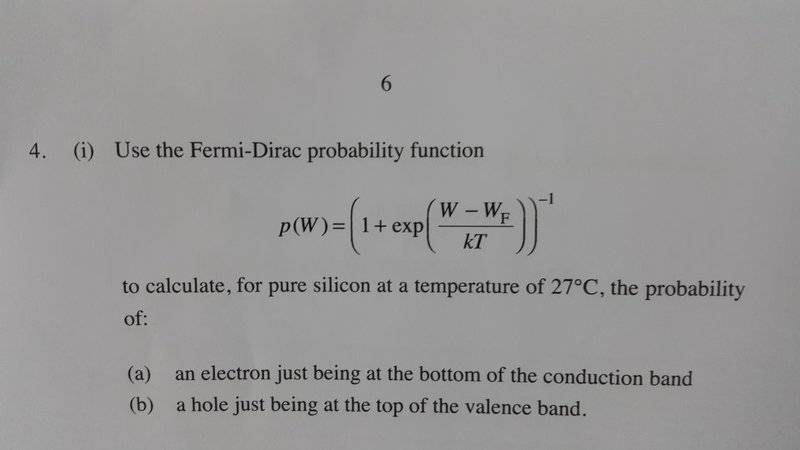
20160909_171333.jpg
20160909_171413.jpg
only
Could you please help me to do part ( b )
I don't know how to do it.
 
Physics news on Phys.org
falcon555 said:
Hi dear friends
Please reffer to my work , I did part ( a ) View attachment 105669 View attachment 105670only
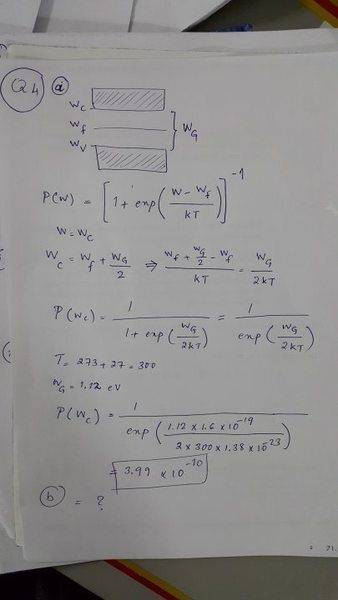
Could you please help me to do part ( b )
I don't know how to do it.
(a) is correct.
(b): If p is the fraction of electrons in the conduction band (at energy EG/2) & coming from the valence band, what would be the fraction of holes left behind in the valence band, seeing as those electrons came from the top of the valence band?
Hint: no electrons going to the conduction band ⇒no missing holes!
 
Thanks rude man...
I'm not getting what you mean. ...
Can you explain it in a different way or show on a diagram. ...
 
falcon555 said:
Thanks rude man...
I'm not getting what you mean. ...
Can you explain it in a different way or show on a diagram. ...

I may work on this some more but I think you should post this in the advanced physics section where I think it belongs. I covered this material many years ago in a graduate course (taught by a future Nobelist!).
 
Then the equation may change to the below
20160910_112813.jpg


I guess. .
If this is correct then we have to write an equation for W h in term of Wg and Wf to eliminate Wf.
What will be that equation?
 
How to shift this post to the advanced physics section?
 
falcon555 said:
Then the equation may change to the below View attachment 105702

I guess. .
If this is correct then we have to write an equation for W h in term of Wg and Wf to eliminate Wf.
What will be that equation?
OK, after a bit more perusal on my part:

My textbook gives the probability distribution for holes as not W(p) as it is for electrons, but as 1 - W(p). Without a believable rationale, but I'm sure it's correct, because later on they use that expression for deriving the totality of free carriers for electrons and for holes and get roughly the same number for each, which has to be correct. That was supposed to be my hint in post 2 but as I say it wasn't based on good argument.

So, bottom line, if you use 1 - W(p) for the holes, and use Wv in lieu of Wc, and proceedig exactly as you did in part (a), you will get your answer. Do that and let us know what you come up with.

I am going to ask a moderator to move your post to the advanced physics section for you.
 
Last edited:

Similar threads

  • · Replies 3 ·
Replies
3
Views
2K
  • · Replies 1 ·
Replies
1
Views
4K
  • · Replies 8 ·
Replies
8
Views
2K
  • · Replies 6 ·
Replies
6
Views
3K
  • · Replies 1 ·
Replies
1
Views
3K
  • · Replies 3 ·
Replies
3
Views
3K
  • · Replies 11 ·
Replies
11
Views
4K
  • · Replies 7 ·
Replies
7
Views
2K
  • · Replies 7 ·
Replies
7
Views
2K
  • · Replies 0 ·
Replies
0
Views
3K