Calculating Hybrid Parameters for an Inverting Op Amp

Click For Summary

Discussion Overview

The discussion revolves around calculating the hybrid parameters for an inverting operational amplifier (op amp). Participants explore the theoretical framework and practical implications of using hybrid parameters in the context of an ideal op amp, with a focus on deriving specific equations related to input and output characteristics.

Discussion Character

  • Homework-related
  • Technical explanation
  • Debate/contested

Main Points Raised

  • One participant presents a homework problem involving the calculation of hybrid parameters for an inverting op amp, expressing difficulty in deriving the necessary equations.
  • Another participant points out the conventional designation of h-parameters as h11, h12, h21, and h22, suggesting that using a, b, c, and d may lead to confusion.
  • It is noted that the h21 parameter, under the assumption of an ideal op amp, would be infinite due to the output current into a short circuit being infinite for any non-zero input current.
  • The h11 parameter is identified as the input impedance with the output shorted, which can be observed as R1 + R2.
  • The h12 parameter is described as the reverse voltage transfer ratio, which would be "1" for an ideal op amp when a voltage is applied to the output.
  • Participants discuss the implications of assuming an ideal op amp with zero output impedance, leading to h22 also being infinite.
  • One participant expresses that introducing a non-zero output impedance complicates the calculations and suggests that it may not be possible to derive a working solution using an ideal op amp.
  • Another participant inquires about the educational context of the problem, asking for details about the course and the source of the problem.

Areas of Agreement / Disagreement

There is no consensus on the feasibility of deriving the equations using an ideal op amp, with some participants suggesting it may be impossible while others provide insights into the theoretical aspects of the parameters.

Contextual Notes

Participants express uncertainty regarding the assumptions made about the op amp's ideality and the implications of introducing non-ideal characteristics, such as output impedance.

Kerren
Messages
9
Reaction score
0
Hi guys :smile: This question has been bugging me for a REALLY long time so thanks in advance for the help :biggrin:!

Homework Statement


Calculate the Hybrid Parameters for an inverting op amp shown below:


https://www.dropbox.com/s/45mjldud2ar5pwg/invOpAmp.jpg


And I need to get it into the form of:

https://www.dropbox.com/s/5vto0ipwtbre7qk/hequiv.jpg


Homework Equations


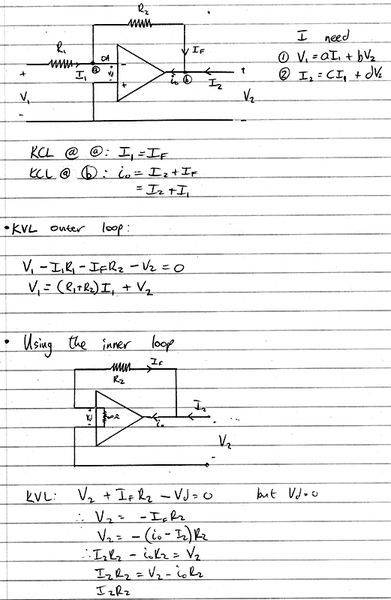
[itex]V_1 = aI_1 + bV_2[/itex]

and

[itex]I_2 = cI_1 + dV_2[/itex]


The Attempt at a Solution


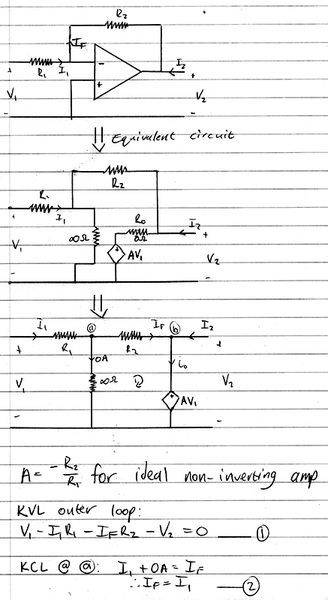
I tried doing it like this:
https://www.dropbox.com/s/9gnpycdi3p6g1ys/p1.jpg

https://www.dropbox.com/s/5u7f3109u1i8zoa/p2.jpg


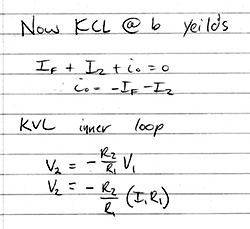
But I got stuck trying to get [itex]I_2[/itex], [itex]I_1[/itex] and [itex]V_2[/itex] all in the same equation.

So I redrew the equivalent model to see if maybe there was another loop I could use:
https://www.dropbox.com/s/p23mwsbjdmmpbex/p3.jpg

Which lead to the exact same result :frown:


So at the moment I'm thinking maybe it isn't possible to get the second equation?


Here the calculations are if they don't load:
p1.jpg


p2.jpg


p3.jpg
 
Physics news on Phys.org
It's conventional to designate the h-parameters as h11, h12, h21 and h22. Using the letters a, b, c and d invites confusion with the ABCD parameters:

http://en.wikipedia.org/wiki/Two-port_network

Is this an actual homework problem?

The h21 parameter is the ratio of the output current (with the output shorted to ground) to the input current. If the opamp is taken to be ideal with zero output impedance, then the output current into a short will be infinite for any non-zero input current, and hence, h21 would be "∞".

The parameter h11 is the input impedance with the output shorted. We can see by inspection that it would be R1+R2.

The h12 parameter is the reverse voltage transfer ratio with the input open circuited. To determine this, we apply a voltage to the output and take the ratio of that voltage to the voltage that would appear at the input; it would be "1". The opamp would fight the application of a test voltage to its output, but that's the definition of h12.

Finally, the h22 parameter is the output conductance with the input open circuited. Since an ideal opamp has zero output impedance, h22 will be "∞".

Using h parameters with this circuit wouldn't be appropriate if the opamp is ideal. I would assume a small output impedance (call it Ro); then h21 and h22 wouldn't be "∞", and you wouldn't have the fighting voltage source problem when applying the test voltage to the output to determine h12.
 
Thank you!

Awesome! Thanks so much for the response :biggrin:!

I originally had [itex]R_o[/itex] in my calculations but since the op amp is ideal I had to make it equal to zero :smile: With [itex]R_o[/itex] in the mix I did have another loop but my problem there was that I was introducing a variable that was not given in the question so I'd have to try to get it in terms of [itex]I_1[/itex], [itex]V_1[/itex], [itex]I_2[/itex] or [itex]V_2[/itex] which also didn't seem practical. Since having an [itex]R_o[/itex] that isn't zero implies that the op amp isn't ideal I decided I'd have to try another route!

It was never stated in the question that it was possible to get a working solution, so I can argue that it is, in fact, impossible using an ideal op amp :biggrin:

Your explanation makes perfect sense, thank you very much for your time and effort :smile:!
 
I'm interested to know a few things about this. Is this a problem given to you in a college level course? What college?

Did this problem come from a text, or did the Prof make it up? If from a text, what text?
 
I've PMed you all the details :)!

Our Professor made this one up :D!
 

Similar threads

  • · Replies 4 ·
Replies
4
Views
3K
  • · Replies 3 ·
Replies
3
Views
2K
  • · Replies 5 ·
Replies
5
Views
3K
  • · Replies 9 ·
Replies
9
Views
2K
  • · Replies 13 ·
Replies
13
Views
3K
  • · Replies 3 ·
Replies
3
Views
2K
  • · Replies 3 ·
Replies
3
Views
2K
  • · Replies 1 ·
Replies
1
Views
1K
  • · Replies 3 ·
Replies
3
Views
2K
  • · Replies 10 ·
Replies
10
Views
4K