Calculating power of a permanent magnet DC generator

Click For Summary

Discussion Overview

The discussion revolves around the calculation of power output from a permanent magnet DC generator, with a focus on design considerations, efficiency improvements, and the differences between AC and DC generators. Participants explore theoretical and practical aspects of building a small generator model using accessible materials.

Discussion Character

  • Exploratory
  • Technical explanation
  • Conceptual clarification
  • Debate/contested
  • Homework-related

Main Points Raised

  • One participant inquires about calculating power output based on magnet strength and rotation frequency, expressing uncertainty about AC versus DC generators.
  • Another participant emphasizes the need for more information to analyze power output, noting that AC generators are typically more efficient than DC generators.
  • Concerns are raised about the efficiency of a single loop coil at low RPMs, with suggestions that stronger magnets or more loops may be necessary for practical power generation.
  • Participants discuss the impact of increasing the number of coils on voltage output, suggesting that more loops can significantly enhance voltage while noting that amperage is less of a concern.
  • One participant provides a formula for calculating output voltage for a single loop DC generator, highlighting factors like pole surface area and magnetic flux density.
  • There is mention of the mechanical stresses involved in building the generator, particularly with lightweight materials like Lego, and the potential for construction issues to affect performance.
  • A suggestion is made to experiment with a small DC motor as a generator to gain practical experience with power generation.
  • Another participant shares their experience with building PM alternators and expresses difficulty in achieving calculated power outputs, seeking advice on magnet surface area requirements.

Areas of Agreement / Disagreement

Participants express various viewpoints on the efficiency and design of DC versus AC generators, with no consensus reached on the best approach or specific calculations. The discussion remains unresolved regarding the optimal design for the generator and the expected power output.

Contextual Notes

Limitations include the lack of precise measurements for friction, the exact design of coils, and the assumptions made about magnet strength and configuration. The discussion also reflects varying levels of expertise among participants, which may influence the suggestions and claims made.

Who May Find This Useful

Individuals interested in DIY electronics, hobbyist generator construction, and those exploring basic principles of electromagnetism may find this discussion beneficial.

Temp89
Messages
7
Reaction score
0
Hello, I'm building a DC generator for fun (of the cardboard and lego variety). It is based on this model:
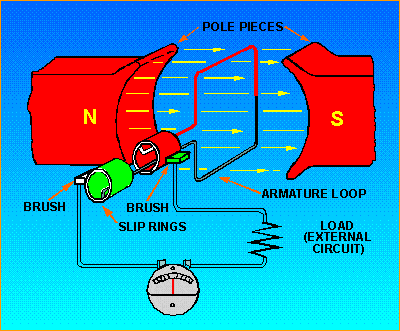
32NE0396.GIF


How would you calculate the power output from that, assuming we know the strength of the magnets and the frequency of rotation?

Are there any easy ways to increase output/efficiency without significantly altering the model or adding too much weight to the armature?

I'm embarrased to say I don't know the difference between an AC and DC generator. Which one is better?

I also heard that something along the lines of electrical friction slows down the turns of the armature. Will this make it too inefficient to power anything like one of those mini-bulbs?

Thanks.
 
Engineering news on Phys.org
Wow, you need a WHOLE lot more information than you have provided to even get started with such an analysis.

AC (alternating current) will typically be the more efficient mechanical to electrical conversion (generator). The picture you have presented is of an alternating current type of generator.

The power and efficiency concerns relate to the number of windings you provide, the strength of the magnets, the speed of the spin, and the exactness of the design (how close and closed the coils and magnets are and much friction is in the bearings and slip brushes).

Without such information, any thoughts of calculating power ratings would be impossible.
 
Last edited:
James S Saint said:
Wow, you need a WHOLE lot more information than you have provided to even get started with such an analysis.

AC (alternating current) will typically be the more efficient mechanical to electrical conversion (generator). The picture you have presented is of an alternating current type of generator.

The power and efficiency concerns relate to the number of windings you provide, the strength of the magnets, the speed of the spin, and the exactness of the design (how close and closed the coils and magnets are and much friction is in the bearings and slip brushes).

Without such information, any thoughts of calculating power ratings would be impossible.

each magnet will hold 33kg.
magnets'll be as close to the loop as possible. so assume 1mm.
coils - don't really know what they are. I'm assuming the armature in that pic = a 1 loop coil. what's the best method/design with that?
turns at around 200rpm.
friction is impossible to say. not much is my guess.

I'm not looking for an exact figure.

I've heard of brushless alternators. Are they easier. I'm assuming you can't get electricity from the metal of the alternator itself.
 
Here is a link that might get you into the ball park http://hyperphysics.phy-astr.gsu.edu/hbase/electric/farlaw.html#c1" where you can see how complicated of an issue you are facing.

I can tell you that a single loop at 200Hz will produce too little for you to even measure much less actually do anything with. Even at 10,000 RPM, you might have trouble unless your magnets are strong. But motors and generators were never my specialty even if I had a memory for formulas (which I don't).
 
Last edited by a moderator:
what if I increase the number of coils? the alternator was going to have a width of about an inch or 2. I think I remember seeing a pic of an alternator where it was a whole torus made up loops. Is that what I should be aiming at. Rough estimate is all I really want. Are we talking milliamps?
 
Temp89 said:
what if I increase the number of coils? the alternator was going to have a width of about an inch or 2. I think I remember seeing a pic of an alternator where it was a whole torus made up loops. Is that what I should be aiming at. Rough estimate is all I really want. Are we talking milliamps?
The amperage isn't the issue. The amps will increase with the amount of torque you apply. The issue is voltage. Each loop adds to the voltage. So 100 loops will produce 100 times the voltage that 1 loop would have if turned at the same speed. Although I would recommend as many as you can fit on your armature.

You need to get about 2v to work with typical low voltage LEDs and about 3.6 to work with the more common variety today. They only require from 10 to 20ma and maybe 20-100mw to operate. Sometimes it is easier to use a tiny motor to display the generator's capability. You can get motors that work in micro watts and don't require a voltage minimum.

Usually in such hobby models, the issue is the construction. The windings need to be very close to the magnets. Magnets from old disk drives work well and provide pretty serious flux densities. "Earth magnets" are great. Having the magnets connect magnetically on their backsides helps if you can arrange that.

The physical construction is really the bigger issue. Get something built that you can actually spin fast without it falling apart and the rest will fall in place. A geared setup would help. The speed is what does the trick and overcomes many of the efficiency issues. The faster, the better.
 
Last edited:
Output voltage for a single loop (like the one in the picture) DC generator is as follows:
E = 2/pi * A * B * w

A=pole surface area (pi*r*l)
B=magnetic flux density (tesla)
w= rotational speed (rad/s)

Commercial DC machines have more poles, number of conductors and current paths giving it a higher output voltage and smoother commutation.

Output power are governed by input power minus the losses. Losses are stray/core/mechanical and resistive. As for the machanical stess factor of Lego don't get your hopes to high, the inducued torque can easily break your generator in two.

But anyways good luck.
 
Btw, if you use that slip ring configuration rather than a split ring (commutator), you will have to ensure that your measuring device expects AC, not DC. LEDs won't care because they naturally rectify anyway, but a DC meter will merely wiggle a bit around zero. A diode can be used to rectify, but they require an extra .7v or so or no current will flow.
 
Temp89 said:
Hello, I'm building a DC generator for fun...
Welcome to Physics Forums.

Since you are essentially playing around and learning about this stuff, I'll suggest first getting a small cheap DC motor and play around with using it as a small generator. You should be able to get an LED to light up just spinning the motor quickly by hand. See if you can measure the open circuit voltage and short circuit current, to get a rough idea of its power capacity.

Have fun!
 
  • #10
I know old post. I've built some PM alternators and they never seem to generate the power that I calculated. I am a reciently retired machinist and have a decent CNC shop. d Id like to build some more wind generators. Very windy where I live. :D
Anyhow. The mechanal parts of the project are not a problem but I am having difficulty properly calculating the correct amount of power. I use N42 magnets but I am trying to figure out just how much surface area I need per pole. Any help would be great.
 

Similar threads

Replies
7
Views
2K
  • · Replies 38 ·
2
Replies
38
Views
6K
Replies
21
Views
3K
Replies
9
Views
2K
  • · Replies 10 ·
Replies
10
Views
5K
  • · Replies 20 ·
Replies
20
Views
3K
Replies
0
Views
2K
  • · Replies 5 ·
Replies
5
Views
3K
  • · Replies 7 ·
Replies
7
Views
4K
Replies
2
Views
2K