Calculating Thevenin Equivalent Voltage for a Complex Network

Click For Summary

Discussion Overview

The discussion revolves around calculating the Thevenin equivalent voltage for a complex electrical network using various methods, including source transformations and node voltage analysis. Participants are sharing their equations and approaches to solve the problem, while seeking clarification on specific steps in their reasoning.

Discussion Character

  • Technical explanation
  • Mathematical reasoning
  • Debate/contested

Main Points Raised

  • One participant presents their equations derived from applying source transformations and the node voltage method, leading to a proposed expression for the Thevenin voltage.
  • Another participant suggests that the circuit should be redrawn and argues that source transformations may not be necessary, proposing an alternative approach using Kirchhoff's Voltage Law (KVL).
  • Clarification is sought regarding the origin of a specific current (I1) in the KVL equation, with an explanation provided that relates it to a node current derived from Kirchhoff's Current Law (KCL).

Areas of Agreement / Disagreement

There is no consensus on the best method to calculate the Thevenin equivalent voltage, as participants propose different approaches and express uncertainty about specific steps in the reasoning.

Contextual Notes

Participants have not fully resolved the mathematical steps involved in their calculations, and there are differing opinions on the necessity of source transformations in this context.

magnifik
Messages
350
Reaction score
0
I need help finding the thevenin equivalent voltage for the following network:
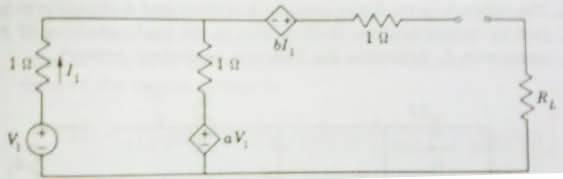
2lxyyh5.jpg


i did source transformations so that i could analyze it using the node voltage method.

72c84j.png

my equations are:
I1 = v1
(a) vx + vx - vT = v1 + av1 - bv1
2vx - vT = v1 + av1 - bv1
(b) vT - vx + vT = bv1
2vT - vx = bv1

when i simplify (by substituting vx), i get
vT = v1/3(a + b + 1)

however, the answer should be
vT = v1/2(a + b + 1 - ab)

help please! thanks.
 
Last edited:
Physics news on Phys.org
magnifik said:
I need help finding the thevenin equivalent voltage for the following network:
2lxyyh5.jpg


i did source transformations so that i could analyze it using the node voltage method.
72c84j.png

my equations are:
I1 = v1
(a) vx + vx - vT = v1 + av1 - bv1
2vx - vT = v1 + av1 - bv1
(b) vT - vx + vT = bv1
2vT - vx = bv1

when i simplify (by substituting vx), i get
vT = v1/3(a + b + 1)

however, the answer should be
vT = v1/2(a + b + 1 - ab)

help please! thanks.

I think I've spotted a problem with how you've redrawn your circuit.

I think it be should more like this,

attachment.php?attachmentid=35760&stc=1&d=1306029035.png


EDIT: There's really no reason to apply source transformations to the circuit at all, the original circuit can be solve by writing two KVL equations.

\text{Equation 1:}

Voc = I_{1} + aV_{1} + bI_{1}

\text{Equation 2:}

-V_{1} + 2I_{1} + aV_{1} = 0

\text{Equation 2} \Rightarrow \text{Equation 1}

This gives the expected result.

The Latex doesn't seem to be working, but hopefully you can follow through my work.
 

Attachments

  • 72c84j.png
    72c84j.png
    1.5 KB · Views: 477
Last edited:
thank you for your help!
 
can you explain for first KVL equation? I'm not sure where the I1 comes from
 
magnifik said:
can you explain for first KVL equation? I'm not sure where the I1 comes from

Here we are writing a KVL in the righthand loop.

Notice that the loop is open thus there is no current flowing in this loop except for the current in the vertical, leftmost branch.

This current is clearly I1 by writing a KCL at the top node.

Clear?
 
jegues said:
Here we are writing a KVL in the righthand loop.

Notice that the loop is open thus there is no current flowing in this loop except for the current in the vertical, leftmost branch.

This current is clearly I1 by writing a KCL at the top node.

Clear?

yup. thanks.
 

Similar threads

  • · Replies 42 ·
2
Replies
42
Views
7K
  • · Replies 28 ·
Replies
28
Views
7K
  • · Replies 5 ·
Replies
5
Views
3K
  • · Replies 1 ·
Replies
1
Views
2K
  • · Replies 10 ·
Replies
10
Views
4K
  • · Replies 9 ·
Replies
9
Views
6K
  • · Replies 12 ·
Replies
12
Views
3K
  • · Replies 8 ·
Replies
8
Views
3K
  • · Replies 7 ·
Replies
7
Views
3K
Replies
3
Views
2K