Can electrons pass through a positively charged disc in electrostatic induction?

Click For Summary

Discussion Overview

The discussion revolves around the concept of electrostatic induction, specifically addressing whether electrons can pass through a positively charged disc in an electroscope setup. Participants explore the mechanisms of charge movement, grounding effects, and the roles of positive and negative charges in the system.

Discussion Character

  • Exploratory
  • Technical explanation
  • Debate/contested

Main Points Raised

  • Some participants explain that grounding the disc allows electrons to flow from the ground, potentially leading to a negatively charged disc, while others assert that the book states it should be positively charged.
  • One participant suggests that the negatively charged rod pushes electrons away, creating a positive charge on the disc, which leads to electrons moving to the leaves and then escaping to ground when a path is provided.
  • Another participant emphasizes the importance of considering the negative charges on the rod, arguing that these charges would move to Earth if a grounding path is established, resulting in a net positive charge on the electroscope after the rod is removed.
  • Concerns are raised about the role of the positively charged source, with some questioning why electrons from the leaves cannot move to the disc as long as the positive source is nearby.
  • A participant describes a scenario where the negatively charged rod causes a certain number of electrons to flee the plate, but the presence of charged leaves limits the actual movement of electrons.
  • Several participants express confusion about specific terms and concepts, such as the "gray bubble" and its relevance to the overall charge distribution in the electroscope system.

Areas of Agreement / Disagreement

Participants express differing views on the mechanics of charge movement and the effects of grounding, indicating that multiple competing perspectives remain without a clear consensus.

Contextual Notes

Participants reference various models and analogies, such as treating the Earth as a huge conductor and using Gaussian surfaces to analyze charge distribution, which may depend on specific assumptions and definitions not fully articulated in the discussion.

Who May Find This Useful

This discussion may be of interest to those studying electrostatics, particularly in understanding the nuances of charge induction, grounding effects, and the behavior of charged systems in physics.
Zahid Iftikhar
Messages
121
Reaction score
24
TL;DR
A simple explanation may be helpful regarding charging by electrostatic induction. Whether a body is positively or negatively charged if a point on the conductor is grounded.
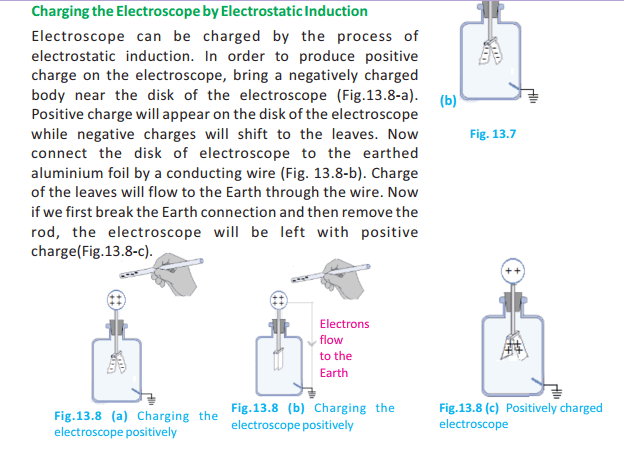
My explantion of this electrostatic induction is that if the disc of electroscope is ground, electrons will flow from the ground and neutralize the disc, leaving the electroscope negatively charged after removal of the ground, but the book says it should be postively charged. As per book, the electrons from the gold leaves will flow to the ground. But it is not convincing as they will have to pass through the positively charged disc. I will be grateful if some scholar helps to explain. High regards.
1696440969367.png
 

Attachments

  • 1696440803353.png
    1696440803353.png
    30 KB · Views: 171
Physics news on Phys.org
Perhaps the easiest way of looking at this is that the negatively charged rod will push electrons away and force a positive charge on the disc - just because that disc is the nearest charge holder. So initially the electrons get pushed to the leafs. But when a path is provided, those electrons will escape to ground.
 
That's a good question. However, you are ignoring the negative charges on the rod in your analysis. Look at the modified drawing below. In (a) there is an excess of negative charges enclosed by the gray bubble. This excess would move to Earth if there is a path in order to neutralize the total charge enclosed. That path is established in (b) and the excess charges move into the Earth. Now the grounding wire is removed with the negatively-charged rod in place. This traps the positive charges on the electroscope so that when the negative rod is removed, the electroscope has a net positive charge.

Electroscope.png
 
  • Like
Likes   Reactions: DrClaude and anuttarasammyak
.Scott said:
Perhaps the easiest way of looking at this is that the negatively charged rod will push electrons away and force a positive charge on the disc - just because that disc is the nearest charge holder. So initially the electrons get pushed to the leafs. But when a path is provided, those electrons will escape to ground.
Thanks, sir for your kind time. My reservation on the provision of path, in this case ground attached to the disc, is that it should attract electrons from the ground, instead of gold leaves. Stated simply, electrons from leaves cannot come to the disc as long as positively charged source remains close to the disc.
 
Zahid Iftikhar said:
Stated simply, electrons from leaves cannot come to the disc as long as positively charged source remains close to the disc.
Why exactly is that the case? What do you think is the role of the positive source? If anything, the positive charges would attract the negative charges.
 
kuruman said:
That's a good question. However, you are ignoring the negative charges on the rod in your analysis. Look at the modified drawing below. In (a) there is an excess of negative charges enclosed by the gray bubble. This excess would move to Earth if there is a path in order to neutralize the total charge enclosed. That path is established in (b) and the excess charges move into the Earth. Now the grounding wire is removed with the negatively-charged rod in place. This traps the positive charges on the electroscope so that when the negative rod is removed, the electroscope has a net positive charge.

View attachment 333044
Thank you very much for your precious time sir. I could not understand what you mean by gray bubble here. Did you mean the disc at the end of the rod? Further what is this object covering the whole electroscope? What is it for? Regards
 
Zahid Iftikhar said:
Thank you very much for your precious time sir. I could not understand what you mean by gray bubble here. Did you mean the disc at the end of the rod? Further what is this object covering the whole electroscope? What is it for? Regards
Look at the modified drawing I attached in post #3. It's the volume enclosed by the gray closed area (you may think of it as Gaussian surface) that encloses all the charges in the vicinity of the electroscope. The total charge inside this volume is negative. This means that if there is a connection to Earth, the excess negative charges will leave the Earth until the total charge inside this volume is neutralized.
 
The Earth can be treated as a huge conductor. After connected to the system of disk and leaves, the Earth takes the role of electrostatic induction from the system. So excess electrons in leaves are of no use. They come back to their home position of disk. Thus caused neutrralization of disk harms electric induction made in the whole Earth, so electrons in disk are drawn to the Earth.
 
Zahid Iftikhar said:
Stated simply, electrons from leaves cannot come to the disc as long as positively charged source remains close to the disc.
Let me provide a more complete description of this system. Let's say that the negatively charged rod would normally cause 2 billion electrons to flee the plate - but once the leaves charge up they push back and allow only 1 billion electrons to actually move. So, relative to ground, the plate still holds a negative voltage. Can you see the how it discharges now?
 
  • #10
Thank you very much for this wonderful explanation. It is really very helpful. Regards
 
  • #11
anuttarasammyak said:
The Earth can be treated as a huge conductor. After connected to the system of disk and leaves, the Earth takes the role of electrostatic induction from the system. So excess electrons in leaves are of no use. They come back to their home position of disk. Thus caused neutrralization of disk harms electric induction made in the whole Earth, so electrons in disk are drawn to the Earth.
High regards for your kind reply. It was very useful.
 

Similar threads

  • · Replies 5 ·
Replies
5
Views
2K
  • · Replies 10 ·
Replies
10
Views
5K
  • · Replies 11 ·
Replies
11
Views
2K
  • · Replies 22 ·
Replies
22
Views
7K
  • · Replies 18 ·
Replies
18
Views
4K
  • · Replies 14 ·
Replies
14
Views
7K
  • · Replies 7 ·
Replies
7
Views
2K
  • · Replies 8 ·
Replies
8
Views
5K
  • · Replies 21 ·
Replies
21
Views
3K
  • · Replies 4 ·
Replies
4
Views
2K