Can someone identify what this graph is used for?

Click For Summary

Discussion Overview

The discussion revolves around identifying and understanding a specific graph related to chemical reactors, particularly comparing Continuous Stirred Tank Reactors (CSTRs) and Plug Flow Reactors (PFRs) for first-order reactions. Participants seek to clarify the variables and expressions presented in the graph.

Discussion Character

  • Exploratory, Technical explanation, Debate/contested

Main Points Raised

  • One participant notes that the graph is used to compare CSTRs and PFRs performance for first-order reactions but is unclear about the specific expressions and variables involved.
  • Another participant identifies the graph as a type of nomogram or nomograph, suggesting its historical use before modern computing tools, but does not clarify the specific application of this graph.
  • A later reply describes the graph as related to a tubular chemical reactor with axial mixing and provides definitions for the dimensionless groups involved, indicating their significance in the context of axial dispersion and reaction kinetics.

Areas of Agreement / Disagreement

Participants express uncertainty regarding the specific variables and their meanings in the graph. While there is some agreement on the graph's general context related to chemical reactors, the discussion remains unresolved regarding the precise interpretation of the expressions and variables.

Contextual Notes

Limitations include the lack of clarity on the definitions of the variables and the specific context in which the graph is applied. There are also unresolved questions about the exact nature of the graph's use and the assumptions underlying the model it represents.

Dong Aleta
Messages
29
Reaction score
0
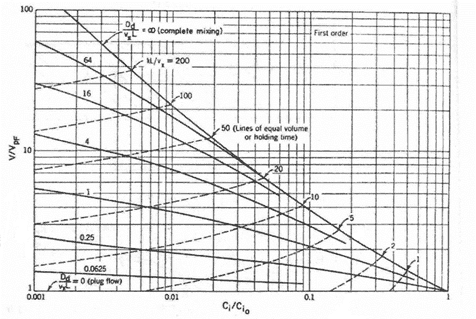
Hi, I was asked by my senior to find out what this graph is and how to use it. No details were given as to where they found it.

I know already that this is used to compare CSTRs and PFRs performance for first order reactions, but I can't deduce what the expressions Dd/(vxL) and kL/vx are for and what the variables represent.

Thanks a lot!
graph.png
 
Engineering news on Phys.org
jedishrfu said:
In general, these kinds of graphs are called nomograms or nomographs:

https://en.wikipedia.org/wiki/Nomogram

They were popular before the advent of personal computers and calculators.

What this particular one is, I'm not sure but I found this website with a similar chart:

http://slideplayer.com/slide/10044354/
Hey, thanks for the response!

Yeah, I'm familiar with nomographs. I just can't determine what the variables in the graph represent.

But thanks a lot for this information! I really appreciate it!
 
This graph is for a tubular chemical reactor in which there is axial mixing/dispersion. The velocity profile is assumed to be flat. The reaction is assumed to be first order decay. The dimensionless group ##D_d/v_xL## is a measure of the axial dispersion, and is the inverse of the Peclet number. The dimensionless group ##kL/v_x## is the ratio of the residence time in the tube to the characteristic decay time for the reaction.

##D_d## = axial dispersion coefficient
##v_x## = axial velocity
L = length of tube
k = first order reaction rate constant
 
  • Like
Likes   Reactions: jedishrfu

Similar threads

  • · Replies 10 ·
Replies
10
Views
40K
  • · Replies 4 ·
Replies
4
Views
3K
  • · Replies 2 ·
Replies
2
Views
10K
Replies
1
Views
3K
  • · Replies 17 ·
Replies
17
Views
10K
Replies
1
Views
5K
  • · Replies 2 ·
Replies
2
Views
4K
  • · Replies 4 ·
Replies
4
Views
32K
Replies
24
Views
8K
  • · Replies 216 ·
8
Replies
216
Views
31K