terence cheng
- 3
- 0
Hi I got stuck at the following circuit problem which involves linear algebra, since I am not a physics major, I don't even have the basics to get started. Please shed some light, really appreciate it! Thanks a lot.
1. Homework Statement
Consider a long chain of resistors wired up like this
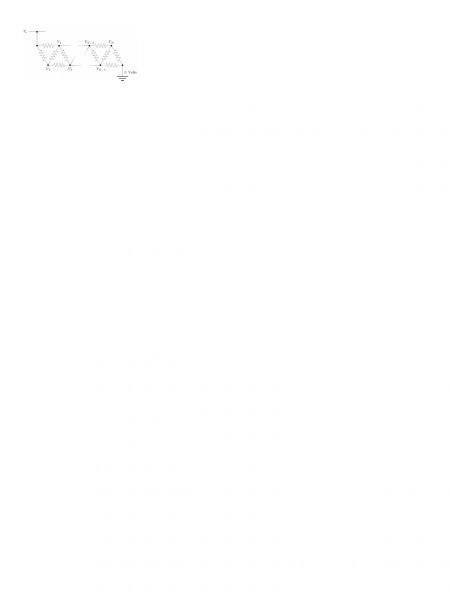
All the resistors have the same resistance R. The power rail at the top is at voltage V+ = 5V. The problem is to find the voltages V1 . . . VN at the internal points in the circuit.
Using Ohm’s law and the Kirchhoff current law, which says that the total net current flow out of (or into) any junction in a circuit must be zero, show that the voltages V1 . . . VN satisfy the equations
3V1 − V2 − V3 = V+,
−V1 + 4V2 − V3 − V4 = V+,
... −Vi−2 − Vi−1 + 4Vi − Vi+1 − Vi+2 = 0, ...
−VN−3 − VN−2 + 4VN−1 − VN = 0,
−VN−2 − VN−1 + 3VN = 0.
Express these equations in vector form Av = w and find the values of the matrix A and the vector w.
I considered when N = 2, it gives me a "Wheatstone bridge" with V1 = V2 = V/2
but then how should i continue? thanks a lot![/B]
1. Homework Statement
Consider a long chain of resistors wired up like this
All the resistors have the same resistance R. The power rail at the top is at voltage V+ = 5V. The problem is to find the voltages V1 . . . VN at the internal points in the circuit.
Using Ohm’s law and the Kirchhoff current law, which says that the total net current flow out of (or into) any junction in a circuit must be zero, show that the voltages V1 . . . VN satisfy the equations
3V1 − V2 − V3 = V+,
−V1 + 4V2 − V3 − V4 = V+,
... −Vi−2 − Vi−1 + 4Vi − Vi+1 − Vi+2 = 0, ...
−VN−3 − VN−2 + 4VN−1 − VN = 0,
−VN−2 − VN−1 + 3VN = 0.
Express these equations in vector form Av = w and find the values of the matrix A and the vector w.
Homework Equations
The Attempt at a Solution
I considered when N = 2, it gives me a "Wheatstone bridge" with V1 = V2 = V/2
but then how should i continue? thanks a lot![/B]