Centripetal force for off-centered cylinders rolling down a curve

Join the discussion
Ask a follow-up here, or get your own question answered by working scientists, mathematicians and engineers — people, not an autocomplete.
Real named experts · corrections over time · the nuance an AI answer skips
12 replies · 2K views
caesium
Messages
1
Reaction score
0
Homework Statement
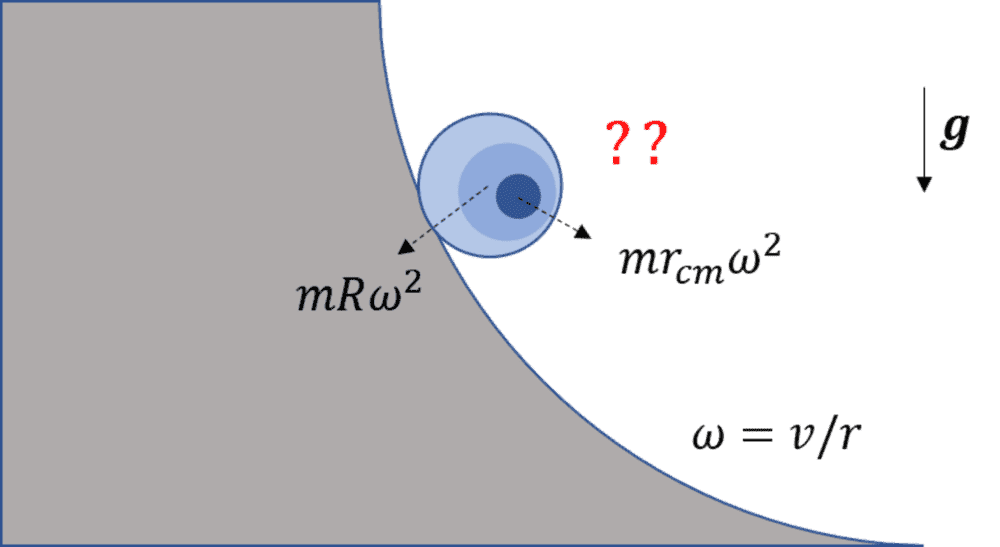
Let's say we have a cylinder of radius r with non-uniform density, resulting in a center of mass shifted away from center of geometry. Let's assume that this center of mass mid-way between center and circumference. So, r_cm = r/2.

Now, let's say this cylinder is rolling down on a curved path of radius R + r. Assume no slip condition.

What is the centripetal force on this cylinder? Does it have "two centripetal forces", from which we find a resultant?
Relevant Equations
There are no equations here.
My initial attempt: Total Centripetal force on the cylinder would be given by $$\textbf{F}_{net} = mR\omega^2 \textbf{e}_1+mr_{cm}\omega^2 \textbf{e}_2$$ where the vectors e_1 and e_2 have magnitude 1 and point radially outwards (and continuously changing as the cylinder rolls down) as marked in the sketch below. Please advise. Thank you.
nmjg667dcd-jtls3.png
 
Physics news on Phys.org
wrobel said:
and to which point of the cylinder is this force applied? and why?
As I wrote, given the velocity and the trajectory, it is better to start with the definition of centripetal acceleration. Multiplying that by the mass gives the centripetal force.
 
haruspex said:
As I wrote, given the velocity and the trajectory, it is better to start with the definition of centripetal acceleration. Multiplying that by the mass gives the centripetal force.
Let us have an inertial coordinate frame. For the cylinder I want to write the angular momentum equation about the origin of this frame. And how should I include the torque of the centripetal force into this equation? If it is force indeed, I must put its torque into the angular momentum equation
 
Last edited:
By definition, centripetal acceleration is that component of linear acceleration which is orthogonal to the velocity.
In principle, we can find the velocity and acceleration of the mass centre. But there is insufficient information here since we do not know the moment of inertia.