Clarification on force on frictional surface constant speed

Click For Summary
SUMMARY

This discussion clarifies the concept of forces acting on objects in the context of maintaining constant speed. It emphasizes that a 10-N force applied to a block on a frictional surface and a 20-N force acting on a 2-kg object moving upward are both forces that maintain motion rather than push or pull against the object. The key takeaway is that forces act on objects directly, and when forces are balanced, the net force is zero, allowing for constant velocity as per Newton's First Law of Motion.

PREREQUISITES
  • Understanding of Newton's Laws of Motion
  • Basic knowledge of force and friction concepts
  • Familiarity with the concept of equilibrium in physics
  • Ability to analyze forces acting on objects in motion
NEXT STEPS
  • Study Newton's First Law of Motion in detail
  • Explore the concept of equilibrium and net forces in physics
  • Learn about frictional forces and their impact on motion
  • Examine real-world applications of forces maintaining constant speed
USEFUL FOR

Students of physics, educators teaching mechanics, and anyone interested in understanding the principles of forces and motion in real-world scenarios.

meloettakawaii
Messages
17
Reaction score
1
for the following 2 examples from:
http://www.physicsclassroom.com/class/energy/Lesson-1/Calculating-the-Amount-of-Work-Done-by-Forces

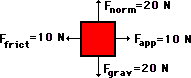
A 10-N force is applied to push a block across a frictional surface at constant speed for a displacement of 5.0 m to the right.
u5l1a15.gif

Would it be more accurate to say that a 10-N force is applied to 'Maintain' (not to push or pull) a block across a frictional surface at constant speed for a displacement of 5.0m to the right?

because the 10-N force is acting upon the frictional force canceling it out in order for the block to continue moving at its original velocity. the 10-N force isn't acting on the block to push it when it is canceled out by friction. the block is in equilibrium with constant velocity.

also

An approximately 2-kg object is pulled upward at constant speed by a 20-N force for a vertical displacement of 5 m.

u5l1a17.gif

Would it be more accurate to say that an approximately 2-kg object is 'moving' upward at a constant speed 'maintained' by a 20-N force for a vertical displacement of 5 m?

because again, the tension force is acting not on the object but on the force of gravity. (any excess would be acting on the object). if a force is canceled out, it can't act on the object!

thanks.
 
  • Like
Likes   Reactions: Pierce610
Physics news on Phys.org
meloettakawaii said:
for the following 2 examples from:
http://www.physicsclassroom.com/class/energy/Lesson-1/Calculating-the-Amount-of-Work-Done-by-Forces

A 10-N force is applied to push a block across a frictional surface at constant speed for a displacement of 5.0 m to the right.
u5l1a15.gif

Would it be more accurate to say that a 10-N force is applied to 'Maintain' (not to push or pull) a block across a frictional surface at constant speed for a displacement of 5.0m to the right?

because the 10-N force is acting upon the frictional force canceling it out in order for the block to continue moving at its original velocity. the 10-N force isn't acting on the block to push it when it is canceled out by friction. the block is in equilibrium with constant velocity.

also

An approximately 2-kg object is pulled upward at constant speed by a 20-N force for a vertical displacement of 5 m.

u5l1a17.gif

Would it be more accurate to say that an approximately 2-kg object is 'moving' upward at a constant speed 'maintained' by a 20-N force for a vertical displacement of 5 m?

because again, the tension force is acting not on the object but on the force of gravity. (any excess would be acting on the object). if a force is canceled out, it can't act on the object!

thanks.
Your thinking is not correct. Forces act on objects, not on other forces. In your second example, the 20 N applied force acts upward on the object, and the 20 N weight force (gravity force) acts downward on the object. Together, the net force acting on the object is 0, so the object, once set in motion with a nudge, moves at constant speed , per Newton 1. Or in your first example, both the applied 10 N force and the opposite 10 N friction force act on the object. If you were the 'object', you would certainly feel an internal force acting on you, even though the net external force acting on you is 0.
 

Similar threads

  • · Replies 7 ·
Replies
7
Views
2K
  • · Replies 20 ·
Replies
20
Views
5K
  • · Replies 24 ·
Replies
24
Views
4K
  • · Replies 1 ·
Replies
1
Views
1K
  • · Replies 7 ·
Replies
7
Views
6K
  • · Replies 20 ·
Replies
20
Views
2K
  • · Replies 8 ·
Replies
8
Views
3K
  • · Replies 52 ·
2
Replies
52
Views
4K
  • · Replies 37 ·
2
Replies
37
Views
5K
  • · Replies 59 ·
2
Replies
59
Views
5K