Complex contour integral proof

Join the discussion
Ask a follow-up here, or get your own question answered by working scientists, mathematicians and engineers — people, not an autocomplete.
Real named experts · corrections over time · the nuance an AI answer skips
1 reply · 1K views
GGGGc
Homework Statement
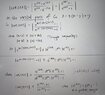
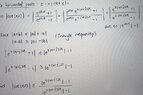
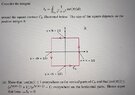
How can I show that from the contour C_N (I’ve attached) that absolute value of cot(pi*z) is less than or equal to 0 everywhere on vertical parts of C_N and less than or equal to a value everywhere on the horizontal parts?
Relevant Equations
|a+b|<=|a|+|b|
|a-b|>=|a|-|b|
I’ve attached my attempt. I’ve tried to use triangle inequality formula to attempt, but it seems I got the value which is larger than 1. Which step am I wrong? Also, it seems I cannot neglect the minus sign in front of e^(N+1/2)*2pi. How can I deal with that?
 

Attachments
  • IMG_0099.jpeg
    IMG_0099.jpeg
    69.2 KB · Views: 122
  • IMG_0100.jpeg
    IMG_0100.jpeg
    61.1 KB · Views: 120
  • IMG_0101.jpeg
    IMG_0101.jpeg
    61.8 KB · Views: 144
Physics news on Phys.org
You got as far as [tex] |\cot \pi z | = \left|\frac{e^{2i\pi z} + 1}{e^{2i\pi z} - 1} \right| = \left|<br /> \frac{e^{2i\pi x}e^{-2\pi y} + 1}{e^{2i\pi x}e^{-2\pi y} - 1}\right|[/tex] Why not go further? Multiply numerator and denominator by the complex conjugate of the denominator. Then you can easily write down the exact value of [itex]|\cot \pi z|^2[/itex], and at that point you can start trying to bound it on each side of the contour.

Or write [tex] |\cot \pi z| = \frac{|e^{2i\pi x} + e^{2\pi y}|}{|e^{2i\pi x} - e^{2\pi y}|}[/tex] and then you can obtain an upper bound by maximizing the distance between [itex]e^{2i\pi x}[/itex] and [itex]-e^{2\pi y}[/itex] in the numerator and mimizing the distance between [itex]e^{2i\pi x}[/itex] and [itex]e^{2\pi y}[/itex] in the denominator.
 
Last edited: