Discussion Overview
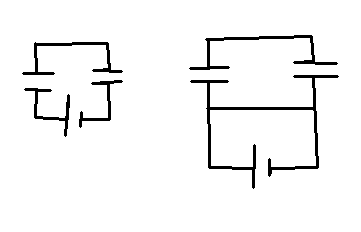
The discussion revolves around the classification of capacitor connections in terms of series and parallel configurations. Participants explore the definitions and implications of these terms in circuit analysis, particularly in the absence of a voltage source.
Discussion Character
- Debate/contested
- Conceptual clarification
- Exploratory
- Mathematical reasoning
Main Points Raised
- Some participants assert that the left configuration of capacitors is in series, while the right configuration is not in parallel but rather short-circuited.
- There is a contention regarding the definition of parallel connections, with some arguing that components can be considered in parallel if they share the same current, regardless of their physical arrangement.
- A participant questions whether components in a closed loop without a battery can be classified as series or parallel, suggesting that the absence of a voltage source complicates this classification.
- Another participant emphasizes that without a voltage or current source, the terms series and parallel lose their meaning, as they depend on how voltages and currents are distributed in the circuit.
- One participant proposes a scenario involving a charged capacitor and other components of lower voltage, questioning if this arrangement could lead to a current flow that equalizes voltages across components.
- There is a suggestion that a rigorous mathematical treatment of circuit analysis, such as Kirchhoff's rules, is necessary to clarify the complexities of the discussion.
- A later reply seeks to clarify a previous statement by providing specific cases involving voltage differences and current flow in a loop without a voltage source.
Areas of Agreement / Disagreement
Participants generally disagree on the definitions and implications of series and parallel connections, particularly in the absence of a voltage source. Multiple competing views remain regarding how to classify connections based on current and voltage distributions.
Contextual Notes
Limitations in the discussion include assumptions about circuit configurations and the lack of clarity regarding how components are connected and how voltages are assigned. The complexity of the scenarios presented leads to potential misunderstandings.