Cooling Time for Air Conditioning

Click For Summary

Discussion Overview

The discussion revolves around the cooling time of air conditioning systems, particularly in relation to airflow rates and their impact on temperature reduction and humidity control. Participants explore the implications of different airflow rates on cooling efficiency and comfort in a controlled environment.

Discussion Character

  • Technical explanation
  • Debate/contested
  • Conceptual clarification

Main Points Raised

  • One participant inquires about calculating cooling time for rooms with different airflow rates, suggesting that higher airflow may reduce heat load faster and thus decrease cooling time.
  • Another participant argues that at lower flow rates, the cooled air must be delivered at a lower temperature to achieve the same BTU/hr, which may affect air mixing but not the overall cooling rate.
  • A third participant emphasizes that cooling for comfort involves both temperature reduction and dehumidification, noting that faster cooling isn't necessarily better and that humidity removal may dominate the cooling time.
  • One participant points out that "cooling time" is not typically a useful metric for sizing HVAC systems, as oversizing can lead to humidity issues and reduced efficiency.
  • Another participant highlights the trade-offs of higher airflow, mentioning potential noise and reduced dehumidification effectiveness, while also noting benefits such as improved air distribution and perceived cooling.
  • A later reply reiterates that "cooling time" is not a primary consideration for HVAC sizing but suggests that the optimal solution may depend on specific applications, particularly for intermittent use.

Areas of Agreement / Disagreement

Participants express differing views on the relevance of cooling time in HVAC system design, with some arguing it is not a useful metric while others suggest it may be important depending on the application. There is no consensus on the best approach to airflow and cooling efficiency.

Contextual Notes

Participants note that the discussion involves assumptions about system sizing, airflow rates, and the balance between cooling and dehumidification, which may vary based on specific conditions and applications.

Who May Find This Useful

This discussion may be useful for HVAC professionals, engineers, and individuals involved in air conditioning system design or evaluation, particularly in understanding the complexities of airflow and cooling efficiency.

Annindita94
Messages
1
Reaction score
0
TL;DR
How to calculate cooling time
Please advise for cooling time on air conditioning.
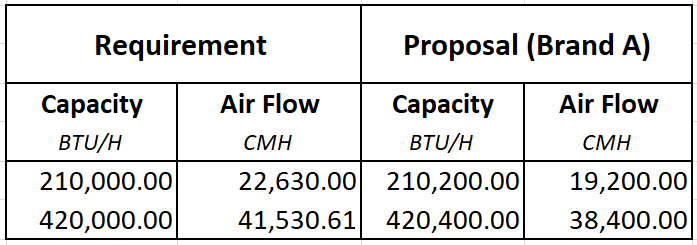
I have a project and customer asked me to make a comparison between their requirement and my proposal. And here's the result.
1598521911690.png


Let's say that we provide a room with same capacity as above, function, delta T, load on that room, but ONLY air flow that is different, how can I know or calculate cooling time for both rooms?

Is it correct that higher air flow will be reduce heat load more faster that lower air flow? If that so, how about the time?
Maybe higher air flow can reduce and reach temp on 1 hour, and lower air flow will reduce temp on 1.5 hours.

Thank you so much for your help before.
 
Science news on Phys.org
At the lower flow rate, in order to deliver the same BTU/hr, the cooled air must be delivered at a lower temperature. This will affect the mixing or homogeneity of the air in the conditioned space not the delivery of "cool". There may be slight variations from this ideal behavior because on dehumidification, but that will be small I believe.
So the issue is how well the air is mixed after delivery to the conditioned space. The rate of delivery of "cool" should be the same regardless, and the times should be the same.
 
  • Like
Likes   Reactions: Annindita94, Lnewqban, russ_watters and 1 other person
I agree with hutchpd. Additionally:

'Cooling' (for human comfort) is a combination of temperature reduction and de-humidification. 'Faster' isn't necessarily 'better' in that situation. An ideally sized system will run 100% of the time on the hottest day of the year (maybe 95% to account for future global warming?). If this system is to be used intermittently, humidity removal will likely dominate the cooling time - the 2 systems aren't significantly different in that regard - the proposed unit will (theoretically) produce a lower humidity result. The differences between 'proposed' and 'required' are very small after allowing for variations due to actual duct/return performance.
 
  • Like
Likes   Reactions: Annindita94 and russ_watters
"Cooling time" is not generally a useful consideration for sizing HVAC systems, and substantially oversizing can cause problems, depending on the system type. Oversizing can cause humidity problems, may reduce efficiency, and of course costs more.
 
  • Like
Likes   Reactions: sophiecentaur and Annindita94
Bad: Higher airflow means more noise, less contact time in coil for dehumidification and additional heat transferring into supplied air from the blower motor.

Good: Higher airflow means longer throw of diffusers, less air stratification and hot pockets formation (if any) and more evaporative effect on human skin (which induces the perception of cooler environment).
 
  • Like
Likes   Reactions: Annindita94 and russ_watters
russ_watters said:
"Cooling time" is not generally a useful consideration for sizing HVAC systems, and substantially oversizing can cause problems, depending on the system type. Oversizing can cause humidity problems, may reduce efficiency, and of course costs more.
That all makes sense but doesn't the optimal solution depend on the application. If AC is not used continuously and, as with heating systems, they are often used when no one needs them, then reaching a desired temperature quickly can be a good thing.

From what I have seen, the philosophy of AC seems to lag behind that of Heating. People are only too aware of the need for insulation in cold climates but not so much in hot. I think that point should be made in a thread like this.
 

Similar threads

  • · Replies 12 ·
Replies
12
Views
1K
  • · Replies 21 ·
Replies
21
Views
3K
  • · Replies 11 ·
Replies
11
Views
3K
  • · Replies 1 ·
Replies
1
Views
2K
  • · Replies 10 ·
Replies
10
Views
3K
  • · Replies 3 ·
Replies
3
Views
2K
  • · Replies 16 ·
Replies
16
Views
3K
  • · Replies 5 ·
Replies
5
Views
3K
  • · Replies 4 ·
Replies
4
Views
3K
  • · Replies 11 ·
Replies
11
Views
4K