Coulomb's law and electric fields

Click For Summary
SUMMARY

This discussion focuses on solving electrostatics problems using Coulomb's law, specifically calculating the net electrostatic force on charges arranged in an equilateral triangle. The formula used is Fe=[kq1q2]/r², with k=8.99x10⁹ N m²/C² and q=2.50x10⁻⁶ C. The participants clarify the importance of calculating the x and y components of forces acting on each charge and emphasize that the forces between charges are equal and opposite due to Newton's third law. The final resultant force is determined to be 4.33 N/C directed upward.

PREREQUISITES
  • Coulomb's Law for electrostatic forces
  • Vector decomposition into x and y components
  • Basic trigonometry (sine and cosine functions)
  • Understanding of action-reaction pairs in physics
NEXT STEPS
  • Study vector addition and resultant forces in two dimensions
  • Learn about electric field concepts and calculations
  • Explore advanced applications of Coulomb's law in different charge configurations
  • Investigate the role of geometry in electrostatics problems
USEFUL FOR

Students studying electrostatics, physics educators, and anyone seeking to understand the principles of electric forces and fields in a geometrical context.

BobRoss
Messages
34
Reaction score
0
I'm having a bunch of trouble with an electrostatics questions as well as an electric fields question. I'll start with the electrostatics problem.

Homework Statement


I am given the following equilateral triangle and asked to calculate the net electrostatic force on each charge.
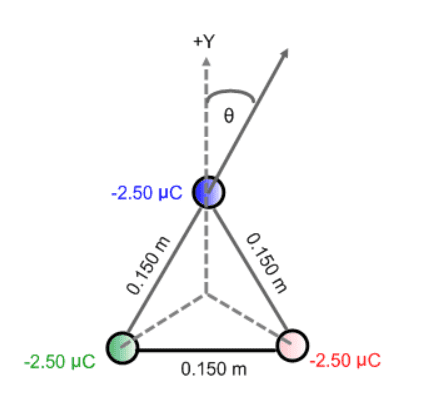
Q087F.png


Homework Equations


Fe=[kq1q2]/r2

The Attempt at a Solution


So since the charges are all equal and the distances between them are all equal, the force of the blue on red is equal to the force of red on green which is equal to the green on the blue. So I find:

Fe=[kq1q2]/r2
Fe=[(8.99x10⁹)(2.50x10⁻⁶C)(2.50x10⁻⁶C)]/(0.150 m)2
Fe=2.4972 N/C

I don't really know how to proceed past this. I think I need to break things down into x and y components but I don't know how I would draw those here. I know that since all of the charges are negative they will be repelling each other but how do I figure out the magnitude and direction of that repulsion?
 
Physics news on Phys.org
Consider just the red and blue charges. They sit in the xy-plane so the force on the blue charge will have no z-component. Make a drawing of just the two charges in the xy plane, and you should be able to calculate the components of the force. Do the same thing for the green and blue pair. This time they will lie in the yz plane, so you'll have no x-component and non-vanishing y and z components. The total force will be the sum of the two individual forces.

You'll have to do some geometrical reasoning to figure out where in the axes each charge sits.
 
Okay so here is what I have:

FB on R=2.4972 N/C

x1=sin30°(2.4972 N/C)
x1=1.2486 N/C

y1=cos30°(2.4972 N/C)
y1=-2.162638638 N/C

FB on G=2.4972 N/C

x2=sin30°(2.4972 N/C)
x2=-1.2486 N/C

y2=cos30°(2.4972 N/C)
y2=-2.162638638 N/C

Is that correct so far? The next part confuses me where you say "This time they will lie in the yz plane, so you'll have no x-component and non-vanishing y and z components. The total force will be the sum of the two individual forces."

I've never had to do any questions that used the z plane so I'm not sure what this means.
 
OK, I interpreted the dotted lines as the x, y, and z axes; otherwise, I'm not sure why they would be drawn in that way. Is that your drawing or the book's?

If it's just a two-dimensional problem, then your calculations look okay. What you want to do, however, is find the two force acting on one charge and sum those. Right now, you're finding the components of the force acting on two different charges due to one charge.
 
I pulled the picture straight from the assignment. There hasn't been any three dimensional examples in the text yet so I don't think they intended this one to be. So I've now done:

x1+x2
=1.2486 N/C + (-1.2486 N/C)
=0

y1+y2
=-2.162638638 N/C + (-2.462638638 N/C)
=-4.325277276 N/C

So then the resultant force will be 4.33 N/C downward? But if they are all negative charges shouldn't they be repelling each other and the force would be upward? Or do I have the direction completely wrong?
 
Read the last paragraph of my previous response. I probably edited after you read it initially.
 
Sorry, I'm not quite sure what you mean by
find the two force acting on one charge and sum those. Right now, you're finding the components of the force acting on two different charges due to one charge.
 
You're finding the components of the force the blue charge exerts on the red and green charges, i.e, "B on R" and "B on G". (If that's not what you intended, your math is wrong too.) Those forces act on different bodies, so it doesn't make sense to sum them.

What you need is the force that R exerts on B and the force that G exerts on B. Those two forces both act on B, so you can sum them.
 
Didn't I find that in my first post when I did:

Fe=[kq1q2]/r2
Fe=[(8.99x10⁹)(2.50x10⁻⁶C)(2.50x10⁻⁶C)]/(0.150 m)2
Fe=2.4972 N/C

Since they all have the same charge and are the same distance from each other, aren't they all exerting a force of 2.4972 N/C on each other? And in my third post I found the components of blue on red and blue on green. Isn't this the same as finding the components for red on blue and green on blue since they have the same charge?
 
  • #10
Sort of, but not for the reason you give, i.e., that they have the same charge. The forces a pair of charges exert on each other are an action-reaction pair, so by finding the components of one, you effectively find the components other other. This is true regardless of what the charges are. You have to remember that the action-reaction pair of forces are equal and opposite to get the directions right.
 
  • #11
I see. So then what exactly do I need to calculate here to find the total net electrostatic force on each charge? The x and y components of green on blue and the x and y components of red on blue, and then add those together and find the resultant?
 
  • #12
Yup.
 
  • #13
I think I'm confused as to how to draw the vector diagram for this so I can find the components with proper directions. Here is a very quick MSPaint of how I've done it:

http://i.imgur.com/sHSJt.png

That isn't right though is it?
 
  • #14
Looks fine so far. Why do you think there's a problem?
 
  • #15
Oh good. I wasn't sure because that is how I got the components in post #3 and I thought I was on the wrong track. So again:

FR on B components

x component
x1=sin30°(2.4972 N/C)
x1=1.2486 N/C

y component
y1=cos30°(2.4972 N/C)
y1=-2.162638638 N/C

FG on B components

x component
x2=sin30°(2.4972 N/C)
x2=-1.2486 N/C

y component
y2=cos30°(2.4972 N/C)
y2=-2.162638638 N/C

Then I add the x components and the y components.
x1 +x2=1.2486 N/C + (-1.2486 N/C)
=0

y1 +y2=-2.162638638 N/C + (-2.462638638 N/C)
=-4.325277276 N/C

I'm not sure about this next part.
resultant=√x2+y2
R=√(0)2+ (-4.325277276 N/C)
R=4.325277276

So the answer is 4.33 N/C ? In what direction?
 
  • #16
All of the components you calculated have the wrong sign. The force of R on B points upward and to the left, so the y-component should be positive and the x-component, negative, etc.

The resultant is the vector sum of the two forces. In this case, you'll get
\vec{R} = 4.33\hat{y}~\mathrm{N/C}and its magnitude, as you found, is \|\vec{R}\|=4.33~\mathrm{N/C}.
 
  • #17
Okay I see. And the force of green on blue will point upward and to the right. So the resultant will be in the positive y direction? Or could I call it 90°?
 
  • #18
Yes, in the +y direction or 90 degrees. As long as you're clear about what you mean, it should be okay.
 
  • #19
Okay, thanks for all of your help. I think I understand it now.
 

Similar threads

  • · Replies 22 ·
Replies
22
Views
4K
  • · Replies 3 ·
Replies
3
Views
1K
Replies
17
Views
3K
  • · Replies 5 ·
Replies
5
Views
1K
  • · Replies 12 ·
Replies
12
Views
3K
  • · Replies 2 ·
Replies
2
Views
3K
Replies
10
Views
8K
  • · Replies 2 ·
Replies
2
Views
4K
Replies
11
Views
1K
  • · Replies 12 ·
Replies
12
Views
1K