How Do You Calculate the Counterweight Needed to Balance an L-Shaped Bar?

  • Context: Undergrad 
  • Thread starter Thread starter Alistair Vowles
  • Start date Start date
  • Tags Tags
    Calculation
Click For Summary
SUMMARY

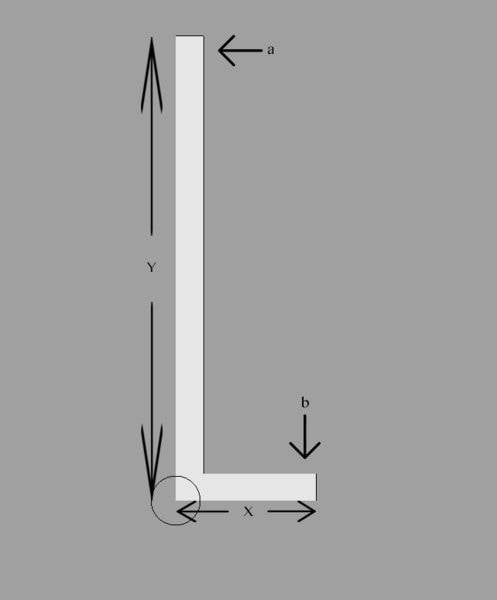
The calculation for the counterweight needed to balance an L-shaped bar involves understanding the forces acting on the system. The formula derived from the discussion is b = ay/x, where 'b' is the counterweight force, 'a' is the applied force (such as wind), 'y' is the length of the vertical arm, and 'x' is the length of the horizontal arm. It is crucial to account for safety factors, especially in engineering applications, where the counterweight should be at least double or quadruple the calculated value to accommodate gusty winds and velocity gradients.

PREREQUISITES
  • Understanding of basic physics principles, specifically torque and equilibrium.
  • Familiarity with the concepts of force and lever arms.
  • Knowledge of safety factors in engineering design.
  • Ability to perform algebraic manipulations to rearrange formulas.
NEXT STEPS
  • Research the principles of torque and equilibrium in static systems.
  • Learn about safety factors in structural engineering, particularly for wind loads.
  • Explore the effects of velocity gradients on forces acting on tall structures.
  • Investigate adjustable counterweight systems for dynamic load applications.
USEFUL FOR

Engineers, physics students, and anyone involved in designing structures that must withstand variable forces, such as wind resistance on L-shaped bars or similar frameworks.

Alistair Vowles
Messages
2
Reaction score
0
I hope this will be an easy one to answer that I could just use a little help with.

I have an L shaped bar where 'X' is on a flat surface. The pivot point is the circle.

Can someone help me with a formula to calculate the force needed at point 'b' , given a certain force applied at point 'a' , to not allow the bar to pivot.

Force 'a' will be a varying force (wind) so I want to make sure I have enough counterweight for force 'b' to allow for this variable.

The fig is not to scale and I plan to have the length of 'X' to be adjustable to decrease the force needed at point 'b' .

I hope this makes sense and thank you for the help !
L bar.jpg
 

Attachments

  • L bar.jpg
    L bar.jpg
    7.1 KB · Views: 1,293
Physics news on Phys.org
b=a*y/x
 
If you want an explanation...

If you don't want it to move/accelerate then the net torque must be zero.

Let's define counter clockwise as positive. Then...

ay - bx = 0

Rearrange to give...

ay = bx
Then
b = ay/x
 
Thankyou very much. This is perfect and exactly what I needed.
 
Um, force being wind resistance is spread all the way along y but can be taken as applying at the average point (y/2) (roughly) to simplify the calculation.

So, b = ay/x/2Be aware though that if the base is on the ground or a surface, there is a velocity gradient increasing with distance from the surface which is the reason for (roughly). If the structure is very tall, this could be a significant consideration. If it's an engineering question, you will need at least double, probably quadruple (according to regulation) b to provide a safety factor. This is especially important for aero forces as they are proportional to velocity squared and wind is gusty.

You may already have taken all this into account, it's not stated.
 

Similar threads

  • · Replies 14 ·
Replies
14
Views
2K
  • · Replies 2 ·
Replies
2
Views
11K
  • · Replies 12 ·
Replies
12
Views
2K
  • · Replies 3 ·
Replies
3
Views
1K
  • · Replies 11 ·
Replies
11
Views
2K
  • · Replies 45 ·
2
Replies
45
Views
5K
  • · Replies 2 ·
Replies
2
Views
2K
  • · Replies 18 ·
Replies
18
Views
3K
  • · Replies 6 ·
Replies
6
Views
1K
  • · Replies 4 ·
Replies
4
Views
2K