Discussion Overview
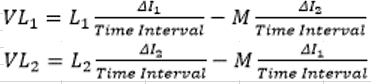
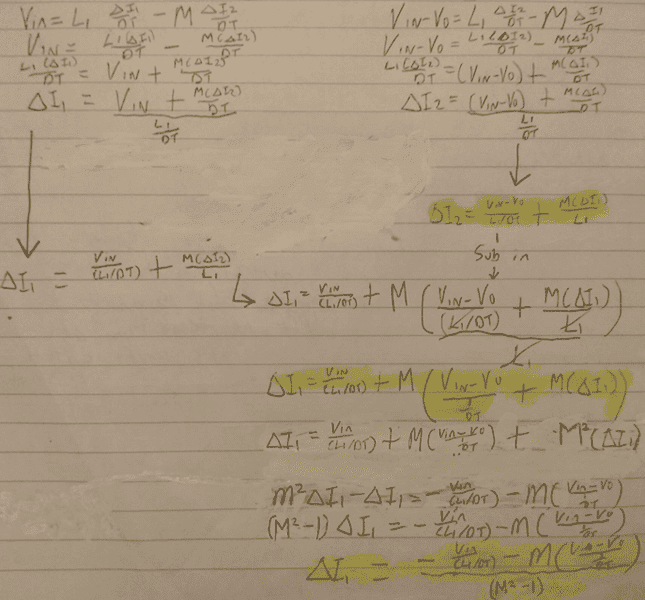
The discussion revolves around calculating the ripple current in a coupled inductor boost converter, specifically focusing on the variables ∆i1 and ∆i2. Participants are exploring the derivation of formulas for these ripple currents, considering the effects of voltage levels and time intervals in the converter's operation. The context includes design considerations for a boost converter as part of an assignment.
Discussion Character
- Exploratory
- Technical explanation
- Homework-related
Main Points Raised
- One participant seeks assistance in deriving formulas for ripple currents ∆i1 and ∆i2, expressing uncertainty about their correctness.
- Another participant requests a schematic and time-domain waveforms to better understand the problem.
- A participant mentions the need to derive expressions for ripple currents at specific time points (DT, T/2, DT+T/2, and T).
- There is a discussion about the topology of the converter, with one participant clarifying that it is not a flyback converter.
- One participant expresses curiosity about the use of coupled inductors and requests more information about the topology.
- Another participant references a document that discusses a different topology involving coupled inductors, noting its potential for achieving a higher boost ratio.
- There is uncertainty expressed regarding how the coupled inductor aspect contributes to ripple current management.
- A participant offers to run a simulation to explore the topology further, indicating a willingness to assist despite time constraints.
Areas of Agreement / Disagreement
Participants have not reached a consensus on the derivation of the ripple current formulas or the implications of using coupled inductors in this context. Multiple viewpoints and uncertainties remain regarding the topology and its effects.
Contextual Notes
Participants have not provided complete assumptions or definitions related to the ripple current calculations, and there are unresolved questions about the specific topology being discussed.