Undergrad Understanding the Definition of Cp and its Relationship to Cv: Explained

Click For Summary
SUMMARY

This discussion focuses on the derivation of the relationship between heat capacities, Cp and Cv, using fundamental thermodynamic principles. The participants clarify that Cv is defined as the partial derivative of internal energy with respect to temperature at constant volume, while Cp is defined using enthalpy. The relationship is established through the use of the first and second laws of thermodynamics, leading to the equation C_p - C_v = T(∂T p)_V(∂T V)_p. This highlights the importance of understanding the conditions under which these derivatives are taken.

PREREQUISITES
  • Understanding of thermodynamic laws, specifically the first and second laws.
  • Familiarity with the concepts of internal energy and enthalpy.
  • Knowledge of partial derivatives in thermodynamics.
  • Basic understanding of Gibbs free energy and its implications.
NEXT STEPS
  • Study the derivation of the first and second laws of thermodynamics in detail.
  • Learn about the Legendre transform and its application in thermodynamics.
  • Explore the implications of Gibbs free energy in thermodynamic processes.
  • Investigate the significance of partial derivatives in thermodynamic equations.
USEFUL FOR

Students and professionals in thermodynamics, physicists, and engineers seeking to deepen their understanding of heat capacities and their interrelation in thermodynamic systems.

11thHeaven
Messages
48
Reaction score
0
Hi all, I'm working through a derivation of the general relationship between Cp and Cv and there's one point which is confusing me.

I understand that
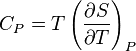
3c0a0cc895e45267dbaa601d4c29318d.png


and

ea5771ed8bd497e2dd089cfcf3e502bf.png


and that this implies the following:

32b7fb39a707cb5f2360d5c6d8b3d76e.png


but isn't this equal to 0? Shouldn't the two partial derivatives on the right hand side, by the cyclic rule, multiply to -(∂S/∂T)V?

I know that I'm missing something here but I can't work out what it is.

Help appreciated!
 
Physics news on Phys.org
What you hold constant makes a difference.
 
Hm, I'm not sure what you want to derive, but let's start defining the heat capacities and see, where this leads to.

Start from energy conservation employing the 1st and 2nd fundamental laws
$$\mathrm{d} U=\mathrm{d} Q-p \mathrm{d} V=T \mathrm{d} S-p \mathrm{d} V.$$
This implies
$$C_V:=\left (\frac{\partial Q}{\partial T} \right)_{V}=\left (\frac{\partial U}{\partial T} \right)_V=T \left (\frac{\partial S}{\partial T} \right)_V.$$
For ##C_p## we need the enthalpy, given by the Legendre transform
$$H=U+p V ; \Rightarrow \; \mathrm{d} H=T \mathrm{d} S+V \mathrm{d} p,$$
and thus
$$C_p=\left (\frac{\partial H}{\partial T} \right )_p=T \left (\frac{\partial S}{\partial T} \right)_p.$$
Now we can use
$$\frac{C_p}{T}=\left (\frac{\partial S}{\partial T} \right)_p = \det \left (\frac{\partial(S,p)}{\partial(T,p)} \right) = \det \left (\frac{\partial(S,V)}{\partial(T,V)} \right) \det \left (\frac{\partial(T,V)}{\partial(T,p)} \right) = \left [ (\partial_T S)_V (\partial_V p)_T-(\partial_V S)_T (\partial_T p)_V \right ] (\partial_p V)_T = \frac{C_V}{T} - (\partial_p S)_T (\partial_T p)_V.$$
Now we can use the Gibb's free energy
$$G=U-TS+pV \; \Rightarrow \; \mathrm{d} G=-S \mathrm{d} T+V \mathrm{d} p,$$
to derive
$$\partial_p \partial_T G=-(\partial_p S)_T=\partial_T \partial_p G=(\partial_T V)_p$$
to get
$$C_p-C_v=T (\partial_T p)_V (\partial_T V)_p.$$
 
In sci-fi when an author is talking about space travellers or describing the movement of galaxies they will say something like “movement in space only means anything in relation to another object”. Examples of this would be, a space ship moving away from earth at 100 km/s, or 2 galaxies moving towards each other at one light year per century. I think it would make it easier to describe movement in space if we had three axis that we all agree on and we used 0 km/s relative to the speed of...

Similar threads

  • · Replies 6 ·
Replies
6
Views
2K
  • · Replies 1 ·
Replies
1
Views
2K
Replies
2
Views
3K
Replies
5
Views
9K
Replies
12
Views
2K
  • · Replies 22 ·
Replies
22
Views
3K
  • · Replies 3 ·
Replies
3
Views
2K
  • · Replies 1 ·
Replies
1
Views
2K
  • · Replies 1 ·
Replies
1
Views
2K
  • · Replies 12 ·
Replies
12
Views
3K

