Creating on/off capability using same normally opened P.B

  • Thread starter Thread starter DjMadness
  • Start date Start date
Click For Summary

Discussion Overview

The discussion revolves around designing a control circuit using relays and a single normally open push-button switch to achieve a toggle function for a lamp. Participants explore the feasibility of implementing a self-latching mechanism that allows the lamp to turn on and off with repeated presses of the same button, while adhering to certain logic laws in control systems.

Discussion Character

  • Exploratory
  • Technical explanation
  • Debate/contested

Main Points Raised

  • The original poster (OP) describes a desired function for a control circuit that uses a single push-button to toggle a lamp on and off, raising concerns about the limitations of using a single input for multiple outputs.
  • Some participants suggest that the OP's circuit diagram is difficult to understand due to incorrect labeling of components, specifically confusing relay contacts with capacitors.
  • One participant notes that the OP is using industrial control conventions for schematic symbols, which differ from standard electronic representations.
  • Another participant introduces the concept of a T (toggle) flip-flop from digital electronics as a potential solution, although they express uncertainty about implementing it with relays.
  • There is a disagreement regarding the interpretation of schematic symbols, with some participants asserting that the OP's symbols do not align with standard practices in electronics.

Areas of Agreement / Disagreement

Participants do not reach a consensus on the clarity of the OP's circuit diagram or the appropriateness of the symbols used. There are competing views on the interpretation of the schematic and the feasibility of the proposed toggle function using a single push-button.

Contextual Notes

Limitations include potential misunderstandings due to differing conventions in schematic representation and unresolved technical details regarding the implementation of the toggle function with relays.

DjMadness
Messages
35
Reaction score
0
Hello,

Excited to design, using relays, corresponding switches and timers, a control diagram that has a function as follows:

When user presses the push-button, a lamp turns on and remains that way (self-latched). After a small time delay when the user re-presses the same push-button the light goes off and so on repeatedly...

Regularly in control diagrams, there are several logic laws that user must obey in order to have an efficient system functioning. In this case, a single input CANNOT create different outputs.[1]

I know that there are self-latching relays, and one can program a chip to make a counter and do this small function, but the intention is to exercise drawing industrial control montages.
Before posting problems related to [1], I have used a single push button with an N.O switch and another N.O auxiliary one that both function under the same order of button switch. The circuit is as follow and is 100% functioning:
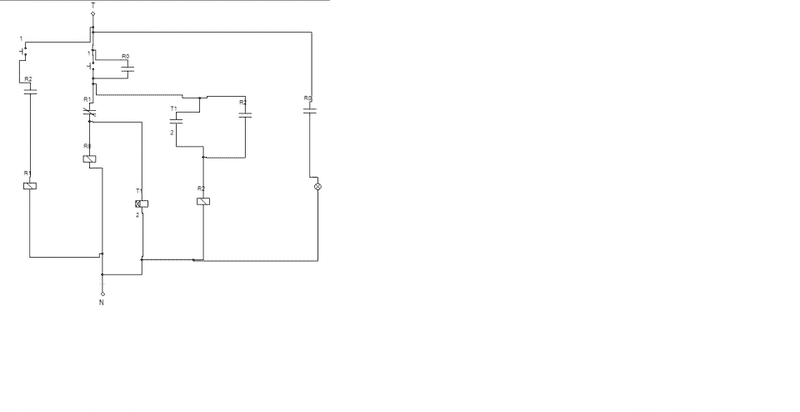
pb.png


I've labeled the push buttons as 1 referring to two N.O switched for the same P.B

The purpose of creating this thread, is to hear comments, and opinions whether if the above circuit is achievable using a single N.O switch from the push button instead of two, without disregarding law referred as [1].

I have such circuits but all of them failed, due to the fact that the same N.O switch even if interfaced to timers, cannot make more than one decision that is passing current or not.

Since all were failed, no need to upload them.

Awaiting your comments.
Dj
 
Engineering news on Phys.org
DjMadness said:
I've labeled the push buttons as 1 referring to two N.O switched for the same P.B

your circuit is difficult to comprehend, and is not helped by the fact that all your resistor labels are capacitors

how about redrawing the circuit and this time use the correct symbols and labels so we can see more correctly what your circuit is trying to show

also show connections for power supply, label them + and - and indicate the voltage usedDave
 
  • Like
Likes   Reactions: berkeman
The OP is using the Industrial Control, Electrician, convention for the schematic

What we Electronic folks would consider a capacitor, are Normally Open relay contacts in their language, with the "R" designation here denoting a "Relay". You will notice that R1 contact has a slash thru it to denote Normally Closed contacts. The rectangles with a slash thru them are relay coils.

On the extreme right, the Circle with an inscribed X is a lamp (slightly non-standard representation).

On the left, top, the symbol labeled "1" with a sideways "T" is a Normally Open Push Button.

(edit) p.s. A search for Ladder Logic or Industrial Control may find some standards for these symbols.
 
  • Like
Likes   Reactions: berkeman, DjMadness and davenn
Tom.G said:
The OP is using the Industrial Control, Electrician, convention for the schematic

ahhh
Im not an Industrial Control, Electrician. I'm an electronics tech ... that's not how we techs draw relay contacts it's how we draw non polarised caps :wink:Dave
 
  • Like
Likes   Reactions: berkeman
davenn said:
ahhh
Im not an Industrial Control, Electrician. I'm an electronics tech ... that's not how we techs draw relay contacts it's how we draw non polarised caps :wink:Dave
Dear Dave,

No matter what professional you are, if you read right the description I've wrote before uploading the image you can comprehend what I was talking about. Symbols are after all tools to ameliorate comprehension. A non polarized capacitor, generally a ceramic capacitor in electronic circuit can be drawn like N.Os are drawn in my circuit, but if so, the circuit makes no sense, bunch of resistors and capacitors in series/parallel would be flu.
 
DjMadness said:
Dear Dave,

No matter what professional you are, if you read right the description I've wrote before uploading the image you can comprehend what I was talking about. Symbols are after all tools to ameliorate comprehension. A non polarized capacitor, generally a ceramic capacitor in electronic circuit can be drawn like N.Os are drawn in my circuit, but if so, the circuit makes no sense, bunch of resistors and capacitors in series/parallel would be flu.
I have no idea what you just posted. Thread locked until you can send me a message explaining yourself.
 

Similar threads

  • · Replies 5 ·
Replies
5
Views
865
  • · Replies 7 ·
Replies
7
Views
1K
  • · Replies 2 ·
Replies
2
Views
2K
  • · Replies 31 ·
2
Replies
31
Views
5K
Replies
2
Views
2K
Replies
37
Views
7K
  • · Replies 4 ·
Replies
4
Views
2K
  • · Replies 8 ·
Replies
8
Views
3K
  • · Replies 2 ·
Replies
2
Views
2K
  • · Replies 9 ·
Replies
9
Views
2K