Design a converging/diverging nozzle

Click For Summary
SUMMARY

The discussion focuses on the design of a converging-diverging (CD) nozzle intended to produce 20mN thrust under atmospheric conditions with a reservoir pressure of 1.4 bar and ambient pressure of 1 bar. Key insights reveal that the pressure ratio is insufficient to choke the flow, rendering the use of a CD nozzle inappropriate for achieving supersonic exhaust. Additionally, the use of isentropic relations for calculating velocity is flawed due to incorrect temperature assumptions, necessitating the use of local temperature for accurate Mach number calculations. The mass flow and throat area calculations also incorrectly assume choked flow, requiring a reevaluation of the design parameters.

PREREQUISITES
  • Understanding of converging-diverging nozzle design principles
  • Knowledge of isentropic flow relations and their applications
  • Familiarity with pressure ratios and their impact on flow choking
  • Basic thermodynamics, particularly regarding temperature and Mach number calculations
NEXT STEPS
  • Research the conditions necessary for flow choking in nozzles
  • Study the effects of pressure ratios on nozzle performance
  • Learn about isentropic relations and their correct application in fluid dynamics
  • Explore the design and performance characteristics of converging-only nozzles
USEFUL FOR

Aerospace engineers, mechanical engineers, and students involved in fluid dynamics or propulsion system design will benefit from this discussion.

aerograce
Messages
63
Reaction score
1
I am intending to design a CD nozzle that produces 20mN thrust under atmospheric conditions.
The reservoir pressure will be 1.4 bar, and the ambient pressure will be 1 bar. The other variables are adjustable. This will in the end be sent out for fabrication.My process is as follow,
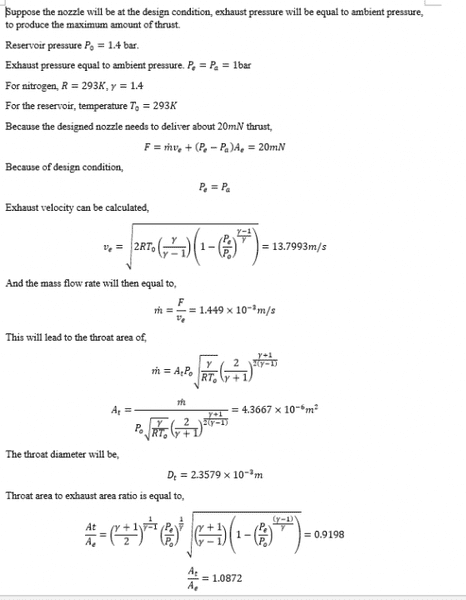
upload_2016-11-3_21-56-55.png

May I know if this procedure is reasonable? The throat area to exhaust area ratio looks dubious though.
 
Engineering news on Phys.org
This does not look correct to me. Your first step should be checking to see if your pressure ratio is even large enough to choke the flow. It isn't. Therefore, there is no reason to use a converging-diverging nozzle since you won't actually be going supersonic with your exhaust anyway.

Next, you appear to be using isentropic relations between the pressure ratio and the Mach number to calculate the velocity, which may be okay here, but you are using the wrong temperature. You have to use the temperature at the location at which you are caclulating the velocity if you want to convert the Mach number this way. Using the temperature in the reservoir will just give you the Mach number at the exit relative to the speed of sound in a completely different location, which is clearly meaningless.

Last, your mass flow/throat area calculation assumes the flow is choked, which, as I mentioned before, it is not.
 
As boneh3ad said, your pressure ratio is too low to choke the flow, so you'll need to rethink your design in some way (either increase your pressure ratio, or switch to a converging-only nozzle)
 

Similar threads

Replies
3
Views
1K
  • · Replies 36 ·
2
Replies
36
Views
6K
  • · Replies 90 ·
4
Replies
90
Views
9K
  • · Replies 26 ·
Replies
26
Views
3K
  • · Replies 8 ·
Replies
8
Views
6K
  • · Replies 2 ·
Replies
2
Views
12K
  • · Replies 2 ·
Replies
2
Views
1K
  • · Replies 45 ·
2
Replies
45
Views
6K
  • · Replies 2 ·
Replies
2
Views
3K
  • · Replies 5 ·
Replies
5
Views
2K