Design AC Coupled Amplifier: 12V Supply, 30mV Input, 24dB Gain

Click For Summary
SUMMARY

The discussion focuses on designing an AC coupled amplifier powered by a 12V supply, targeting an input voltage of less than 30mV and a gain of 24dB. The circuit consists of two transistor stages, with the first stage amplifying the signal for the second. Key requirements include an input impedance greater than 1.2 million ohms and an output impedance less than 180 ohms. Participants suggest that achieving such high input impedance with the desired gain necessitates additional components and negative feedback, and recommend considering operational amplifiers for better performance.

PREREQUISITES
  • Understanding of transistor amplifier design
  • Knowledge of gain calculations in dB
  • Familiarity with input and output impedance concepts
  • Experience with negative feedback in amplifier circuits
NEXT STEPS
  • Research resistor value calculations for transistor amplifiers
  • Learn about operational amplifier configurations for high input impedance
  • Study the effects of negative feedback on amplifier performance
  • Explore FETs as input devices in amplifier designs
USEFUL FOR

Electronics engineers, audio engineers, and hobbyists involved in amplifier design and optimization will benefit from this discussion.

Ashyboo
Messages
1
Reaction score
0
Hey guys.

I want to design an AC coupled amplifier, to be powered by a 12V supply. The input voltage should be less than 30mV and the gain of the circuit should be 24dB. The circuit has 2 stages with the gain of the 1st transistor amplifier being used to amplify the signal going into the 2nd transistor.

I already know how the circuit should look but I need to ensure that the input impedance is greater than 1.2million ohms and the output impedance less than 180ohms.

From the circuit below, does anyone know what resistor values I should use for this criteria?
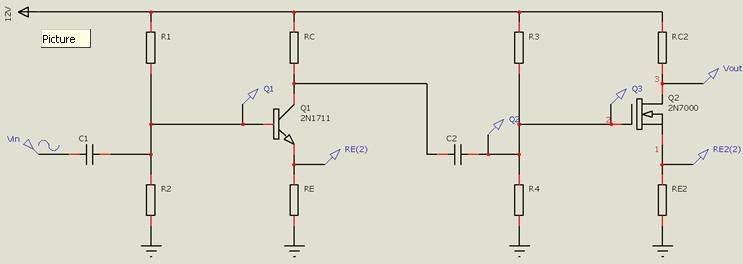
amp.jpg


Thanx in advance.
 
Engineering news on Phys.org
You are barking up the wrong tree. You will need a lot more components with a bunch of negative feedback to achieve an input impedance that high with that much gain. That would be my approach anyway. What is wrong with using several op-amps?
 
Agreed. It is pretty hard with discrete analog devices. The gain of transistors can vary by as much as 3 to 1, so you end up making it and adjusting it just to make it work.

The "gain" specified in dB is actually a fractional voltage gain due to the different input and output impedances. If someone wants a voltage gain of 16 they should just say so, not try to dress it up with dB figures.

The gain of the first stage is approximately RC / RE and the input impedance is approximately hfe * RE. But the bias resistors appear in parallel with the inputs and the loads for both stages.

Both of these calculations force very large values of RC and RE so the collector current becomes very small and the base current gets microscopic.

If I had to use those components, it might be worth using the FET as the input device.
 

Similar threads

  • · Replies 3 ·
Replies
3
Views
4K
  • · Replies 5 ·
Replies
5
Views
3K
Replies
14
Views
2K
  • · Replies 5 ·
Replies
5
Views
5K
  • · Replies 13 ·
Replies
13
Views
4K
  • · Replies 21 ·
Replies
21
Views
3K
Replies
3
Views
6K
  • · Replies 6 ·
Replies
6
Views
3K
  • · Replies 7 ·
Replies
7
Views
2K
  • · Replies 41 ·
2
Replies
41
Views
6K