KennyRodgers
- 8
- 1
Summary:: figuring the 'realmax' and 'realmin' from a hypothetical distribution of bits
I am attempting to figure the 'realmax' and the 'realmin' from this hypothetical distribution of bits.
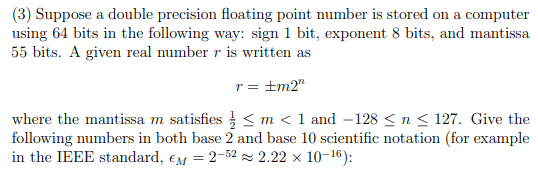
I know the largest the mantissa can be is (1-eps), and the smallest is just 1/2. Also I note the restriction on m. I want to convert m so it is in the range from [1,2]. So m' = m*2.
However, I am not sure if I need to recalculate the exponent range to accommodate 3 bits for 0, infinity and NAN. Thus I keep thinking the exponent range should be 256 - 2 = 254 -> 254/2 = 127 -> -126 < n < 127 where -127 is reserved for 0. Also, 256 and 255 are reserved for infinity and Nan, thus we have 256 - 2
I think realmax = (1-eps)*2*2^(127) = (1-eps)*2^(128)
and realmin = (0.5)*2*2^(-126) = 2^(-126)
Thoughts?
I am attempting to figure the 'realmax' and the 'realmin' from this hypothetical distribution of bits.
I know the largest the mantissa can be is (1-eps), and the smallest is just 1/2. Also I note the restriction on m. I want to convert m so it is in the range from [1,2]. So m' = m*2.
However, I am not sure if I need to recalculate the exponent range to accommodate 3 bits for 0, infinity and NAN. Thus I keep thinking the exponent range should be 256 - 2 = 254 -> 254/2 = 127 -> -126 < n < 127 where -127 is reserved for 0. Also, 256 and 255 are reserved for infinity and Nan, thus we have 256 - 2
I think realmax = (1-eps)*2*2^(127) = (1-eps)*2^(128)
and realmin = (0.5)*2*2^(-126) = 2^(-126)
Thoughts?