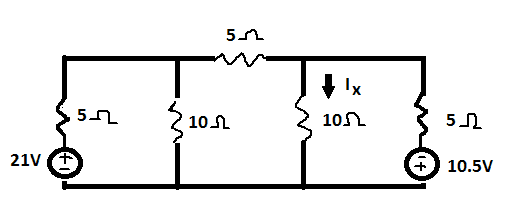
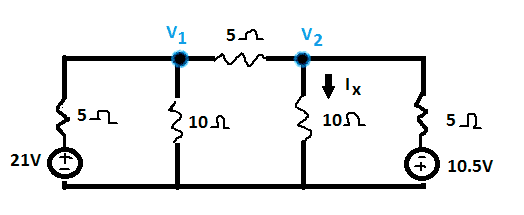
Did I do the nodal analysis right?

Click For Summary

Discussion Overview

The discussion revolves around the application of nodal and mesh analysis methods to solve for the current I(x) in a circuit. Participants share their attempts at solving the problem, including equations derived from both methods, and seek confirmation and guidance on their approaches.

Discussion Character

  • Homework-related
  • Mathematical reasoning
  • Technical explanation
  • Debate/contested

Main Points Raised

  • The original poster presents their nodal analysis equations and calculations for V1 and V2, leading to an initial I(x) value of 0.9A.
  • One participant suggests checking the polarity of the voltage source and proposes that substitution may be a quicker method than Cramer's Rule.
  • The original poster acknowledges a sign error in their equations and recalculates V1 and V2, resulting in I(x) = -0.1A.
  • Another participant indicates that the assumption about I(x) in the mesh analysis may be incorrect, suggesting that I(x) is a combination of mesh currents.
  • The original poster revises their mesh analysis calculations and arrives at I(x) = -0.1A, confirming their understanding of the relationship between the mesh currents.

Areas of Agreement / Disagreement

Participants generally agree on the need to verify equations and assumptions in both nodal and mesh analysis methods. However, there are differing views on the best approach to solve for I(x), with some favoring substitution and others exploring Cramer's Rule.

Contextual Notes

Participants discuss the implications of sign errors and assumptions in their calculations, indicating potential limitations in their approaches. The discussion reflects the complexity of circuit analysis and the need for careful consideration of each method's assumptions.

Who May Find This Useful

This discussion may be useful for students learning circuit analysis techniques, particularly those interested in nodal and mesh analysis methods and their applications in solving for currents in electrical circuits.

asdf12312
Messages
198
Reaction score
1
can someone confirm i did this rite:

Homework Statement


Find I(x)
1zgxh14.png


Homework Equations


see the next part please

The Attempt at a Solution


16jhp47.png

using nodal analysis method i have 2 nodes and these are the equations i got for each, after simplification:

V1: (5/2)V1-V2=21
V2: (5/2)V2-V1=10.5

Using cramer's law, this is matrix i got when i plugged in above equations:

| 5 -2 | |V1| = |42|
| -2 5 | |V2| = |21|

V1=[(42*5)-(21*-2)/(5*5)-(-2*-2)]=12V
V2=[(5*21)-(-2*42)/(5*5)-(-2*-2)]=9V

now recognize that I(x)=V2/10, i got I(x)=0.9A.

so my question is two-part: 1st, did i do this rite? 2nd, is there easier way to solve for I(x)?
 
Physics news on Phys.org


I think you'll want to check the polarity of the 10.5V source, then verify your equations.

With only two equations in two unknowns it may be faster to solve by substitution rather than fire up the Cramer's Rule machinery :smile:
 
yeah your rite, i didnt see that. since the sign of the 10.5 is opposite all i have to do is negate the 21 in the matrix. so solving i get V1=8 and V2=-1. so I(x)=-0.1A?


and btw i did do substitution to check my answer but i wanted to try out cramer's rule to see that i could do it correctly. and in my 1st try i did get the same answers for both methods.
 
asdf12312 said:
yeah your rite, i didnt see that. since the sign of the 10.5 is opposite all i have to do is negate the 21 in the matrix. so solving i get V1=8 and V2=-1. so I(x)=-0.1A?
That looks better :smile:
and btw i did do substitution to check my answer but i wanted to try out cramer's rule to see that i could do it correctly. and in my 1st try i did get the same answers for both methods.
Well that's fine then.
 
my teacher wants me to solve I(x) with mesh analysis so i can prove i can use another method to get the same answer, however I'm having trouble. would apreciate if u could tell me what i am doing wrong:

mesh 1: 15(I1)-10(I2)=21
mesh 2: -10(I1)+25(I2)-10(I3)=0
mesh 3: -10(I2)+15(I3)=10.5

i am going under the assumption that I(x) is equal to -I3. my matrix is:

|15 -10 0| |I1)=|21|
|-10 25 -10| |I2|=|0|
|0 -10 15| |I3|=|10.5|

but when i solve this, i get a weird answer, 1.9A for I3. and I know I(x) is supposed to be -0.1A. can u tell me what i am doing wrong??
 
Last edited:
It would appear that the problem lies with your assumption about Ix; Ix is comprised of a suitable sum of the two mesh currents that flow through it.
 
thanks your rite, i got it. I(x)=I2-I3=1.8-1.9=-0.1A
 

Similar threads

  • · Replies 15 ·
Replies
15
Views
4K
  • · Replies 1 ·
Replies
1
Views
2K
  • · Replies 1 ·
Replies
1
Views
3K
  • · Replies 4 ·
Replies
4
Views
2K
  • · Replies 6 ·
Replies
6
Views
2K
Replies
14
Views
3K
  • · Replies 7 ·
Replies
7
Views
2K
  • · Replies 7 ·
Replies
7
Views
2K
  • · Replies 2 ·
Replies
2
Views
2K
  • · Replies 1 ·
Replies
1
Views
2K