Dipole problem with electric fields

Click For Summary
SUMMARY

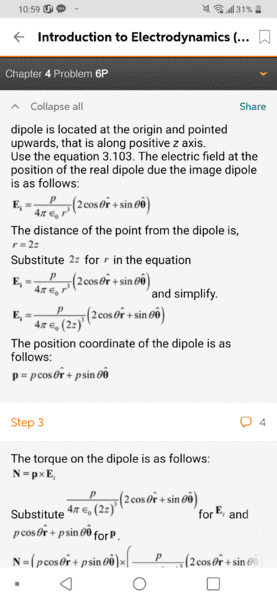
The dipole problem in electric fields, specifically solved through mirror imaging, involves understanding the dipole moment's coordinates. The dipole moment, denoted as \vec{p}, can be expressed as \vec{p}=p \cos{\theta} \, \hat{z}+ p \sin{\theta} \, \hat{x}. The electric field \vec{E} at the location (0,0, 2z) can be computed using the image dipole \vec{p}_{image}=-p \cos{\theta} \, \hat{z} +p \sin{\theta} \, \hat{x}. The torque \vec{N} is calculated as \vec{N}=\vec{p} \times \vec{E}, and discrepancies in the book's computations of \vec{p} are noted.

PREREQUISITES
  • Understanding of dipole moments in electromagnetism
  • Familiarity with vector notation and operations
  • Knowledge of electric fields and their calculations
  • Basic algebra for torque computations
NEXT STEPS
  • Study the concept of mirror imaging in electrostatics
  • Learn how to derive electric fields from dipole moments
  • Explore torque calculations in electromagnetic systems
  • Review the provided resource: Dipole Electric Field PDF
USEFUL FOR

Students and professionals in physics, particularly those focusing on electromagnetism, as well as educators seeking to clarify the dipole problem and its solutions.

bubblewrap
Messages
134
Reaction score
2
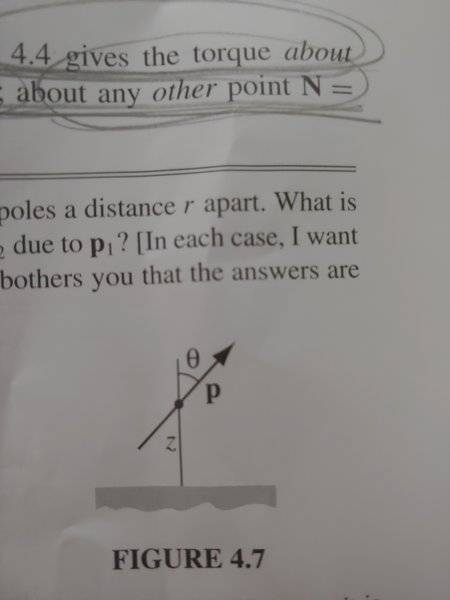
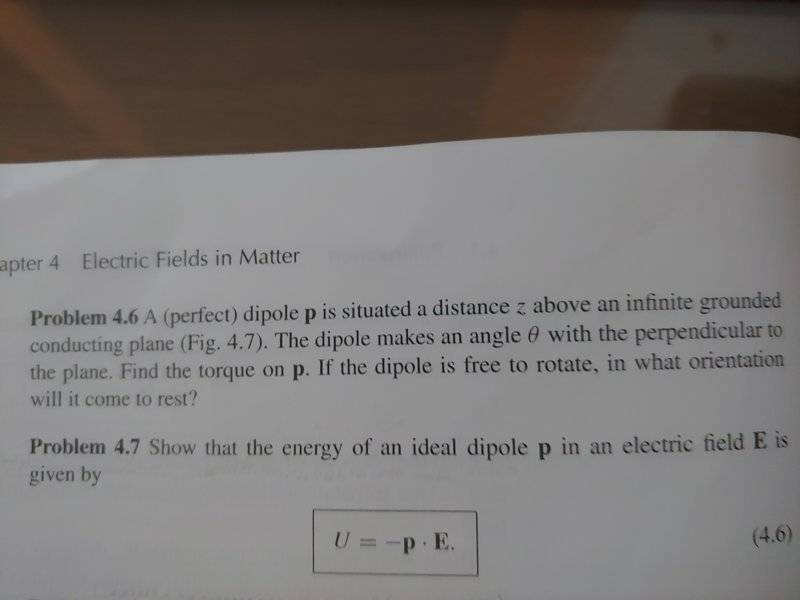
Dipole problem (which is solved through mirror imaging) has been troubling me with its solution. I understand everything except how the dipole moment's coordinates came to be, since when converted into x-y axis, its doesn't make sense. (problem 4.6)

The screenshot contains the solution which says that dipole moment p can be expressed into the terms shown (at the end of step 2, right before step 3
20181031_230650.jpg
Screenshot_2018-10-31-22-59-45.png
20181031_230933.jpg
)
 

Attachments

  • 20181031_230650.jpg
    20181031_230650.jpg
    26.4 KB · Views: 506
  • Screenshot_2018-10-31-22-59-45.png
    Screenshot_2018-10-31-22-59-45.png
    23.4 KB · Views: 412
  • 20181031_230933.jpg
    20181031_230933.jpg
    16.9 KB · Views: 420
Physics news on Phys.org
It helps to start with a good source. Try: http://phys.columbia.edu/~nicolis/Dipole_electric_field.pdf ## \\ ## Meanwhile ## \vec{p}_{image}=-p \cos{\theta} \, \hat{z} +p \sin{\theta} \, \hat{x} ## where we will assume the dipole has ## \phi=0 ## for the angle which it points.## \\ ## Using ## \vec{r}=2 z \, \hat{z}##, ##\vec{ E} ## (at location ##(0,0, 2z) ## from ## \vec{p}_{image} ##), can be computed from ## \vec{p}_{image} ##. ## \\ ## Meanwhile, ## \vec{p}=p \cos{\theta} \, \hat{z}+ \sin{\theta} \, \hat{x} ## should make it an easy algebraic exercise to compute the torque.## \\ ## I do think your book made a mistake in computing ## \vec{p} ##. ## \\ ## I got an expression for electric field ## E ## and torque ## \vec{N}=\vec{p} \times \vec{E} ##. I'd be happy to see how your result compares to mine.
 
Last edited:
  • Like
Likes   Reactions: berkeman

Similar threads

  • · Replies 1 ·
Replies
1
Views
2K
  • · Replies 10 ·
Replies
10
Views
2K
  • · Replies 1 ·
Replies
1
Views
2K
  • · Replies 13 ·
Replies
13
Views
3K
  • · Replies 11 ·
Replies
11
Views
5K
  • · Replies 4 ·
Replies
4
Views
3K
  • · Replies 4 ·
Replies
4
Views
7K
  • · Replies 1 ·
Replies
1
Views
2K
  • · Replies 73 ·
3
Replies
73
Views
6K
  • · Replies 7 ·
Replies
7
Views
4K