Do internodes break in runners?

  • Thread starter Thread starter gracy
  • Start date Start date
  • Tags Tags
    Break
Click For Summary

Discussion Overview

The discussion revolves around the nature of internodes in runners, specifically whether they break and how this affects the independence of new plants. Participants explore the definitions and differences between runners and stolons, as well as the implications of internode integrity on plant survival and reproduction.

Discussion Character

  • Exploratory
  • Technical explanation
  • Conceptual clarification
  • Debate/contested

Main Points Raised

  • Some participants inquire whether internodes in runners actually break and if this is necessary for the new plant to survive independently.
  • One participant suggests that if internodes break, the new plants will have the necessary components to survive, such as their own root systems.
  • Another participant questions the implications if internodes do not break, proposing that the plant can still thrive once the bud establishes its own root system.
  • There is a discussion about the difference between runners and stolons, with some participants referencing external sources for clarification.
  • One participant asserts that runners and stolons are essentially the same, while another provides a more nuanced definition, noting their different origins and growth patterns.
  • There is mention of how both runners and stolons can develop roots and can potentially break off from the parent plant to form independent plants.
  • One participant emphasizes that definitions in botany may not fully capture the complexities of plant behavior in nature.

Areas of Agreement / Disagreement

Participants express differing views on the breaking of internodes and the definitions of runners and stolons. There is no consensus on whether internodes must break for new plants to survive, and the discussion remains unresolved regarding the distinctions between runners and stolons.

Contextual Notes

Participants reference various definitions and characteristics of runners and stolons, but there is ambiguity regarding the exact nature of their roots and growth behaviors. The discussion highlights the complexity of plant anatomy and reproduction, which may not align neatly with textbook definitions.

gracy
Messages
2,486
Reaction score
83
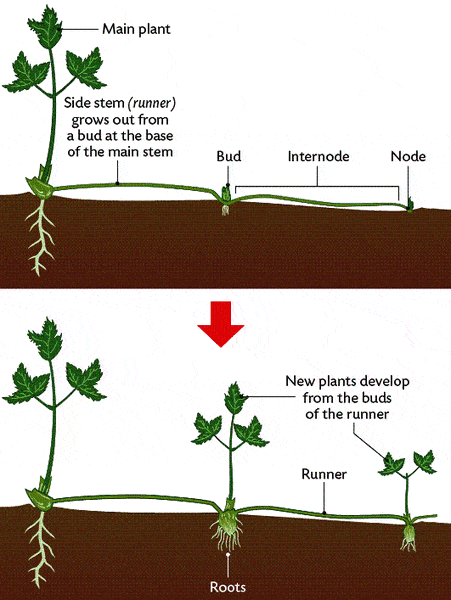
Runners are stems that grow horizontally above the ground. They have nodes where buds are formed. These buds grow into a new plant.
image002.gif

The thing I want to ask is does internode break?In a video I have seen internodes break and then the new plant lives independently ,is it right?Do internodes really break?
 
Biology news on Phys.org
If the internodes break, the new plants will be perfectly able to survive independently of the original plant as it will have all the necessary components (e.g. is own root system) to do so.
 
  • Like
Likes   Reactions: gracy
And if internodes do not break?
 
Then the plant can still grow fine. After the bud establishes is own root system, I'd suspect the plants will be fine whether the internodes are intact or broken.
 
  • Like
Likes   Reactions: gracy
According to wikipedia, runners and stolons are the same thing.
 
  • Like
Likes   Reactions: gracy
I have found out that sub aerial stems develop from lower branches of stem are called stolon while side stem which grows out from bud at the base of the main stem is called runner.stolon grows obliquely downward while runners (sub aerial stem)creep horizontally on the soil.Stolon has adventitious root .I don't know about runners whether they have true or adventitious roots.
Is it correct?
 
Adventitious literally means out of place. This is purely for us humans - the plant is doing just fine, thank you, because it evolved to reproduce vegetatively and well as sexually. You can create adventitious roots at home by cutting an herb stem with a few leaves on it off, and placing the cut-off piece into a glass of water. This is called rooting.

You can induce rooting with stolons or with runners by burying them or cutting them off from the parent and doing the glass of water trick.

So they really are very similar. Plant anatomy has a slightly different viewpoint. It deals with the origin - the tissues from which a structure developed - of structures like stolons and runners. If I recall correctly - stolons arise from the cambium in the stem, and runners arise from axillary buds (or the meristem in the bud, more correctly).

The point is the what differentiates them not what they look like, or whether they have roots. but where they arise. Either can create roots - either can break off from the parent to form an independent plant. Sometimes this feature kinda runs amok and you get dangling "babies" Chlorophytum - spider plant:

Sorry about the advertisement - this is the only one I could find showing "babies":
http://www.joann.com/28in-spider-plant/7856081.html?mkwid=x0sHCDie|dc&utm_source=google&utm_medium=cpc&utm_term=&utm_campaign=Shopping+-+Home+Decor&CS_003=12310478&CS_010=[ProductId]&gclid=Cj0KEQjw9JuuBRC2xPG59dbzkpIBEiQAzv4-G_cIIulLf_SfdrNOV2oNbNaFsnlkcpBH4IfjeZC-F18aAv-U8P8HAQ
Chlorophytum:
https://en.wikipedia.org/wiki/Chlorophytum_comosum

So this plant has a kind-of "stolon-runner" which does not fit the definition about stolons having roots.

Actually these definitions are great for starters but, darn it, plants in the real world cannot read Botany books. So they do all kinds of weird things.
 
Last edited:
  • Like
Likes   Reactions: gracy
You wrote a lot.Congrats that paid off. I actually understood !:smile:
 

Similar threads

  • · Replies 10 ·
Replies
10
Views
3K
Replies
2
Views
2K
Replies
2
Views
1K
  • · Replies 8 ·
Replies
8
Views
1K
Replies
7
Views
8K
  • · Replies 35 ·
2
Replies
35
Views
6K
  • · Replies 3 ·
Replies
3
Views
6K
Replies
4
Views
2K
  • · Replies 10 ·
Replies
10
Views
4K
  • · Replies 5 ·
Replies
5
Views
3K