Do the Fresnel equations of reflection apply to monochromatic light?

Click For Summary
SUMMARY

The Fresnel equations apply to monochromatic light, such as light with a wavelength of approximately 420 nm, when estimating reflectance and transmittance at the interface of two media. The index of refraction, denoted as n(λ), is wavelength-dependent and must be considered in calculations. Additionally, when monochromatic light passes through a collimator, it remains unpolarized if the light source itself is unpolarized. Understanding these principles is essential for accurate optical analysis.

PREREQUISITES
  • Understanding of the Fresnel equations for reflection and transmission
  • Knowledge of the wavelength dependence of the index of refraction
  • Familiarity with optical components like collimators
  • Basic principles of light polarization
NEXT STEPS
  • Study the derivation and application of the Fresnel equations
  • Research the effects of wavelength on the index of refraction in different media
  • Learn about the characteristics of polarized vs. unpolarized light
  • Explore the design and function of optical collimators
USEFUL FOR

Optical engineers, physicists, and students studying optics who need to understand the behavior of monochromatic light at media interfaces.

XLAYZ
Messages
7
Reaction score
0
Hello,

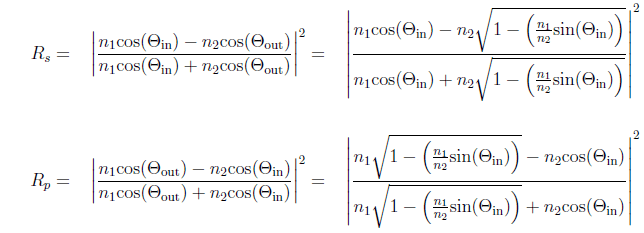
I have a monochromatic light source (wavelength ~ 420 nm), which will be incident on the interface of two different media. Could someone please explain if the Fresnel equations applies with monochromatic light when estimating the reflectance and transmitance?
Thank you in advance!

Fresnel equation:
QQ截图20190827123751.png
 
Science news on Phys.org
XLAYZ said:
Could someone please explain if the Fresnel equations applies with monochromatic light when estimating the reflectance and transmitance?

Would it help if I pointed out that the index of refraction n = n(λ)?
 
  • Like
Likes   Reactions: XLAYZ
Andy Resnick said:
Would it help if I pointed out that the index of refraction n = n(λ)?
Thank you for your hint, now I realized that I also need to take the wavelength into account.
BTW, when a constant monochromatic light (λ≈420 nm) passes through a ø 2.5 mm and 15 mm collimator to produce parallel light beams, is this light unpolarized? Thanks.
 

Similar threads

  • · Replies 8 ·
Replies
8
Views
2K
  • · Replies 58 ·
2
Replies
58
Views
8K
  • · Replies 1 ·
Replies
1
Views
2K
  • · Replies 5 ·
Replies
5
Views
2K
  • · Replies 6 ·
Replies
6
Views
4K
  • · Replies 2 ·
Replies
2
Views
2K
  • · Replies 2 ·
Replies
2
Views
3K
  • · Replies 2 ·
Replies
2
Views
9K
  • · Replies 1 ·
Replies
1
Views
962
  • · Replies 3 ·
Replies
3
Views
2K