Does an iron ring shield a static magnetic field?

3 replies · 3K views · last reply
greypilgrim
Messages
583
Reaction score
45
Hi.
This picture shows an iron ring shielding a static magnetic field:
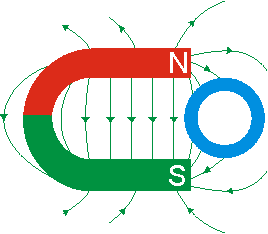
Diagram of a horseshoe magnet with red N pole and green S pole, field lines drawn from N to S, with a blue ring placed to the right of the magnet's open end.

Does this really work, and why? I know that a conductor can shield an electric field (Faraday cage) and a changing magnetic field (Lenz's law), but why would it shield a static field? Especially since iron is a ferromagnet.
 
Attachments
  • Diagram of a horseshoe magnet with red N pole and green S pole, field lines drawn from N to S, with a blue ring placed to the right of the magnet's open end.
    hufeisen_feld_ri_magnetfeld_ver.gif
    2.5 KB · Views: 1,014
"It can" is a better answer than "it will". The field lines go through the iron and not the air.
 
greypilgrim said:
Hi.
This picture shows an iron ring shielding a static magnetic field:
View attachment 238637
Does this really work, and why? I know that a conductor can shield an electric field (Faraday cage) and a changing magnetic field (Lenz's law), but why would it shield a static field? Especially since iron is a ferromagnet.
The iron ring will provide a lower-reluctance path to the magnetic flux so areas to the right of the ring will have a much lower B field than were the ring absent.

Magnetic circuits are analogous to electric ones: substitute mmf for emf, reluctance for resistance, flux for current, permeability for resistivity, etc. The main difference is that magnetic flux is not nearly so well confined to its "conductor" (a low-reluctance path) as current is to wire.
 
You can understand this phenomenon from the perspective of magnetic reluctance. But I think the description from the book is more accurate.
Textbook figure Fig. 2.25 Magnetic shielding: (a) parallel field lines bending around a circular high-permeability ring with concentric thin shells; (b) a flat plate with lines passing straight through; (c) a ring showing S and N poles on its sides.