Does an iron ring shield a static magnetic field?

Join the discussion
Ask a follow-up here, or get your own question answered by working scientists, mathematicians and engineers — people, not an autocomplete.
Real named experts · corrections over time · the nuance an AI answer skips
3 replies · 3K views
greypilgrim
Messages
583
Reaction score
45
Hi.
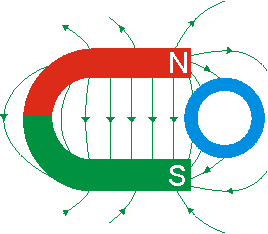
This picture shows an iron ring shielding a static magnetic field:
hufeisen_feld_ri_magnetfeld_ver.gif

Does this really work, and why? I know that a conductor can shield an electric field (Faraday cage) and a changing magnetic field (Lenz's law), but why would it shield a static field? Especially since iron is a ferromagnet.
 

Attachments

  • hufeisen_feld_ri_magnetfeld_ver.gif
    hufeisen_feld_ri_magnetfeld_ver.gif
    2.5 KB · Views: 1,000
Physics news on Phys.org
greypilgrim said:
Hi.
This picture shows an iron ring shielding a static magnetic field:
View attachment 238637
Does this really work, and why? I know that a conductor can shield an electric field (Faraday cage) and a changing magnetic field (Lenz's law), but why would it shield a static field? Especially since iron is a ferromagnet.
The iron ring will provide a lower-reluctance path to the magnetic flux so areas to the right of the ring will have a much lower B field than were the ring absent.

Magnetic circuits are analogous to electric ones: substitute mmf for emf, reluctance for resistance, flux for current, permeability for resistivity, etc. The main difference is that magnetic flux is not nearly so well confined to its "conductor" (a low-reluctance path) as current is to wire.
 
You can understand this phenomenon from the perspective of magnetic reluctance. But I think the description from the book is more accurate.
微信图片_20200421141140.jpg