Electric Field Strength Conservation in Direction of Motion

Click For Summary
SUMMARY

The discussion focuses on the Lorentz covariance of the Faraday and Maxwell 2-forms, emphasizing that electric and magnetic field strengths remain invariant in the direction of motion. It references Einstein's work in "Zur Elektrodynamik bewegter Körper," where he assumes invariance to establish the covariance of Maxwell's equations. The transformation laws for electric and magnetic fields under Lorentz boosts are derived, demonstrating that components parallel to the direction of motion remain unchanged while perpendicular components are modified by the Lorentz factor, γ.

PREREQUISITES
  • Understanding of Lorentz transformations
  • Familiarity with Maxwell's equations
  • Knowledge of tensor calculus
  • Basic concepts of electromagnetism
NEXT STEPS
  • Study the derivation of Lorentz transformations in detail
  • Explore the implications of Maxwell's equations in different reference frames
  • Learn about the properties of second-rank tensors in physics
  • Investigate the role of the luminiferous aether in historical physics
USEFUL FOR

This discussion is beneficial for physicists, students of electromagnetism, and anyone interested in the foundational principles of special relativity and field theory.

StateOfTheEqn
Messages
73
Reaction score
0
(Sorry for the typo in the title. I don't know how to get rid of it)

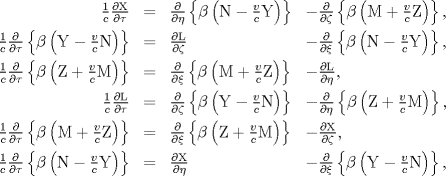
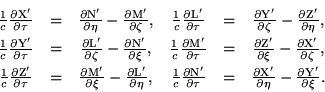
Recently I was looking at the Lorentz co-variance of F=dA (the Faraday 2-form) and *F=*dA (the Maxwell 2-form). I realized that Lorentz co-variance implies that the electric field strength and magnetic field strength are invariant in the direction of motion. In Einstein's notation in Zur Elektrodynamik bewegter Körper (Engl trans.:ON THE ELECTRODYNAMICS OF MOVING BODIES), X=X' and L=L'. It struck me as interesting that he had to assume the invariance in order to prove the co-variance of Maxwell's equations:

Maxwell's eqns:
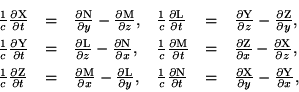
img78.gif


transformed:

img79.gif


and now in the new variables:
img86.gif


Notice how he assumes X=X' and L=L'. This was no small assumption since it was at the time something Poincare was wanting to prove. The proof is, it seems, because it is necessary to establish co-variance, an established fact by then - otherwise you could measure the absolute velocity of the Earth through the luminiferous aether.

Further along he states explicitly:
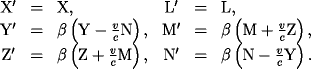
img93.gif
 
Physics news on Phys.org
It's simply the transformation law for a 2nd-rank tensor,
[tex]F'^{\mu \nu}={\Lambda^{\mu}}_{\rho} {\Lambda^{\nu}}_{\sigma} F^{\rho \sigma}.[/tex]
Plugging in the components in 1+3-dimensional notation, i.e., for [itex]\mu \in \{1,2,3 \}[/itex]
[tex]F^{0 \mu}=\partial^{0} A^{\mu}-\partial^{\mu} A^0=\partial_0 A^{\mu} + \partial_{\mu} A^0=\dot{A}^{\mu}+\partial_{\mu} \Phi=-E^{\mu},[/tex]
and for [itex]\mu,\nu \in \{1,2,3 \}[/itex]
[tex]F^{\mu \nu}=\partial^{\mu} A^{\nu} - \partial^{\nu} A^{\mu}=-\partial_{\mu} A^{\nu} + \partial_{\nu} A^{\mu}=\epsilon^{\nu \mu \rho} B^{\rho},[/tex]
you find the transformation law in terms of [itex](\vec{E},\vec{B})[/itex] for a boost,
[tex] \begin{split}<br /> \vec{E}'&=\gamma(\vec{E}+\vec{\beta} \times \vec{B})-\frac{\gamma^2}{1+\gamma} \vec{\beta}(\vec{\beta} \cdot \vec{E}),\\<br /> \vec{B}'&=\gamma(\vec{B}-\vec{\beta} \times \vec{E})-\frac{\gamma^2}{1+\gamma} \vec{\beta}(\vec{\beta} \cdot \vec{B}),<br /> \end{split}[/tex]
where [itex]\vec{\beta}=\vec{v}/c[/itex] and [itex]\gamma=1/\sqrt{1-\vec{\beta}^2}[/itex]. As you see, the components in boost direction are indeed unchanged.

Projecting to the parts in direction of [itex]\vec{\beta}[/itex] and perpendicular to it gives
[tex] \begin{split}<br /> \vec{E}_{\parallel}'&=\vec{E}_{\parallel},\\<br /> \vec{B}_{\parallel}'&=\vec{B}_{\parallel},\\<br /> \vec{E}_{\perp}'&=\gamma(\vec{E}_{\perp}+\vec{\beta} \times \vec{B}),\\<br /> \vec{B}_{\perp}'&=\gamma(\vec{B}_{\perp}-\vec{\beta} \times \vec{E}).<br /> \end{split}[/tex]
 
  • Like
Likes   Reactions: 1 person

Similar threads

Replies
1
Views
3K
Replies
3
Views
2K
  • · Replies 2 ·
Replies
2
Views
1K
  • · Replies 4 ·
Replies
4
Views
2K
  • · Replies 7 ·
Replies
7
Views
3K
  • · Replies 8 ·
Replies
8
Views
2K
  • · Replies 108 ·
4
Replies
108
Views
9K
  • · Replies 7 ·
Replies
7
Views
3K
  • · Replies 22 ·
Replies
22
Views
2K
  • · Replies 12 ·
Replies
12
Views
2K