Electrically Conducting Bacteria

Click For Summary

Discussion Overview

The discussion centers on electrically conducting bacteria, particularly their mechanisms of electricity conduction and potential ecological applications. Participants explore the biological and chemical processes involved, as well as the implications for future research in this area.

Discussion Character

  • Exploratory, Technical explanation, Debate/contested

Main Points Raised

  • Some participants describe bacteria that conduct electricity through nano-filaments or protein "wires" formed around strings of bacteria.
  • There is curiosity about how bacteria benefit from being part of an electrical cable, particularly regarding their role in electron transfer.
  • One participant notes the existence of open questions in the field and anticipates significant research developments in the coming years.
  • Another participant highlights the importance of redox differences in driving microbial metabolisms and suggests that bacteria may evolve mechanisms to utilize electrons passing through them.
  • Concerns are raised about access to scientific articles, with participants expressing frustration over paywalls and advocating for open access to research.

Areas of Agreement / Disagreement

Participants express interest in the topic and acknowledge the complexity of the mechanisms involved, but there is no consensus on specific mechanisms or benefits to the bacteria from their electrical conduction roles. Multiple competing views and questions remain unresolved.

Contextual Notes

Limitations include the lack of detailed understanding of the metabolic processes involved and the specific mechanisms by which bacteria might utilize passing electrons. The discussion also reflects varying access to scientific literature, which may influence participants' ability to engage fully with the topic.

BillTre
Science Advisor
Gold Member
Messages
2,765
Reaction score
12,108
TL;DR
This article describes the developing awareness of bacteria that conduct electricity in different ways to make use of the redox energy in physically separated areas.
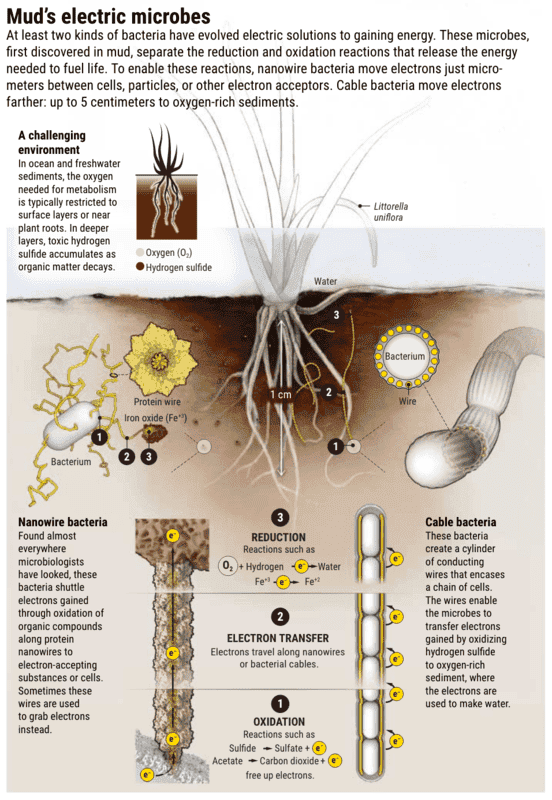
This news article in Science magazine describes what is becoming known about the different kinds of bacteria that can do this, what is known about how they do it, and how people might make use of the phenomena.
The bacteria conduct electricity through either small nano-filaments sticking out from individual cells or in cables formed of protein "wires" around a string of bacteria.
Screen Shot 2020-08-20 at 8.04.27 PM.png

Their chemical abilities expand the possibilities of the ecology (as a set of biological reactions, in an area, using available energy) to make use of these, otherwise under-utilized, environmental energy sources.

I remain curious about how the bacteria through out the length of the cable get benefit from being part of the cable where they just appear to passing the electrons along the chain.
 
Last edited:
  • Like
  • Wow
Likes   Reactions: gleem, DrClaude and DaveE
Biology news on Phys.org
  • Like
Likes   Reactions: BillTre and DaveE
Dang! Must have been sleepy when I posted this.
Here's the link to the news article which should not be behind a pay-wall unless you go there too often (few times a month free I think).
As a AAAS member, I think these articles should be open access in an unlimited manner. It's good PR for science in general.

Interestingly to me:
This making use of redox differences between different chemicals (in different locations, unusually in this case), is the basis of what drives the great variety of microbial metabolisms.

As long as a bacteria (or archaea) can generate a metabolism that harvests energy (from a sufficiently large redox difference, to drive particular cellular reactions) from these reactions, they can evolve ways to plug electron donors and electron acceptors into the biologically universal electron transfer chain, which in turn drives cell energy generation.
I would expect cells to somehow get make some use of these electrons going by to drive the ETS, but don't know how this might work.
 
  • Like
Likes   Reactions: DaveE

Similar threads

  • · Replies 2 ·
Replies
2
Views
3K
  • · Replies 2 ·
Replies
2
Views
2K
Replies
1
Views
3K
  • · Replies 4 ·
Replies
4
Views
3K
  • · Replies 2 ·
Replies
2
Views
4K
  • · Replies 26 ·
Replies
26
Views
10K
  • · Replies 3 ·
Replies
3
Views
3K
  • · Replies 3 ·
Replies
3
Views
3K
  • · Replies 1 ·
Replies
1
Views
3K
Replies
12
Views
12K