EM Waves Vs Photons: Can Physical Explanations Explain All?

Click For Summary

Discussion Overview

The discussion revolves around the nature of electromagnetic (EM) waves and photons, specifically whether certain behaviors of EM waves can be explained solely through a photonic framework. Participants explore the implications of wave-like behavior versus particle-like behavior in various contexts, including diffraction and the paths taken by photons.

Discussion Character

  • Exploratory
  • Debate/contested
  • Conceptual clarification

Main Points Raised

  • One participant questions if there are EM wave behaviors that cannot be explained by photons, specifically regarding the path of photons from emitter to absorber.
  • Another participant interprets a provided image as depicting a polarized wave interacting with a polarizing material, contingent on the alignment of the axis.
  • A participant describes a scenario where an EM wave could potentially navigate around an impenetrable barrier, seeking evidence of such wave-like behavior.
  • One contributor asserts that light exhibits behaviors distinct from particles, citing diffraction as an example and referencing historical developments in the understanding of light.
  • A participant challenges the assumption that photons travel in direct paths, noting that quantum theory does not clarify the specific paths taken by photons.
  • Another participant expresses interest in the philosophical implications of a reality independent of human observation, while acknowledging the interpretative nature of quantum theory.
  • A participant raises a question about whether there are phenomena that cannot be explained by particles traveling in straight lines, using the example of shadow diffraction and its dependence on environmental factors.

Areas of Agreement / Disagreement

Participants express differing views on the nature of light and photons, with no consensus reached regarding the explanations of EM wave behaviors versus photonic interpretations. The discussion remains unresolved with multiple competing perspectives.

Contextual Notes

Participants highlight the limitations of current understanding regarding the paths of photons and the interpretations of quantum theory, indicating that assumptions about direct paths may not hold universally.

rjbeery
Messages
346
Reaction score
8
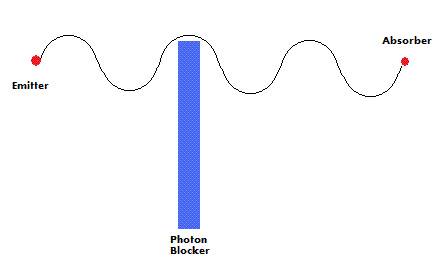
Are there any EM wave behaviors that cannot be explained in a purely physical, "photonic" manner? I'm speaking specifically of the photon's path from emitter to absorber, irrespective of "why" that path was taken (in other words, the double-slit experiment does not qualify in the context of my question). Basically, is the attached picture ever possible?
3392367461_1bbd3a1650.jpg
 
Physics news on Phys.org
That picture looks to me like a representation of a polarized wave going through a polarizing material only if the axis is in the right direction.
 
The picture was an attempt at showing an EM wave doing an "end run" around the edge of an otherwise impenetrable material (a very thin wall, for example). Notice that a photon traveling in a direct path between the emitter and the absorber would not be capable of doing this. Is there evidence that this ever occurs? I'm asking for direct evidence of wave-like behavior.
 
Are you asking, does light ever display behavior that a shower of bullets can't? The answer is yes. Consider diffraction.

If I remember my history correctly, the Airy disk was predicted mathematically before it was observed experimentally. When it was demonstrated soon thereafter, the corpuscular theory of light was demolished.
 
Cantab: I will look into it, thanks so much. Any other ideas?
 
rjbeery said:
photon traveling in a direct path

What makes you think photons travel in direct paths, or indeed in any well-defined path at all? :wink:

Quantum theory doesn't address the question, "which path does a photon (or any other particle) take?" That is the subject of interpretations of quantum theory, about which there is no general agreement.
 
In each case, an EM-wave such as the one you drew is NOT a photon bobbing up and down.
 
jtbell: I find it interesting to assume a fully and objectively realistic world that exists without our involvement. I test my theories by asking questions. Yes, this is the subject of interpretations but, regardless of whether we are unable to ever know the answer, this should not mean that a "true" answer does not exist.

Nick89: Thanks for helping this non-Physicist but I understand that the photon itself does not "bob". I'm curious to know whether there are circumstances inexplicable by straight-traveling particles (or a "shower of bullets" as Cantab described them).

I was thinking along the lines of maybe a shadow which was diffracted along its edges, but shadow diffraction occurs on Earth due to molecular scattering from the air. Basically my question could be answered if I knew whether a shadow has a distinct edge in a vacuum. I think. :rolleyes:
 

Similar threads

  • · Replies 21 ·
Replies
21
Views
3K
  • · Replies 21 ·
Replies
21
Views
2K
  • · Replies 19 ·
Replies
19
Views
1K
  • · Replies 16 ·
Replies
16
Views
3K
  • · Replies 52 ·
2
Replies
52
Views
7K
  • · Replies 4 ·
Replies
4
Views
3K
  • · Replies 22 ·
Replies
22
Views
8K
  • · Replies 105 ·
4
Replies
105
Views
9K
  • · Replies 35 ·
2
Replies
35
Views
11K
  • · Replies 10 ·
Replies
10
Views
4K