Energy/power A levels physics

Click For Summary
The discussion focuses on calculating power and efficiency in physics, specifically in the context of wind energy. The formula for efficiency is provided, and the user is struggling to find the correct approach to derive power without having values for force and velocity. It is clarified that power can also be expressed as energy divided by time, leading to the consideration of wind energy as 1/2 m v^2. The user is encouraged to use the given area and wind speed to find the necessary values for mass and time. Understanding these relationships is essential for solving the problem accurately.
yan_plusheartz
Messages
7
Reaction score
0
Relevant formula
: p(out) / p (in) x 100 percent = efficiency
My question
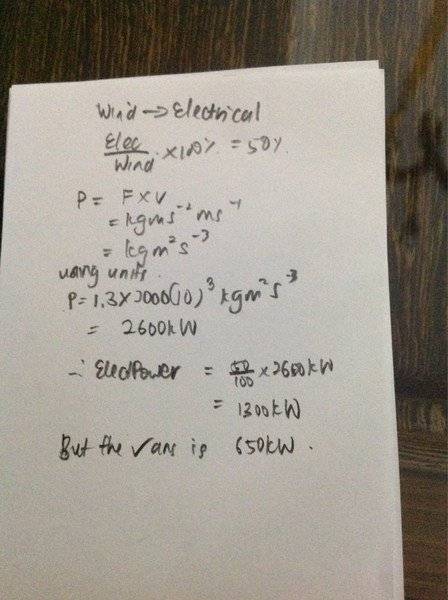
ImageUploadedByPhysics Forums1392289217.339333.jpg


My approach
ImageUploadedByPhysics Forums1392289268.189639.jpg


But the right answer is 650kW
 
Physics news on Phys.org
You use P = F x v but you write ##\rho## x Area x v3. Is that the same ?
 
Yeah I understand that it is not exactly the same. But my problem is , I don't have the value for F and v . And the only formula I know for power is force x velocity. So I did it by using the values given to derive a unit which is the same as power. But I can't seem to get the right answer. and I'm not sure whether my approach is correct or not. Can you teach me the correct method?

anyhow, thank you for taking your time to try to solve my question:)
 
Yes I can. You know that power is energy / time ?
How much energy does the wind bring in /time ?
 
If that case, the wind energy is 1/2 m (10)*2 am I right? Problem is , I don't have the value of mass and time :(
 
That is correct. And they give you the area and the wind speed.
 
Thread 'Correct statement about size of wire to produce larger extension'
The answer is (B) but I don't really understand why. Based on formula of Young Modulus: $$x=\frac{FL}{AE}$$ The second wire made of the same material so it means they have same Young Modulus. Larger extension means larger value of ##x## so to get larger value of ##x## we can increase ##F## and ##L## and decrease ##A## I am not sure whether there is change in ##F## for first and second wire so I will just assume ##F## does not change. It leaves (B) and (C) as possible options so why is (C)...

Similar threads

Replies
2
Views
625
  • · Replies 1 ·
Replies
1
Views
836
  • · Replies 1 ·
Replies
1
Views
1K
  • · Replies 13 ·
Replies
13
Views
1K
  • · Replies 35 ·
2
Replies
35
Views
3K
  • · Replies 2 ·
Replies
2
Views
2K
Replies
1
Views
2K
Replies
5
Views
952
  • · Replies 4 ·
Replies
4
Views
2K
  • · Replies 1 ·
Replies
1
Views
1K