How Does Point Connection Affect Potential in a Circuit with Resistor Ratios?

Click For Summary
SUMMARY

This discussion focuses on the impact of point connection on electric potential in a circuit with resistors R1 and R2, where R1 is defined as √2 times R2. The participants analyze the equivalent resistance and the implications of connecting points M and N, which share the same electric potential, with a conductor. They explore the symmetry of the circuit and the resulting voltage dividers, concluding that despite differing resistances in branches, points M, N, and O maintain the same potential due to equal charge flow through R1.

PREREQUISITES
  • Understanding of electric circuits and potential difference
  • Familiarity with resistor configurations, specifically voltage dividers
  • Knowledge of symmetry in electrical circuits
  • Basic concepts of equivalent resistance calculations
NEXT STEPS
  • Study the principles of voltage dividers in electrical circuits
  • Learn about equivalent resistance calculations for complex resistor networks
  • Explore the concept of symmetry in circuit analysis
  • Investigate the behavior of charge flow in parallel and series circuits
USEFUL FOR

Electrical engineers, circuit designers, and students studying circuit theory who seek to deepen their understanding of potential differences and resistor interactions in electrical circuits.
Peter Velkov
Messages
8
Reaction score
0
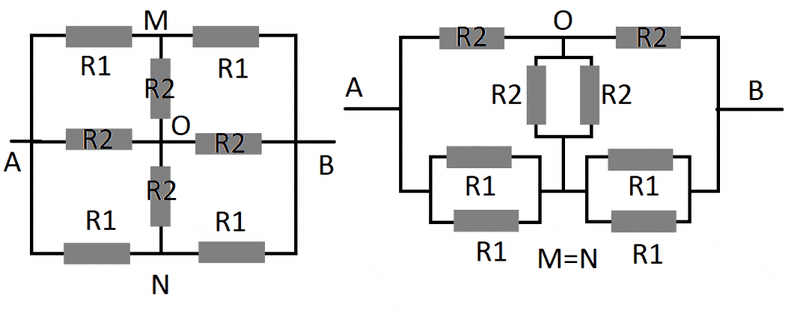
Given an electric circuit, with resistors R1 and R2, find the equivalent resistance R.
Data: R1 = √2.R2

Points M and N have the same electric potential so they can be connected with a conductor and this way we get the second circuit.
222.png
 
Physics news on Phys.org
Peter Velkov said:
Points M and N have the same electric potential so they can be connected with a conductor and this way we get the second circuit.
There is more you can do to simplify the circuit.
 
In terms of what? I know i can solve the parallel ones below, however that won't solve it. There should be a way to proof that M and N are also equal to O.
 
Sure, use symmetry again.
 
mfb said:
Sure, use symmetry again.
It's symmetrical along MO, NO but that doesn't help us much.
 
Temporarily remove the two vertical R2's. What are the potentials at M,N,O?
 
gneill said:
Temporarily remove the two vertical R2's. What are the potentials at M,N,O?
On the upper side we will have a resistor with √2R2, but on the down side R2/√2. So they will be different.
 
Peter Velkov said:
On the upper side we will have a resistor with √2R2, but on the down side R2/√2. So they will be different.
Really? What was your argument for M and N having the same potential in your first post?
 
gneill said:
Really? What was your argument for M and N having the same potential in your first post?
Equal amounts of charge will flow through the upper or downer R1, and since the resistance is equal the voltage will be too. However I don't understand why the points O and M or N will have the same potential as the resistance along the path is different.
 
  • #10
Peter Velkov said:
Equal amounts of charge will flow through the upper or downer R1, and since the resistance is equal the voltage will be too. However I don't understand why the points O and M or N will have the same potential as the resistance along the path is different.

The potentials at M,N, and O are due to the voltage dividers comprised of the resistances in their branches. Here's the situation:
Fig1.png

All three branches have the same potential difference across them (whatever you imagine to be placed across terminals AB). All three branches have the same resistance ratios...
 

Similar threads

  • · Replies 14 ·
Replies
14
Views
1K
Replies
4
Views
2K
Replies
5
Views
2K
  • · Replies 3 ·
Replies
3
Views
2K
Replies
3
Views
2K
  • · Replies 5 ·
Replies
5
Views
2K
Replies
5
Views
2K
  • · Replies 3 ·
Replies
3
Views
2K
Replies
10
Views
1K
  • · Replies 12 ·
Replies
12
Views
1K