Shreyans Jain
- 7
- 0
"How it can be explained mathematically by dP/dV = -gammaP/V
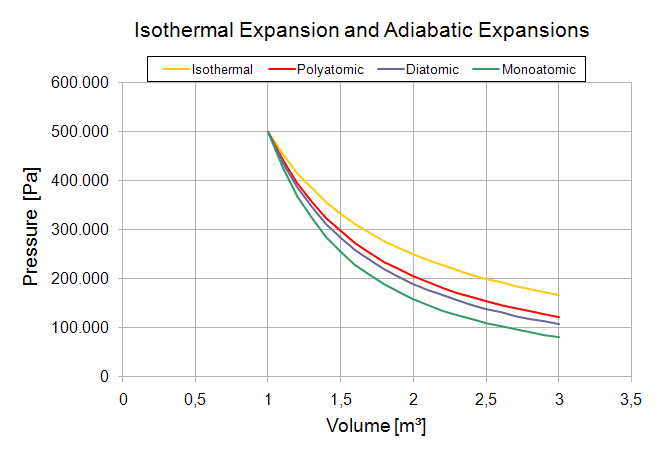
The discussion centers on the mathematical explanation of adiabatic expansion for monoatomic, diatomic, and polyatomic gases, specifically through the differential equation dP/dV = -gammaP/V. Participants clarify the distinction between isothermal and adiabatic processes, noting that adiabatic curves are generally steeper than isothermal curves. The conversation emphasizes the importance of understanding the mathematical solutions to these equations to fully grasp the behavior of gas expansions. Key contributors include users lychette and chestermiller, who provide insights into the mathematical analysis of these processes.
PREREQUISITESStudents and professionals in physics, particularly those studying thermodynamics, as well as anyone interested in the mathematical modeling of gas behaviors during expansion processes.
I am not able to figure out which has greater slope kind of confused in negative slope of adiabaticChestermiller said:What are your thoughts on this?
do you understand that ISOTHERMAL means at constant temperature and that ADIABATIC means no heat transfer?Shreyans Jain said:I am not able to figure out which has greater slope kind of confused in negative slope of adiabatic
Sir i know about that but i am not able to get mathemtical result, if possible could you please send me those.lychette said:The yellow curve shows an isothermal expansion, during the expansion heat energy must be supplied to keep the temperature constant.
The other 3 curves are all adiabatic expansions so no heat energy enters or leaves the gas. Heat energy (internal energy) is removed from the gas and therefore the values of P and V are lower than for the isothermal expansion.
Mathematical analysis will give the details of the curve shapes.
In general adiabatic curves are steeper than isothermal curves...I realize this is not a mathematically rigorous statement but it is helpful ...I hope.
Ps...make sure you are clear about this before you worry about the details of monatomic, diatomic molecules etc !
Sir, i am not able to get the mathematical resultChestermiller said:Do you know the solution to that differential equation that you wrote down? If so, what is it?
Are you saying that you have not had a course in differential equations, and do not know how to solve a homogeneous first order linear ordinary differential equation?Shreyans Jain said:Sir, i am not able to get the mathematical result
I know how to solve a homogeneous first order linear ordinary differential equation but there was something missing which i have got it now now thanks.Chestermiller said:Are you saying that you have not had a course in differential equations, and do not know how to solve a homogeneous first order linear ordinary differential equation?