Explicit non-holonomic equations of motion

Join the discussion
Ask a follow-up here, or get your own question answered by working scientists, mathematicians and engineers — people, not an autocomplete.
Real named experts · corrections over time · the nuance an AI answer skips
4 replies · 1K views
andresB
Messages
627
Reaction score
375
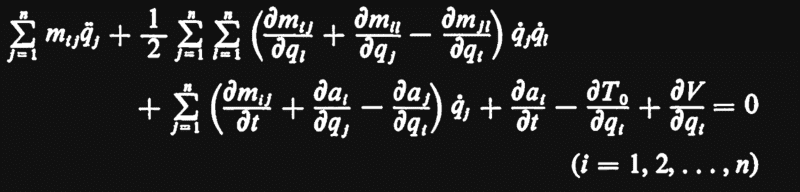
In the holonomic case, we can put the Lagrangian in the Lagrange equations to obtain the explicit form of the equations of motion. From Greenwood's classical dynamics book, the equations are
1661995443042.png


Are there such general equations for the non-holonomic case?
 
Physics news on Phys.org
vanhees71 said:
Have a look in Landau Lifshitz vol. 1, who gets the non-holonomic constraints right. You have to introduce Lagrange multipliers in the right way!

Long time without reading Landau, and I have to say that its treatment of the non-holonomic constraint seems disappointingly scarce.

In any case, I'm not looking for the Euler-Lagrange+ lagrange multipliers equations, they are in every book. Instead I'm lookinf for the final general form of the equation of motion.
 
vanhees71 said:
But these are the final general form of the equation of motion. Non-holonomic constraints are local constraints, and you cannot satisfy them by simply choosing a set of independent coordinates as for holonomic constraints.

But the Lagrange equations are just a step in the final solution of the problem. They have to be solved togheter with the non-holonomic constraint equations. I know how to do it in specific examples that can be found in the standard books, but I would be surprised if no general explicit formulat exist.